
A hospital is deploying an AI system that recommends which patients should be prioritized for a limited number of ICU beds during a surge in admissions. The clinical governance board requires that the system be validated to perform consistently across patients of different ages, ethnicities, and insurance types, and that it undergo extensive testing under simulated surge conditions before any patient's care is affected by its recommendations. Which two responsible AI principles is the board applying with these requirements? (Select TWO.)
Select all correct answers, then click Submit.
Short Explanation
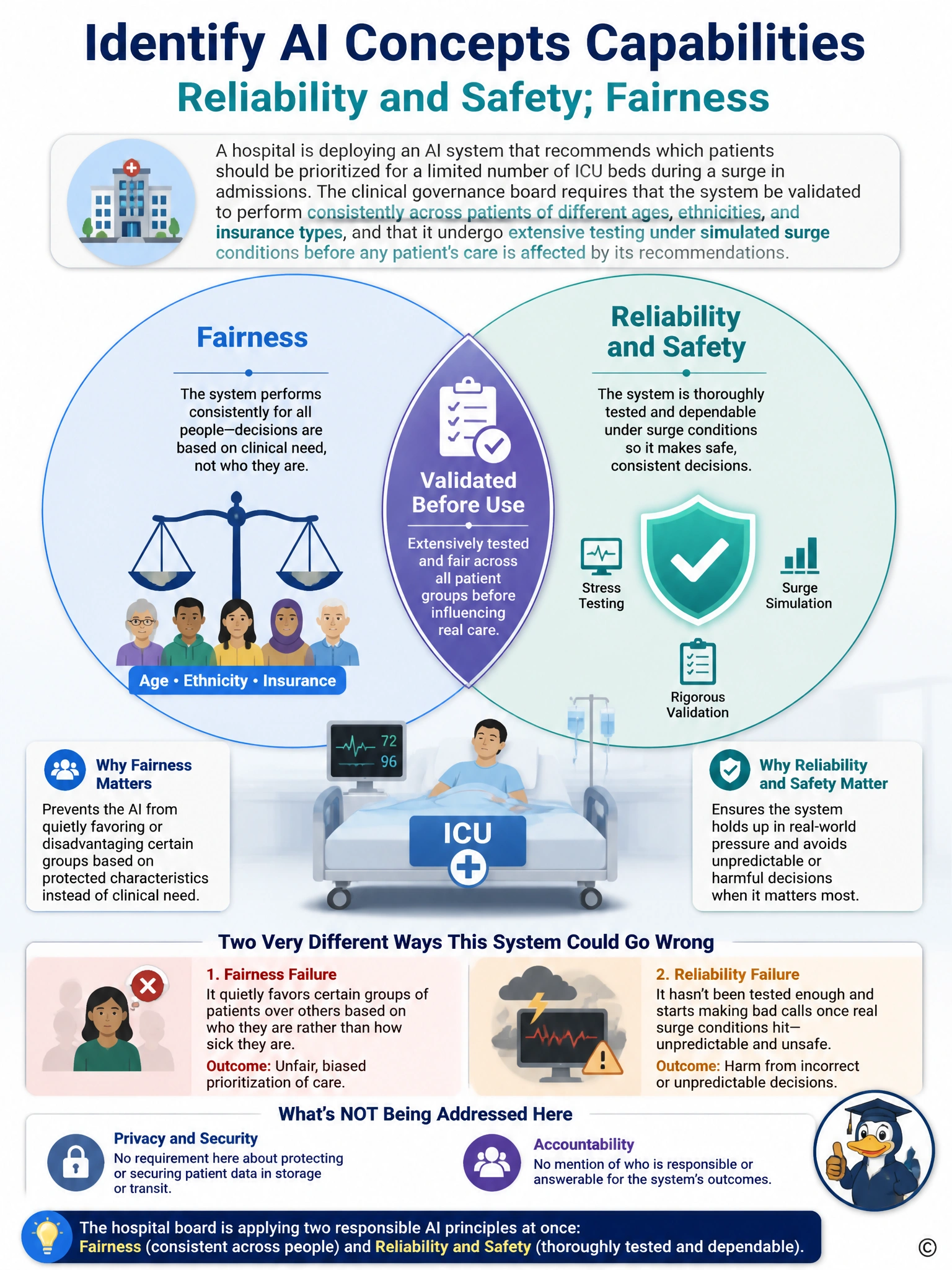
Picture two very different ways this system could go wrong. One way: it quietly favors certain groups of patients over others based on who they are rather than how sick they are, that is a fairness failure. The other way: it simply has not been tested enough and starts making bad calls once real surge conditions hit, unpredictable and unsafe, that is a dependability failure. The hospital board is guarding against both at once, requiring consistent performance across different kinds of patients and requiring extensive testing before the system ever touches a real bed assignment. Notice what is not being addressed here: nobody in the scenario is talking about keeping patient records secure, so protecting stored data is not the point being tested, and nobody is naming a specific person or team who owns the outcome, so assigning responsibility is not what these particular requirements describe either.
Full Explanation
The correct answers are A and D. Requiring the system to perform consistently across patients of different ages, ethnicities, and insurance types is a fairness requirement, guarding against the model systematically disadvantaging any group. Requiring extensive testing under simulated surge conditions before the system affects real patient care is a reliability and safety requirement, guarding against an inadequately validated model making harmful recommendations. Option B is incorrect because privacy and security concerns protecting patient data from unauthorized access or misuse, and the scenario describes validation and consistency requirements, not data protection controls. Option C is incorrect because accountability concerns designating a specific person or team responsible for the system's outcomes, and the board's requirements here describe technical validation criteria rather than an assignment of ownership. Both correct principles address distinct risks that a triage system poses: an unfair system could deprioritize patients based on who they are rather than their clinical need, while an unreliable system could make dangerous errors regardless of who it is evaluating, which is why the governance board addresses both before the system touches patient care.