
A legal-summary assistant built in Foundry occasionally states facts that are not actually present in the internal contract documents it is meant to summarize. The team wants to reduce these unsupported statements. (Select TWO.) Which two changes would directly address this?
Select all correct answers, then click Submit.
Short Explanation
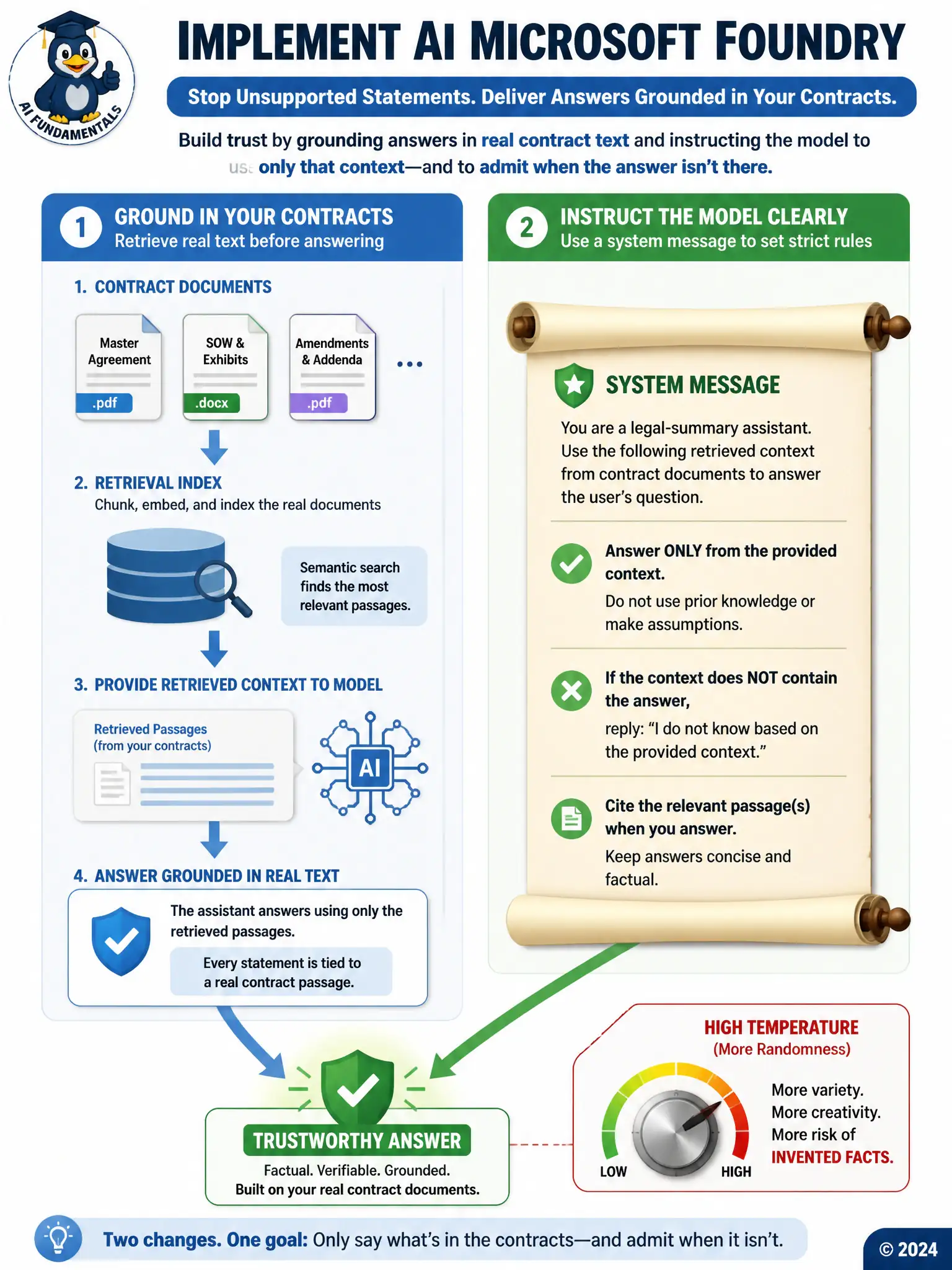
You need to ground the assistant in retrieved contract text and tell it to answer only from that context. If the answer isn't there, it should say so instead of inventing details. Turning up randomness or using a bigger model won't fix unsupported statements.
Full Explanation
The correct choices are grounding the assistant's responses in a retrieval index built from the actual contract documents, so it answers from retrieved text, and adding an explicit system-message instruction telling the model to answer only from the provided context and to say it does not know when the context lacks the answer. Grounding forces the assistant to generate answers from real, retrieved text rather than from patterns memorized during training, which directly reduces statements that are not backed by the source material. The instruction reinforces that same boundary at the instruction level, giving the model explicit permission to say it does not know instead of filling gaps with invented detail. Raising the temperature setting to make responses more creative is incorrect because it increases the variety and creativity of wording, which tends to make ungrounded, invented statements more likely rather than less, working directly against the goal. Switching to a model with a larger parameter count and changing nothing else is incorrect because it does not address the underlying cause, since even large models will generate unsupported statements when they are not grounded in the actual source documents and are not instructed to acknowledge uncertainty.