
A company needs to assign a sentiment label to 2 million archived support tickets overnight, with results needed by the next business day but no requirement for an immediate per-ticket response. Which Foundry deployment approach fits this workload?
Select an answer to reveal the explanation.
Short Explanation
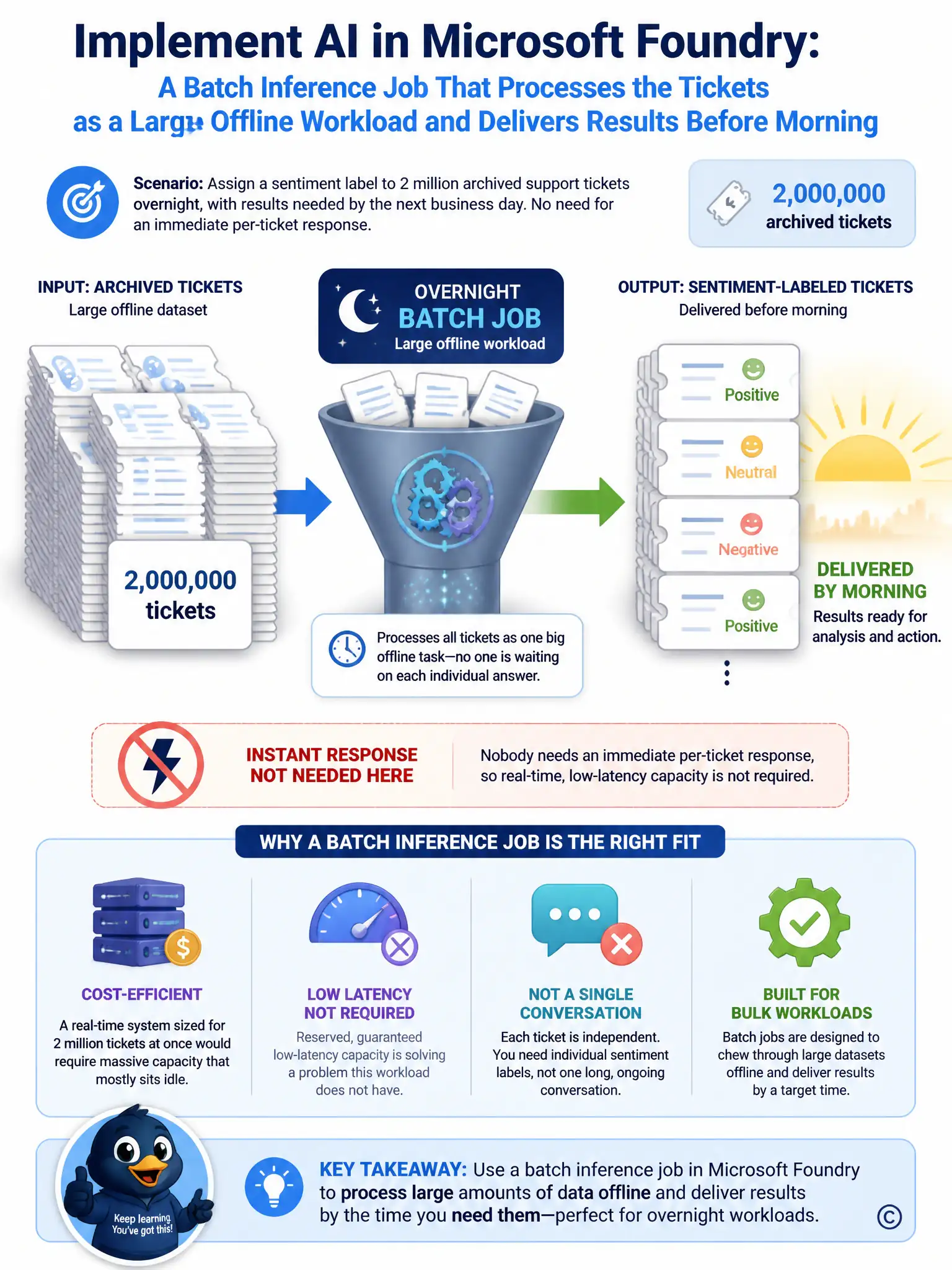
This job is really just about grinding through a huge pile of tickets by morning, with nobody waiting on each individual answer, so you want a batch inference job that chews through everything overnight as one big offline task. Building a real-time system sized for all 2 million simultaneous requests would waste capacity, and reserving guaranteed low-latency traffic solves a problem you don't have. Cramming every ticket into one conversation also doesn't fit independent labels for independent tickets.
Full Explanation
The correct approach is a batch inference job that processes the tickets as a large offline workload and delivers results before morning. It is designed for exactly this situation: a large volume of records that all need to be processed as one offline workload with results ready by a deadline, rather than each ticket needing an instant reply the moment it is submitted. Running 2 million tickets overnight as a batch avoids paying for always-on, low-latency capacity that the workload does not need. A real-time online endpoint sized for the peak of 2 million simultaneous requests is wrong because it would be enormously over-provisioned and expensive for a task that has no live user waiting on any single response. A provisioned-throughput deployment reserved for guaranteed low-latency traffic is wrong because provisioned throughput is meant to guarantee consistent low latency for ongoing interactive traffic, a property this overnight, non-interactive workload does not require and would pay for unnecessarily. A single conversational session that keeps all 2 million tickets in one context window is wrong because it would exceed any realistic context window and conflates a batch data-processing job with a conversational interaction, which is not what sentiment tagging of independent tickets calls for.