
Before launching a Foundry-hosted assistant that answers questions using a retrieved knowledge base, a QA team wants a repeatable, quantitative check of whether answers are actually supported by the retrieved documents and whether the writing reads clearly, across a representative set of test questions rather than a handful of examples someone happens to glance at.
Select an answer to reveal the explanation.
Short Explanation
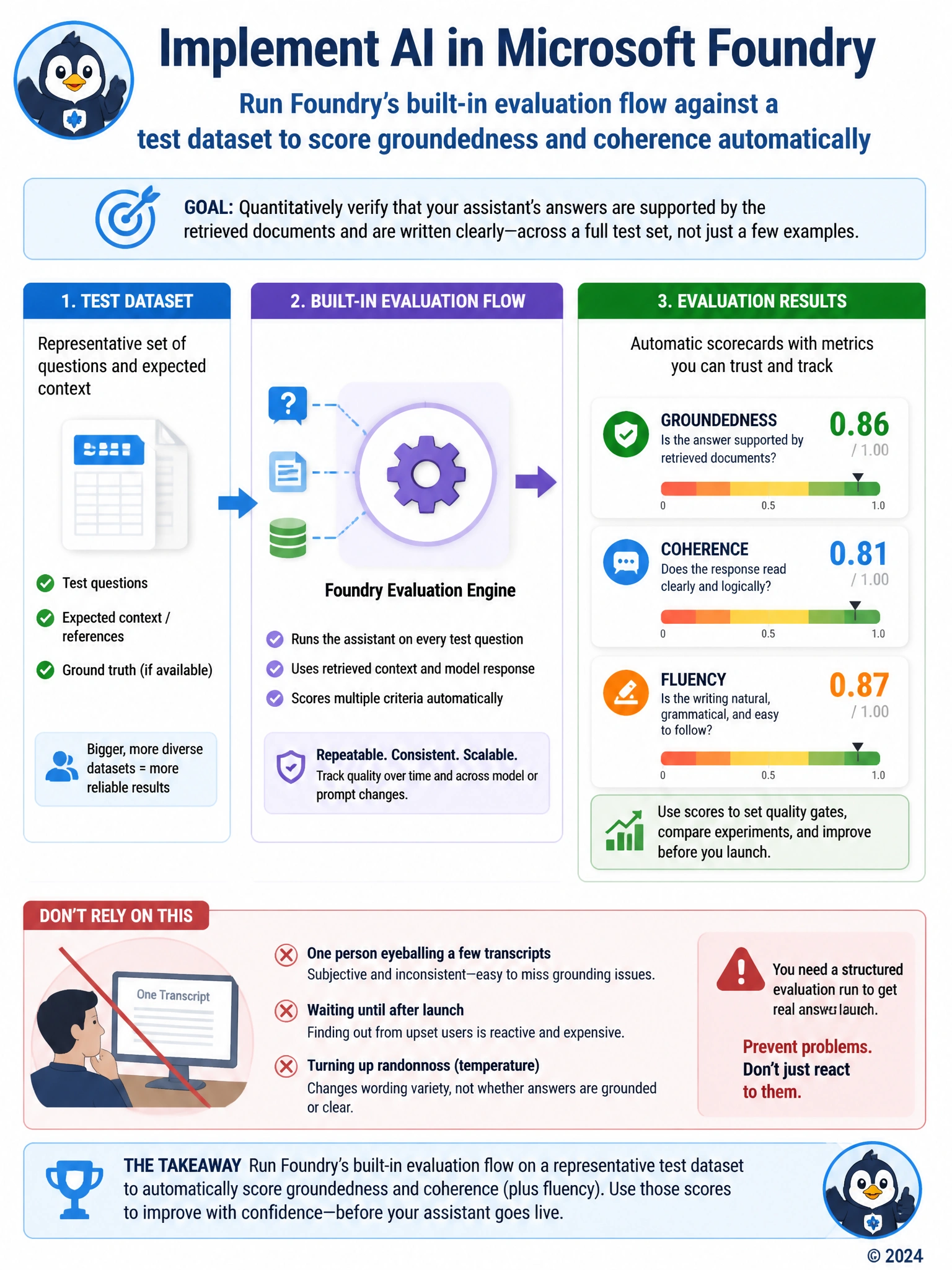
If you actually want to know whether your assistant's answers are backed by the documents it retrieved, and whether the writing holds together, you need something more rigorous than one person eyeballing a few transcripts. Built-in evaluation tooling runs the assistant against a whole test set of questions and scores it on things like groundedness, is the answer actually supported by what was retrieved, and coherence, does the response read clearly, giving you numbers you can track and compare, not just a gut feeling. Waiting until after launch to find out from angry customers is the worst possible time to discover a grounding problem, that's reactive instead of preventive. And turning up the randomness dial on the model doesn't make its answers more grounded or clearer, it just changes how varied the wording is from one run to the next. A structured evaluation run is what actually answers the question the team is asking.
Full Explanation
The correct answer is B. Foundry provides built-in evaluation tooling that runs a model against a prepared test dataset and produces quantitative scores for metrics such as groundedness, which measures whether an answer is supported by the retrieved content, and coherence, which measures how clearly the response reads, giving the QA team a repeatable, scaled check before launch. Option A is incorrect because one person skimming a handful of transcripts is subjective, does not scale to a representative test set, and can easily miss systemic problems that only appear across many varied questions. Option C is incorrect because waiting for customer complaints means real users are exposed to ungrounded or unclear answers first, which is exactly the outcome the pre-launch check is meant to prevent. Option D is incorrect because temperature controls how much randomness the model introduces when generating text, it has no relationship to whether an answer is factually grounded in retrieved documents or how coherent the writing is, and adjusting it does not substitute for measurement. Running a structured evaluation against a test dataset is the direct way to get the quantitative, repeatable check the team needs.