
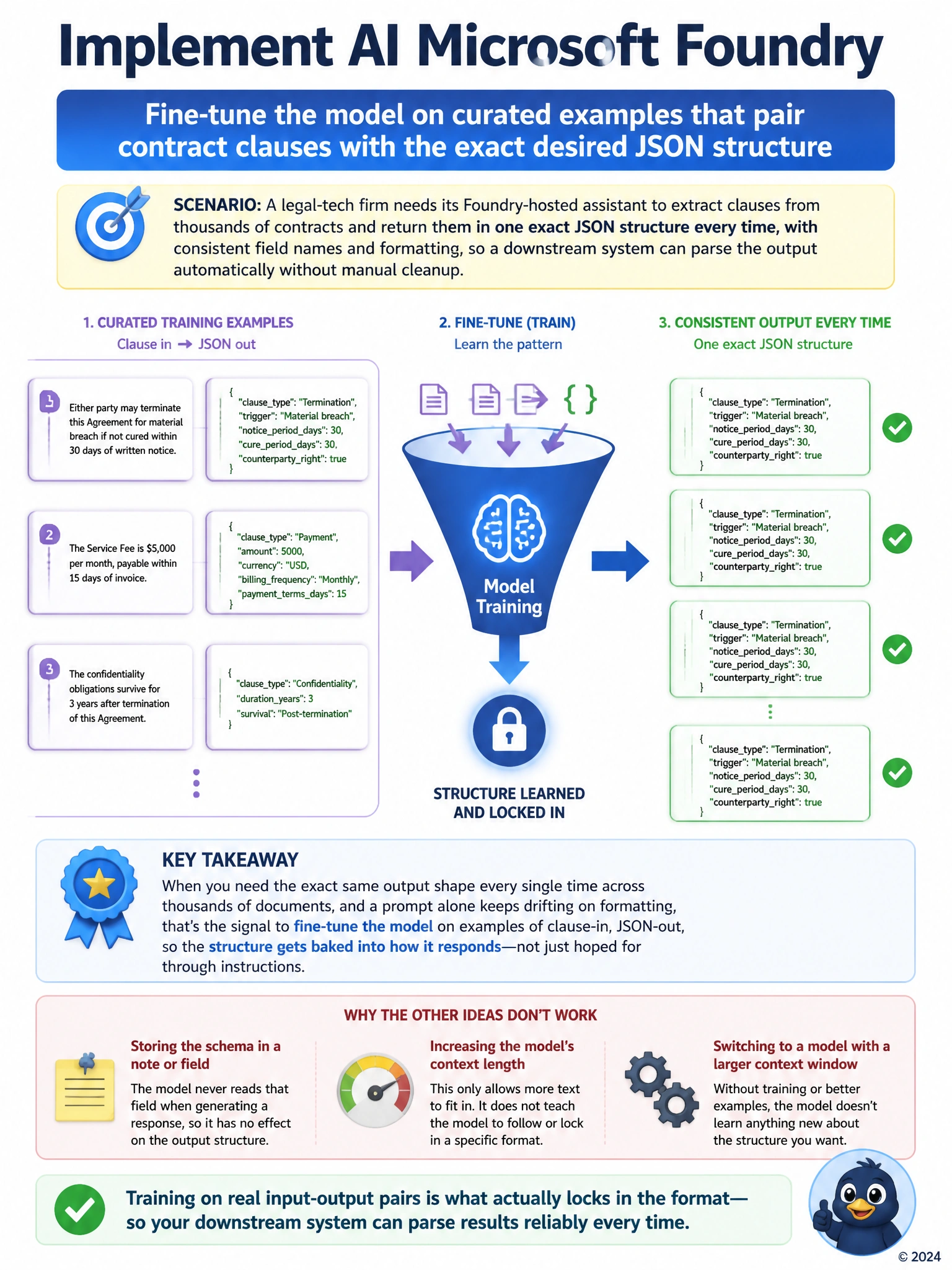
A legal-tech firm needs its Foundry-hosted assistant to extract clauses from thousands of contracts and return them in one exact JSON structure every time, with consistent field names and formatting, so a downstream system can parse the output automatically without manual cleanup.
Select an answer to reveal the explanation.
Short Explanation
When you need the exact same output shape every single time across thousands of documents, and a prompt alone keeps drifting on formatting, that's the signal to actually retrain the model on examples of clause-in, JSON-out, so the structure gets baked into how it responds rather than hoping it follows instructions perfectly every time. A field where you jot down the schema as a note somewhere in the deployment settings does nothing, the model never reads that field when it's generating a response. Bumping up how much text the model can handle at once solves a completely different problem, it's about fitting more words in, not about locking down formatting. And swapping to a model with a bigger context window while leaving your prompt exactly as it was doesn't teach the model anything new about the structure you want, so the inconsistency keeps showing up. Training on real input-output pairs is what actually locks in the format.
Full Explanation
The correct answer is C. Fine-tuning on curated examples that pair real contract clauses with the exact target JSON structure teaches the model's weights to consistently reproduce that structure across thousands of varied documents, which is what a downstream system parsing automatically requires. Option A is incorrect because the model description field is metadata for the deployment, it is not read by the model at inference time and has no effect on the actual output format the model generates. Option B is incorrect because the max token limit controls how much text can be processed or generated in a single call, it does not teach the model what output structure to follow, so longer clauses fitting in context does nothing to fix inconsistent JSON formatting. Option D is incorrect because a larger context window only changes how much text the model can consider at once, and leaving the prompt unchanged means the model still has no reinforced pattern for the exact output structure, so formatting will remain inconsistent across the thousands of contracts. Fine-tuning directly targets the consistency problem the firm is describing.