
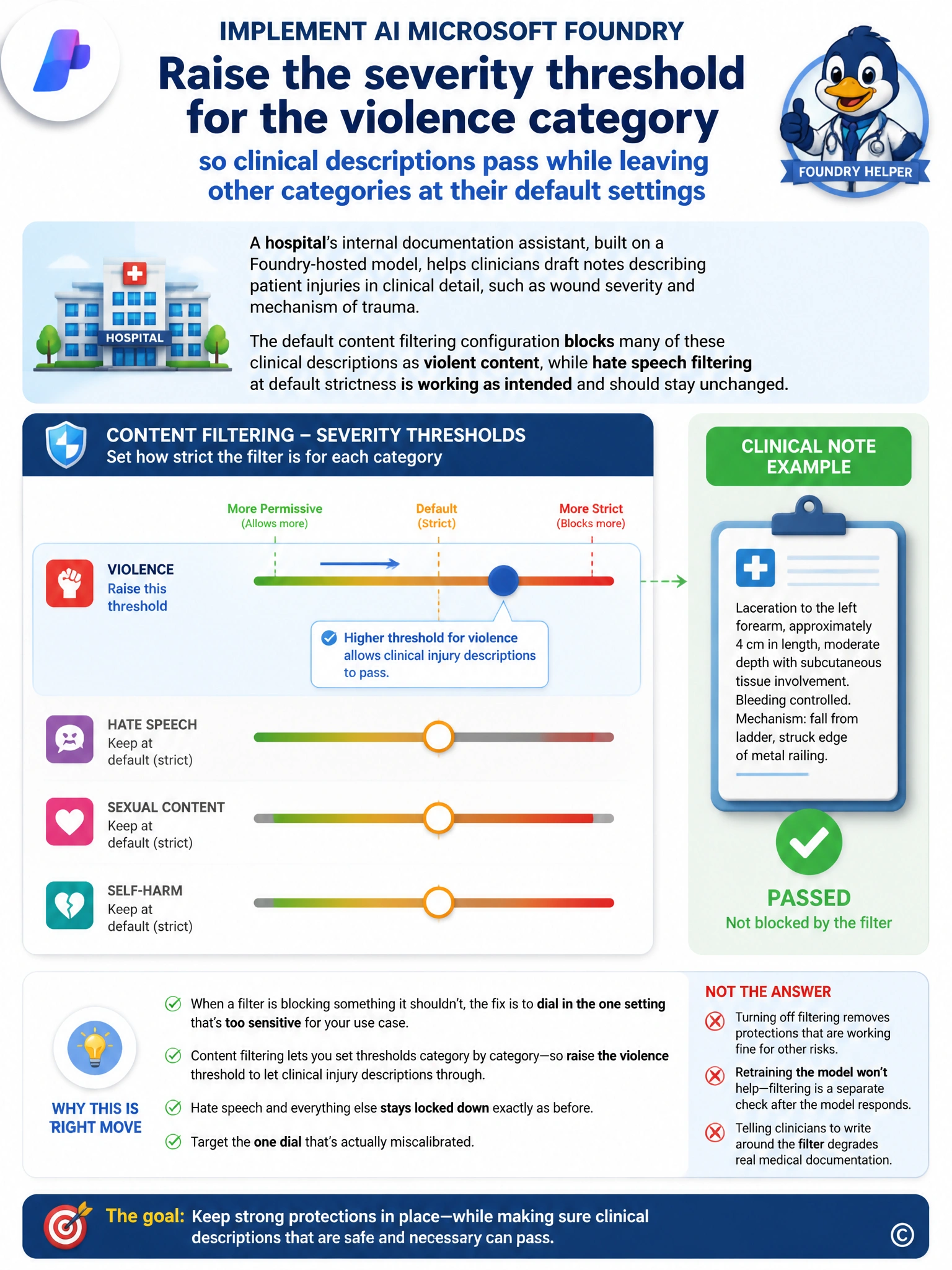
A hospital's internal documentation assistant, built on a Foundry-hosted model, helps clinicians draft notes describing patient injuries in clinical detail, such as wound severity and mechanism of trauma. The default content filtering configuration blocks many of these clinical descriptions as violent content, while hate speech filtering at default strictness is working as intended and should stay unchanged.
Select an answer to reveal the explanation.
Short Explanation
When a filter is blocking something it shouldn't, the fix is rarely to turn off protection everywhere, it's to dial in the one setting that's too sensitive for your use case. Content filtering usually lets you set thresholds category by category, so here the move is nudging up just the violence-related threshold so clinical injury descriptions get through, while hate speech and everything else stays locked down exactly as before. Switching off filtering altogether throws out protections that have nothing to do with the actual complaint, that's way more than the situation calls for. Retraining the model doesn't touch this problem either, because content filtering happens as a separate check after the model responds, so an unchanged filter would still block the output. And telling clinicians to write around the filter means degrading real medical documentation just to dodge a setting, which is a bad trade in a hospital record. Target the one dial that's actually miscalibrated.
Full Explanation
The correct answer is A. Foundry's content filtering lets teams configure severity thresholds independently per category, so the team can raise the threshold specifically for the violence category to allow legitimate clinical descriptions of injuries through, while leaving hate speech and other categories at their protective defaults. Option B is incorrect because disabling filtering entirely removes protection against every category, including hate speech and other harmful content that has nothing to do with the clinical documentation use case, which is far broader than the actual problem. Option C is incorrect because fine-tuning changes what the model tends to generate, it does not change what the separate content filtering layer blocks after generation, so clinical descriptions would still be flagged by the unmodified violence filter. Option D is incorrect because asking clinicians to avoid standard medical terminology to dodge a filter compromises the accuracy and completeness of patient documentation, which is not an acceptable tradeoff in a clinical setting. Adjusting the specific category threshold is the targeted fix that solves the actual problem without weakening protection elsewhere.