
A team is building a simple internal tool that classifies short employee feedback comments as positive or negative. Traffic will be modest and the task itself is straightforward. The team wants to keep both cost and response latency as low as possible while still getting reliable results.
Select an answer to reveal the explanation.
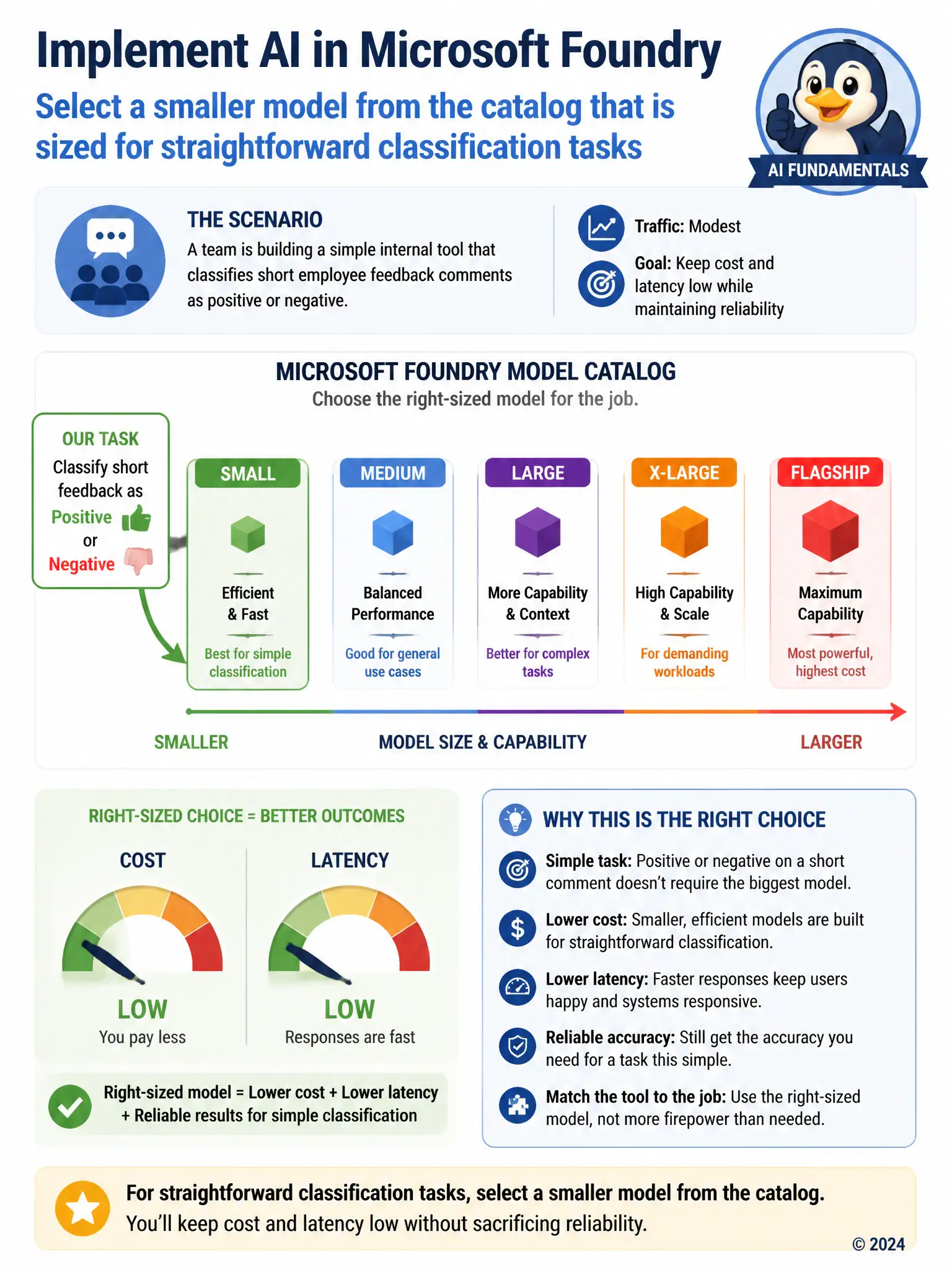
Short Explanation
For a simple positive-or-negative call on a short comment, you don't need the biggest model in the catalog, you need the right-sized one. Smaller models built for straightforward classification keep cost low and responses snappy while still being reliable. Match the tool to the job.
Full Explanation
The correct choice is selecting a smaller model from the catalog that is sized for straightforward classification tasks. The Foundry model catalog includes smaller, more efficient models designed for simpler tasks like short-text sentiment classification, and matching model size to task complexity keeps both cost per call and response latency low without sacrificing reliability on a task this simple. Selecting the largest flagship model in the catalog to guarantee the highest possible accuracy regardless of task complexity is incorrect because the largest flagship model carries higher cost and latency per request, and that extra capacity is wasted on a two-class classification task that does not need deep reasoning or broad general knowledge. Deploying the same model redundantly across multiple regions to reduce latency is incorrect because deploying the same oversized model redundantly across regions addresses geographic latency and availability, not the core cost and per-request latency problem, and it multiplies infrastructure cost rather than reducing it. Increasing the model's context window setting so it can respond faster is incorrect because increasing the context window setting affects how much input and output text a model can handle, it does not make inference faster, and an unnecessarily large context window can add overhead rather than remove it. Choosing a right-sized model for the task is the direct way to satisfy both the cost and latency goals stated in the scenario.