
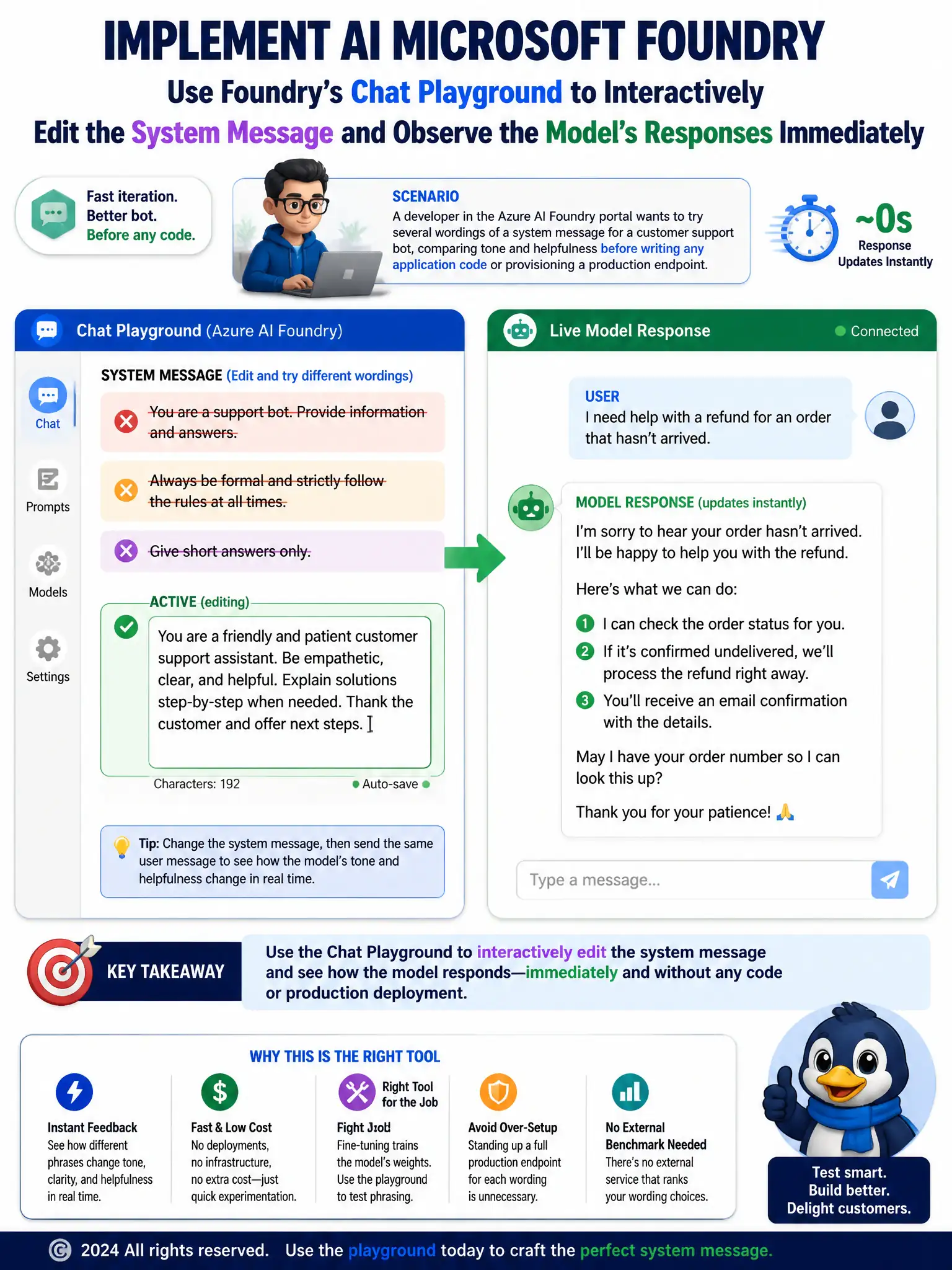
A developer working in the Azure AI Foundry portal wants to quickly try out several different wordings of a system message for a customer support bot, comparing tone and helpfulness before writing any application code or provisioning a production endpoint.
Select an answer to reveal the explanation.
Short Explanation
When you just want to see how a different system message changes the bot's tone, you don't need to write code or spin up a deployment first; you can type it into the chat playground and watch the responses change in real time. That's the whole point of an interactive testing surface: fast, cheap iteration before anything is locked in. The playground is the lightweight, immediate way to test phrasing before anything gets built or deployed.
Full Explanation
The correct answer is the interactive chat playground approach. The Foundry chat playground is built exactly for this kind of rapid, code-free iteration: the developer can edit the system message, send a few sample messages, and see the model responses update immediately, letting them compare tone and helpfulness across variants in minutes. The production endpoint deployment approach is incorrect because standing up a separate production endpoint for every wording variant is slow, requires provisioning and deployment work, and introduces operational overhead for what is still an exploratory, pre-code comparison. The Microsoft benchmarking request approach is incorrect because there is no Microsoft benchmarking service for a team's custom system message wording; evaluating prompt phrasing is the team's own task, not something outsourced to the platform vendor. The fine-tuning approach is incorrect because fine-tuning trains model weights on a dataset and has nothing to do with comparing system message wording, and running one fine-tuning job per phrasing variant would be far more time-consuming and costly than simply testing prompts interactively. The playground exists precisely so teams can iterate on prompt and system message design before committing to any code or infrastructure, which is what this scenario calls for.