
A furniture retailer deploys a Foundry-hosted chat assistant on its website to answer questions about product dimensions and delivery. During testing, customers ask the assistant to write poems and discuss unrelated topics, and it happily complies, drifting from its intended purpose. What should the team configure to keep the assistant focused on furniture-related questions and declining unrelated requests?
Select an answer to reveal the explanation.
Short Explanation
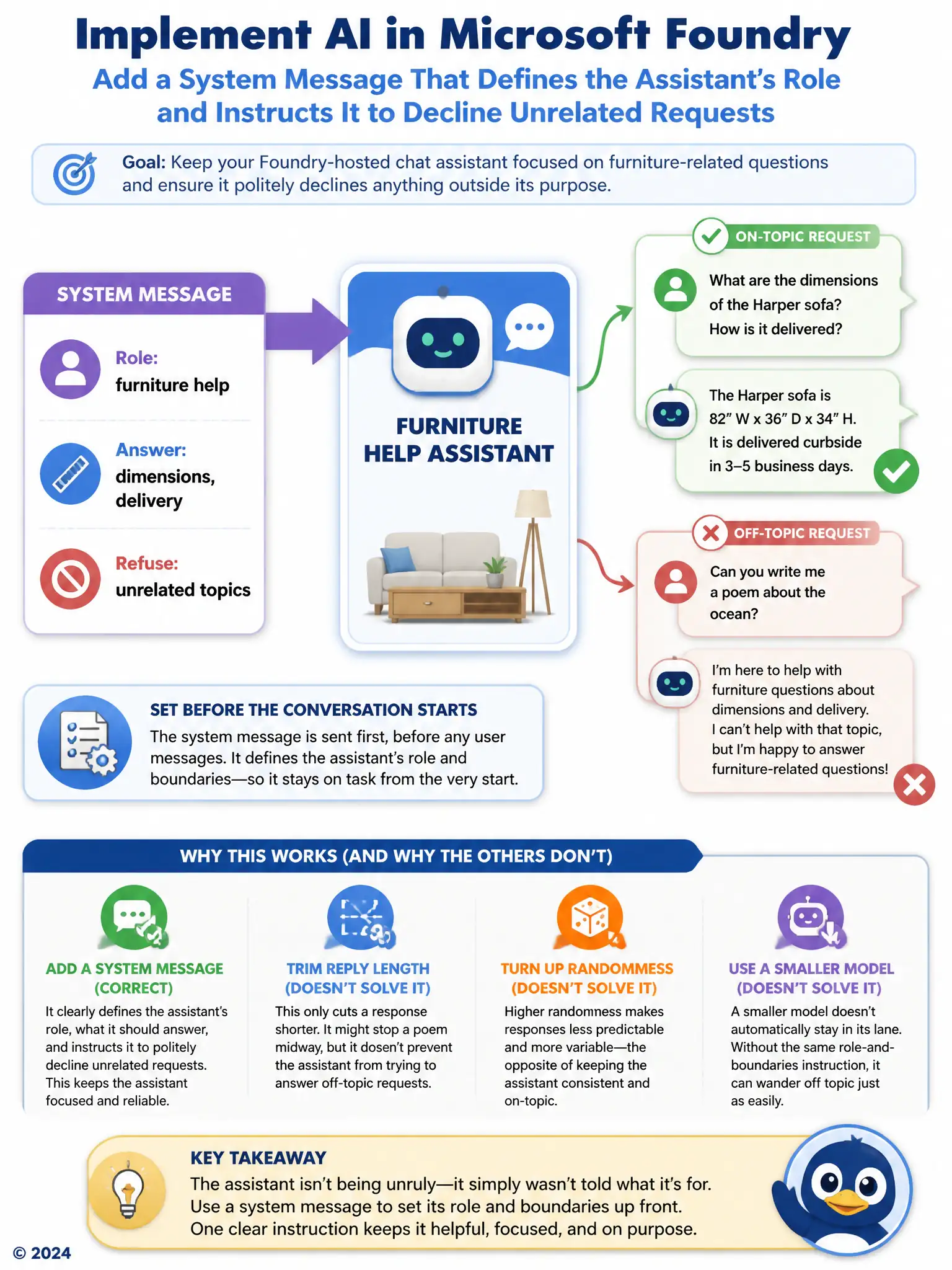
The assistant drifts because nobody gave it a clear job description. Put a system message in front of the conversation that says it's a furniture assistant, answers dimensions and delivery, and politely declines unrelated requests. That's what keeps it on task.
Full Explanation
The correct answer is the system message that defines the assistant's role and instructs it to decline unrelated requests. A system message sets the assistant's role, scope, and behavioral boundaries before any user turn begins, so instructing it to stay focused on furniture dimensions and delivery, and to decline unrelated requests such as writing poems, directly addresses the drift the team observed in testing. The token-limit change is incorrect because lowering the maximum output token limit only shortens how long a response can be; it does not stop the assistant from attempting to engage with an off-topic request, it just cuts the reply short. The temperature change is incorrect because increasing temperature makes output more varied and unpredictable, which would make an already off-topic assistant even harder to control, not more focused. The smaller-model change is incorrect because switching to a smaller model changes general capability and cost, but a smaller model has no inherent instruction to refuse unrelated topics; without a system message defining scope, it could drift just as easily as the larger one.