
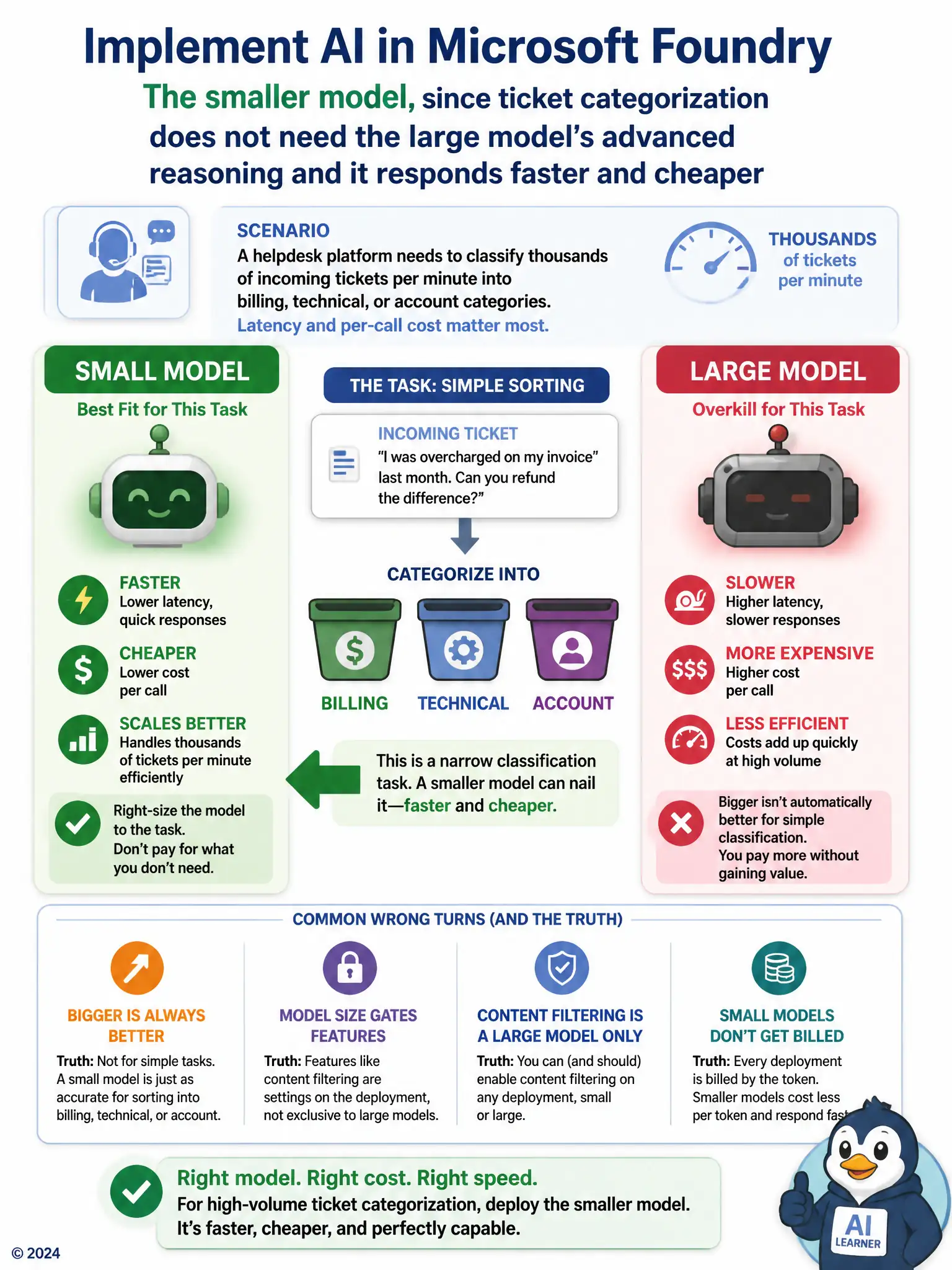
A helpdesk platform needs to classify thousands of incoming tickets per minute into 'billing', 'technical', or 'account' categories. Latency and per-call cost matter more than nuanced reasoning. The team is choosing between a small efficient model and a large flagship model in the Foundry model catalog. Which should they deploy for this task?
Select an answer to reveal the explanation.
Short Explanation
When you're sorting tickets into billing, technical, or account, you don't need the biggest model. The smaller model handles that narrow task accurately, and it answers faster and costs less per call. At thousands of tickets a minute, that speed and cost savings matter.
Full Explanation
The correct choice is the smaller model, since ticket categorization does not need the large model's advanced reasoning and it responds faster and cheaper. Categorizing support tickets into a small, fixed set of labels is a narrow, well-defined task that does not require the deep reasoning or broad world knowledge of a flagship model. A smaller model in the Foundry catalog can handle this classification accurately while responding faster and at lower per-call cost, which matters when processing thousands of tickets per minute. The large flagship model option claiming that larger models always produce more accurate classifications regardless of task complexity is incorrect because larger models are not universally more accurate; on narrow, high-volume classification tasks, a well-suited smaller model often performs comparably while adding unnecessary latency and cost. The large flagship model option claiming that only large models support content filtering is incorrect because content filtering is a platform-level configuration applied to a deployment, not a capability restricted to large models; small models support it too. The smaller model option claiming that Azure only bills per-token for large models, not small ones, is incorrect because Azure applies per-token billing to both small and large model deployments; the smaller model's advantage here is lower cost per token and faster response time, not an exemption from usage-based billing.