
A marketing team uses one Foundry-hosted GPT model deployment for two tasks: drafting creative tagline ideas and answering factual questions about return policy from grounded content. They want the same deployed model to produce varied, imaginative taglines but consistent, literal answers for policy questions. What should they adjust between the two calls to achieve this?
Select an answer to reveal the explanation.
Short Explanation
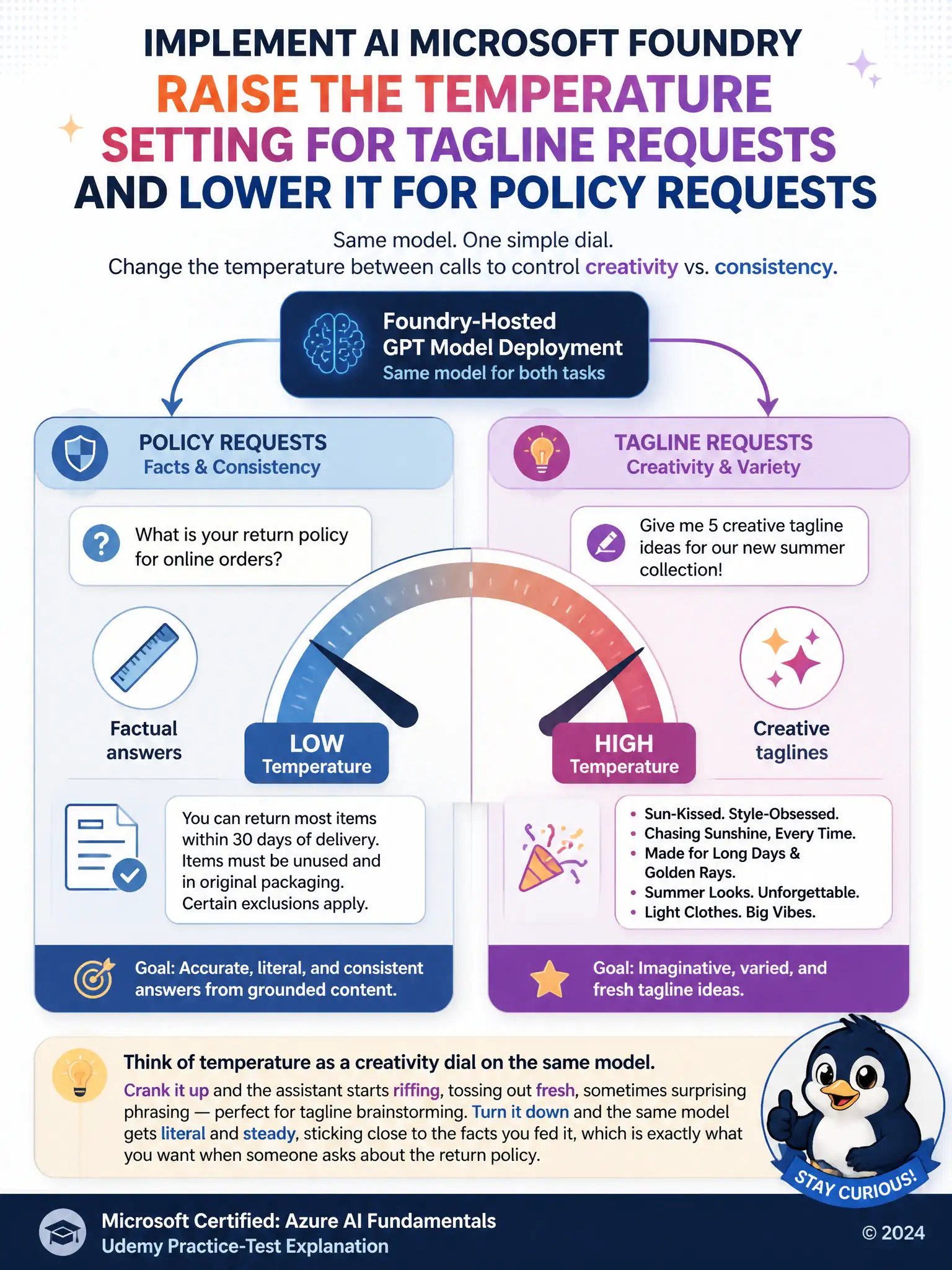
Think of temperature as a creativity dial on the same model. Crank it up for tagline brainstorming, then turn it down for policy answers so the model stays literal and steady. You don't need a bigger model, stricter filters, or retraining—just adjust the dial per request.
Full Explanation
The right adjustment is to raise the temperature setting for tagline requests and lower it for policy requests. Temperature is a per-request parameter that controls how much randomness the model injects into its output. Raising it produces more varied, imaginative taglines, while lowering it produces more literal, consistent answers grounded in the return policy. This lets one deployment serve both needs without any redeployment. Deploying the policy task on a model with a larger context window is incorrect because context window size determines how much text a model can process at once, not how creative or deterministic its output is. Adding a stricter content filter severity to the tagline prompts is incorrect because stricter content filtering changes what gets blocked for safety reasons, not how varied or literal the wording is; a tagline and a policy answer can both pass the same filter. Retraining the model with additional company documents before each call is incorrect because retraining on more documents before every call is a heavy, slow step meant to change what the model knows, not a lightweight way to control randomness on a single request, and it would not by itself make the tagline output more imaginative or the policy output more literal.