
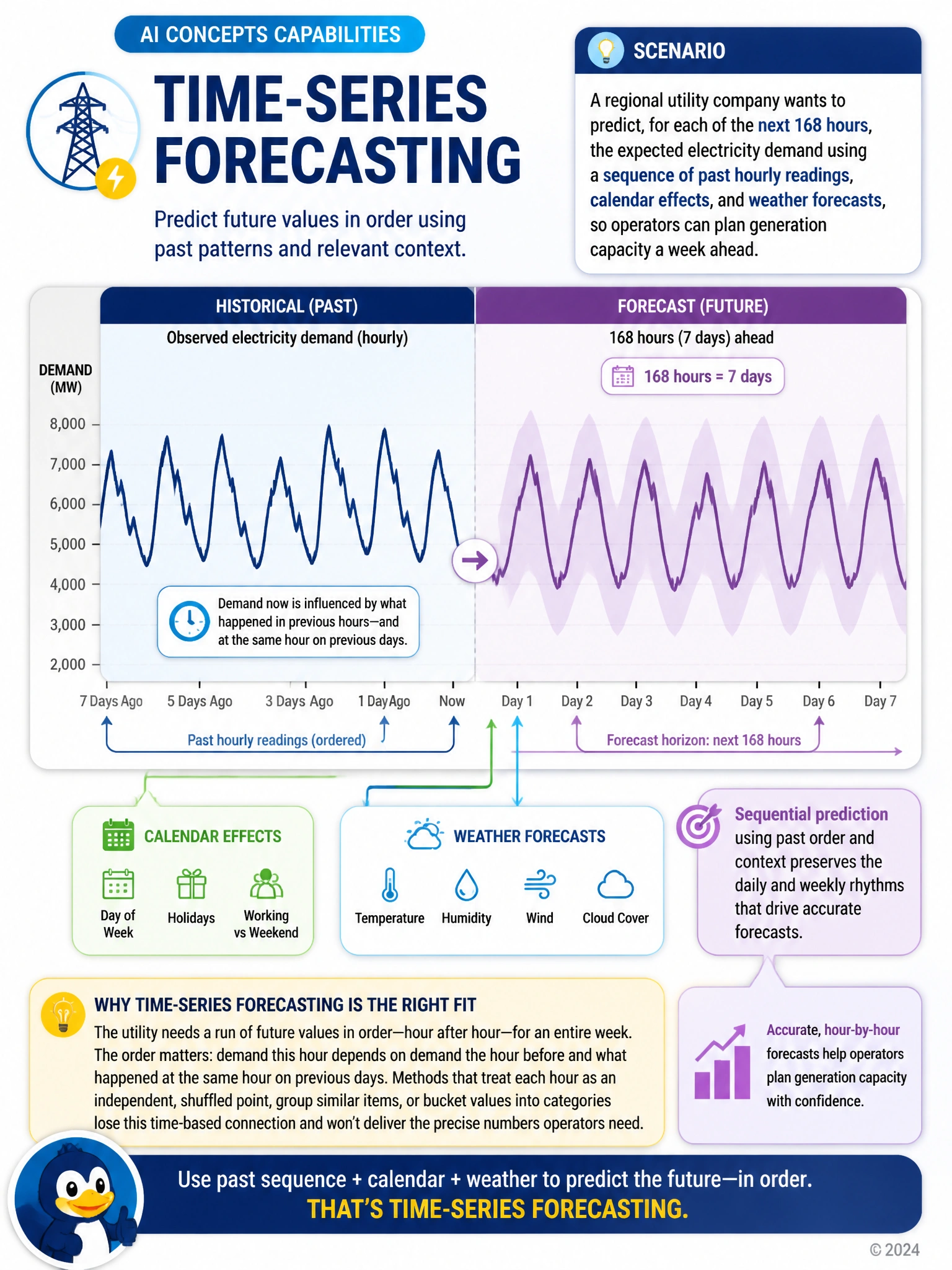
A regional utility company wants to predict, for each of the next 168 hours, the expected electricity demand using a sequence of past hourly readings, calendar effects, and weather forecasts, so operators can plan generation capacity a week ahead. Which machine learning approach best fits this need?
Select an answer to reveal the explanation.
Short Explanation
The giveaway here is that the utility isn't just predicting one number from a snapshot of features, it's predicting a whole run of future values in order, hour after hour, for an entire week. That ordering matters a lot, because electricity demand this hour is closely tied to demand the hour before and to what happened at this same hour on previous days. A method that treats every hour as its own separate, shuffled data point throws away exactly that connection, so it misses the daily and weekly rhythms that make the prediction useful. Sorting customers or readings into unlabeled groups doesn't help either, since grouping similar things together isn't the same as projecting forward in time. And slotting demand into a handful of categories loses the precise numbers operators actually need to plan generation capacity. What fits is an approach built specifically to carry sequence and time into account when projecting multiple steps ahead.
Full Explanation
The correct answer is C. Time-series forecasting is designed to model sequential dependence between observations and produce a sequence of future predictions, which matches the utility's need to project demand hour by hour across an entire week using patterns like daily and seasonal cycles. Option A is incorrect because classification assigns inputs to discrete categories, such as 'high demand' or 'low demand,' rather than producing the specific continuous demand values the operators need for capacity planning. Option B is incorrect because clustering groups similar data points together without predicting any future numeric outcome, so it cannot generate the 168 hourly demand figures the scenario requires. Option D is incorrect because treating each hour as an independent, unordered observation discards the temporal relationships, such as how demand at one hour strongly influences demand in the next, that give forecasting its accuracy; ignoring that order loses the seasonality and momentum patterns that are central to predicting a full week of sequential demand. Because the task depends on ordered, sequential prediction across many future steps, time-series forecasting is the approach that matches the requirement.