
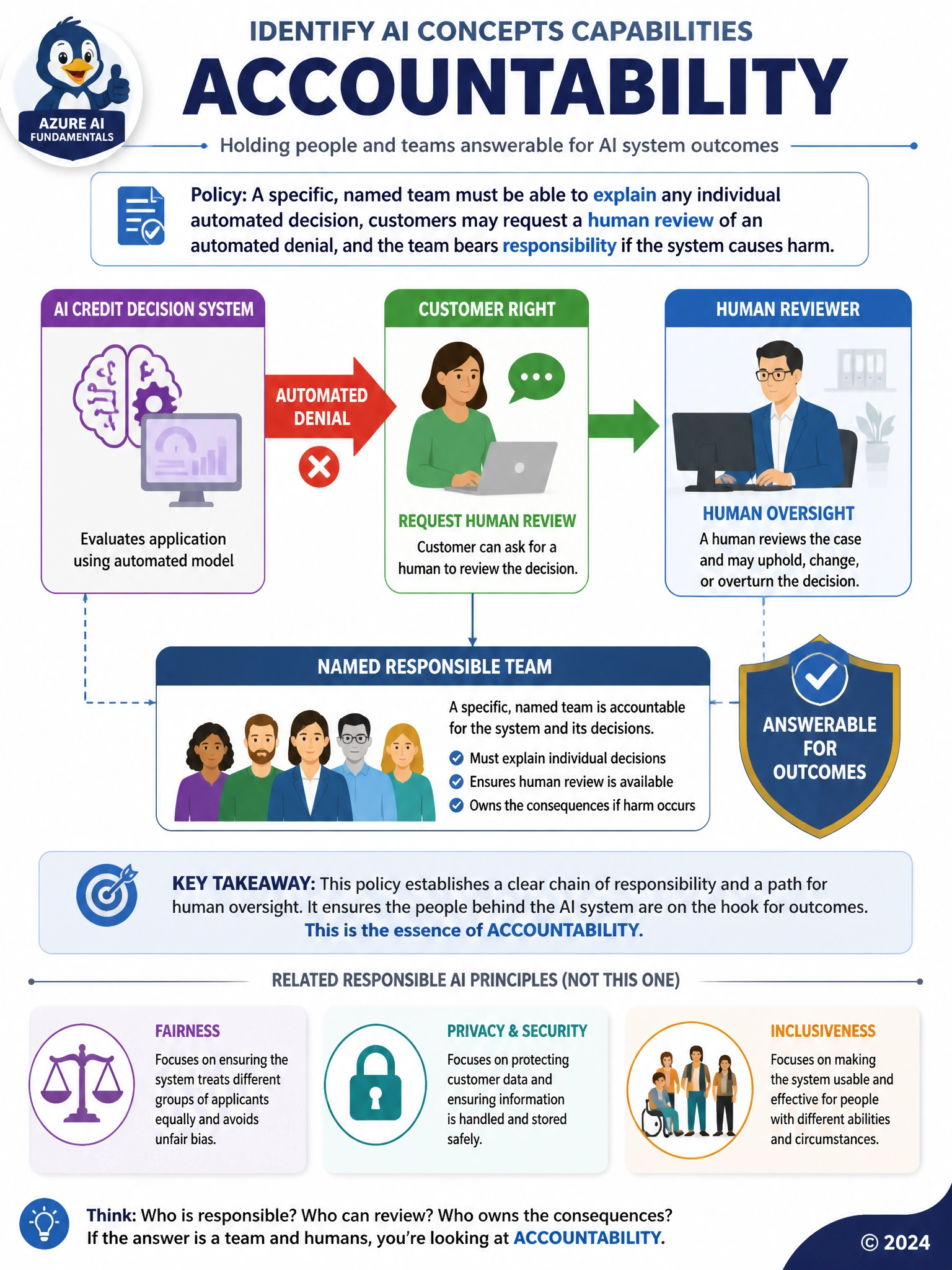
A consumer lender's board adopts a policy for its automated credit-decision system stating that a specific, named team must be able to explain any individual automated decision, that customers may request a human review of an automated denial, and that the team bears responsibility if the system causes harm. Which responsible AI principle does this policy primarily implement?
Select an answer to reveal the explanation.
Short Explanation
Notice what this policy is actually built around: a named team that must answer for decisions, a way for a customer to escalate to a human, and someone who owns the consequences if things go wrong. That combination is about who is on the hook and how oversight works, not about whether different groups of applicants are treated equally, which would be a fairness question instead. It's also not about how the customer's financial data is handled or guarded, which would fall under privacy and security. And it isn't about making the system usable and effective for people with different abilities or circumstances, which is what inclusiveness addresses. What this policy is really establishing is a clear chain of responsibility and a route for a human to step in and review a decision, which is the essence of holding the people behind an AI system answerable for it.
Full Explanation
The correct answer is D. Accountability is the principle that people and organizations must be answerable for how an AI system behaves, and the policy directly implements it by naming a responsible team, guaranteeing a human review pathway, and assigning responsibility for harm. Option A is incorrect because fairness concerns whether the system treats different groups of applicants equitably, which is a separate question from who is answerable for the system's decisions and outcomes. Option B is incorrect because privacy and security concern how applicants' personal and financial data is collected, stored, and protected, not who oversees decisions or provides recourse for a denial. Option C is incorrect because inclusiveness concerns designing the system to work well for people of varying abilities, backgrounds, and circumstances, which is unrelated to establishing a named team, an appeal channel, or an assignment of liability. Because the policy's core elements are naming a responsible party, providing human oversight, and assigning liability for harm, accountability is the principle it puts into practice, even though a well-run credit system would also need to address fairness, privacy, and inclusiveness separately.