
A city library is designing an accessibility kiosk for visitors with low vision. The kiosk must be able to (1) read the printed text on a posted event schedule aloud and (2) describe the general content of a photo on a nearby exhibit wall in a natural-language sentence. Which two Azure AI Vision capabilities does the team need to combine to meet both requirements? (Select TWO.)
Select all correct answers, then click Submit.
Short Explanation
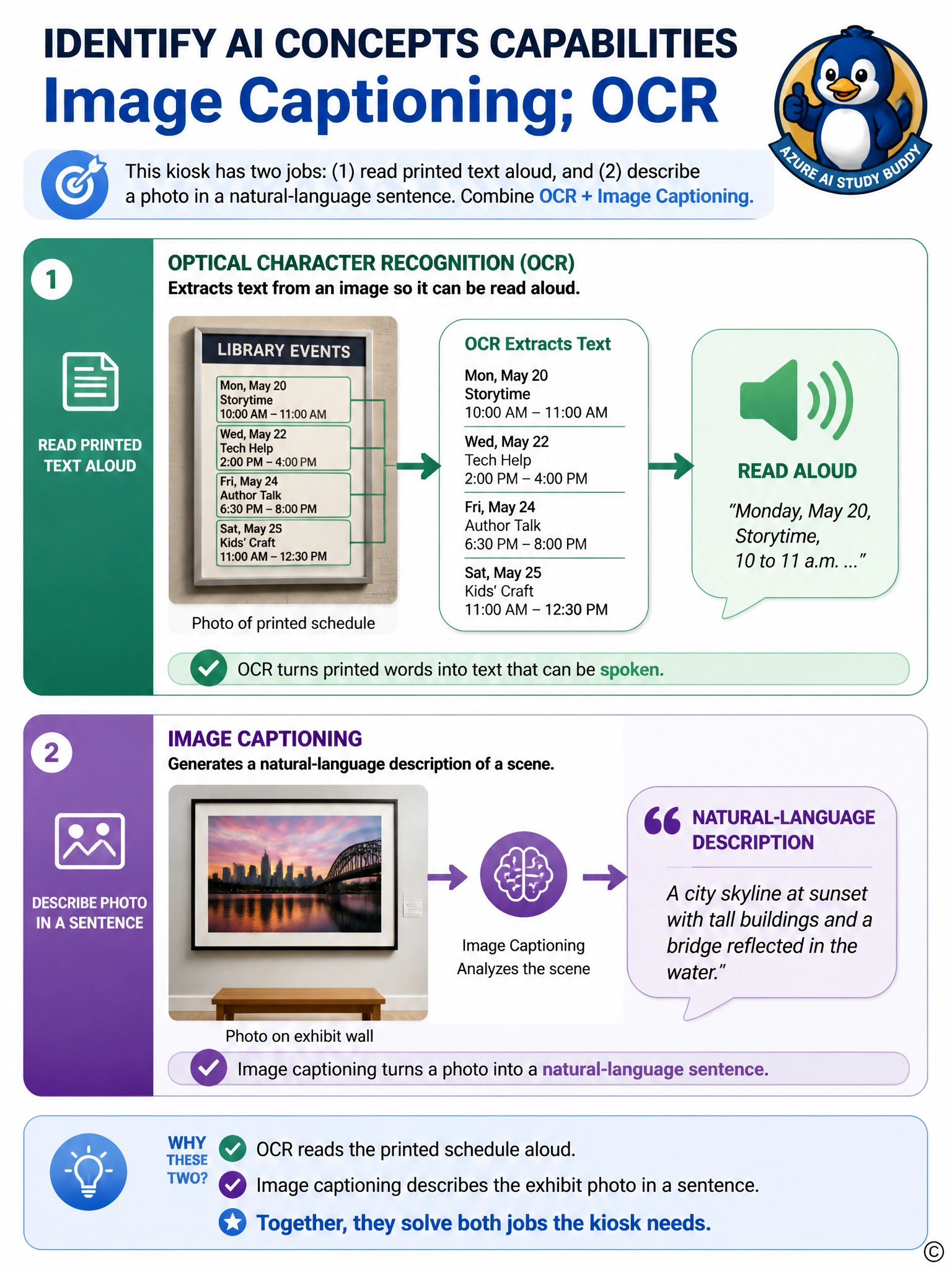
This kiosk actually has two separate jobs, so look for the pair of tools that together cover both. The first job is turning printed words on a schedule into something that can be read aloud, which calls for a tool built specifically to pull text out of an image. The second job is different: taking a photo and producing a spoken sentence that describes what's generally happening in it, which calls for a tool built to generate natural-language descriptions of scenes. A tool that just draws boxes around individual objects gives you a list of labeled items, not a flowing sentence, so it falls short of the description requirement. And a tool that only finds faces is far too narrow, since it says nothing about text or general scene content. The right combination is the text-reading tool plus the scene-describing tool, each solving one half of what the kiosk needs.
Full Explanation
The correct answers are A and D. Optical character recognition extracts the printed characters from the event schedule so the kiosk can convert them to speech, and image captioning generates a natural-language sentence summarizing what a photo depicts, which covers the second requirement of describing the exhibit image. Option B is incorrect because object detection returns bounding boxes and labels for individual objects rather than a flowing descriptive sentence, so it does not produce the kind of narrated summary the exhibit-description requirement calls for. Option C is incorrect because face detection only locates and analyzes human faces within an image; it neither reads printed text nor generates a general description of a photo's overall content, so it addresses neither of the kiosk's two stated needs. Because the scenario explicitly requires both extracting printed text and generating a natural-language description, the team must combine the two capabilities that each solve one of those distinct problems rather than choosing a single all-purpose tool.