
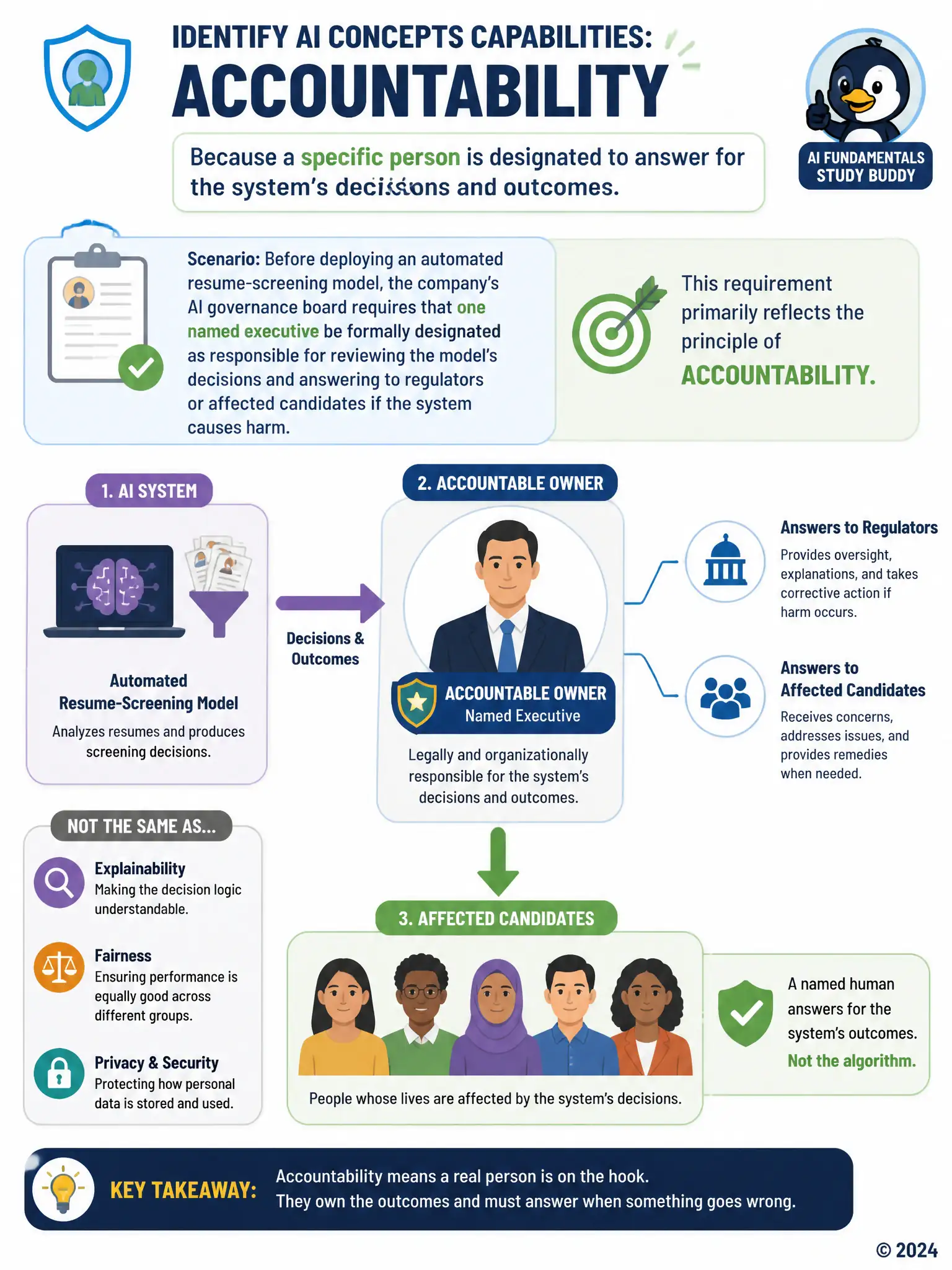
Before deploying an automated resume-screening model, a company's AI governance board requires that one named executive be formally designated as responsible for reviewing the model's decisions and for answering to regulators or affected candidates if the system causes harm. Which responsible AI principle does this requirement primarily reflect?
Select an answer to reveal the explanation.
Short Explanation
Focus on what the board is asking for: not explainability, not fairness across groups, not data protection, but one real person on the hook for what the system does. You're making sure a human, not the algorithm, remains answerable when an automated system affects people's lives. That's accountability.
Full Explanation
Assigning a named executive to own responsibility for the model's decisions and to answer to regulators or affected candidates for its outcomes is the defining characteristic of accountability, the principle that ensures there is always a designated human, not just the system itself, who owns and can be held responsible for an automated system's behavior. The privacy-and-security rationale is incorrect because privacy and security concern how personal data is collected, stored, and protected from misuse, not who is designated to answer for the model's decisions after deployment. The inclusiveness rationale is incorrect because inclusiveness concerns whether the system performs fairly across different groups of candidates, a question about the model's outputs rather than about who is assigned ownership of those outputs. The transparency rationale is incorrect because transparency concerns whether the model's logic and limitations can be explained and understood, which is a separate requirement from naming an owner who is answerable for the system, though the two principles often work together in practice. Designating a responsible individual for outcomes is specifically what accountability requires.