
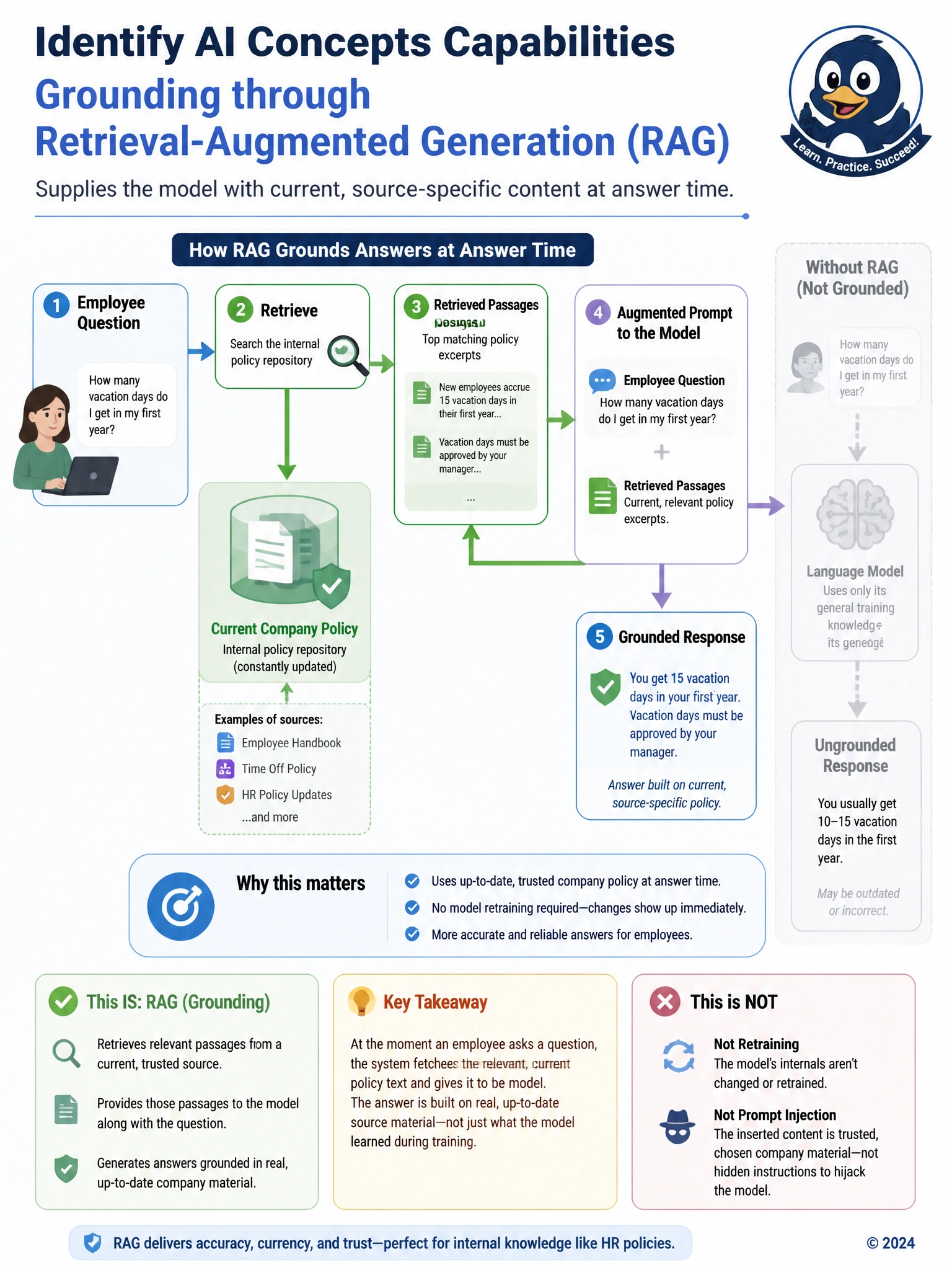
A software company deploys a generative AI chatbot to answer employee questions about internal HR policy. Because the underlying language model was trained on general public text and has no knowledge of the company's specific, frequently updated policy documents, engineers configure the chatbot to first retrieve relevant passages from the company's internal policy repository and insert them into the prompt before the model generates its response. Which concept does this design apply?
Select an answer to reveal the explanation.
Short Explanation
Notice the timing here: the company isn't retraining the model itself, and it isn't waiting for the chatbot to slowly learn from feedback over many conversations. Instead, right when an employee asks a question, the system goes and fetches the relevant, current policy text and hands it to the model along with the question, so the answer is built on real, up-to-date source material instead of whatever the model happened to absorb during its original training. That's a much lighter-weight fix than permanently changing the model's internals, and it means policy updates show up in answers immediately. It's also worth noting this isn't the same thing as a malicious actor sneaking hidden instructions into a model's input to hijack its behavior; here the inserted content is trusted, deliberately chosen company material meant to make the answer more accurate, not to manipulate it.
Full Explanation
The correct answer is B. Retrieving relevant policy passages and inserting them into the prompt at the moment of the question, rather than relying on what the model memorized during training, is the definition of grounding through retrieval-augmented generation: it supplies current, source-specific content so the response reflects the company's actual, up-to-date policy rather than the model's general pretraining. Option A is incorrect because reinforcement learning involves a model updating its behavior through reward signals over repeated interactions, not retrieving documents at answer time. Option C is incorrect because fine-tuning permanently adjusts the model's internal weights through additional training, whereas this design leaves the model's weights untouched and instead supplies fresh context per request, which is faster to update and does not require retraining whenever policy changes. Option D is incorrect because prompt injection refers to untrusted or malicious content manipulating a model's instructions to produce unintended behavior, whereas here the retrieved content is trusted, deliberately selected company data intended to improve the accuracy of the answer, not hijack it. Grounding is the concept that connects general-purpose language models to an organization's own live information.