
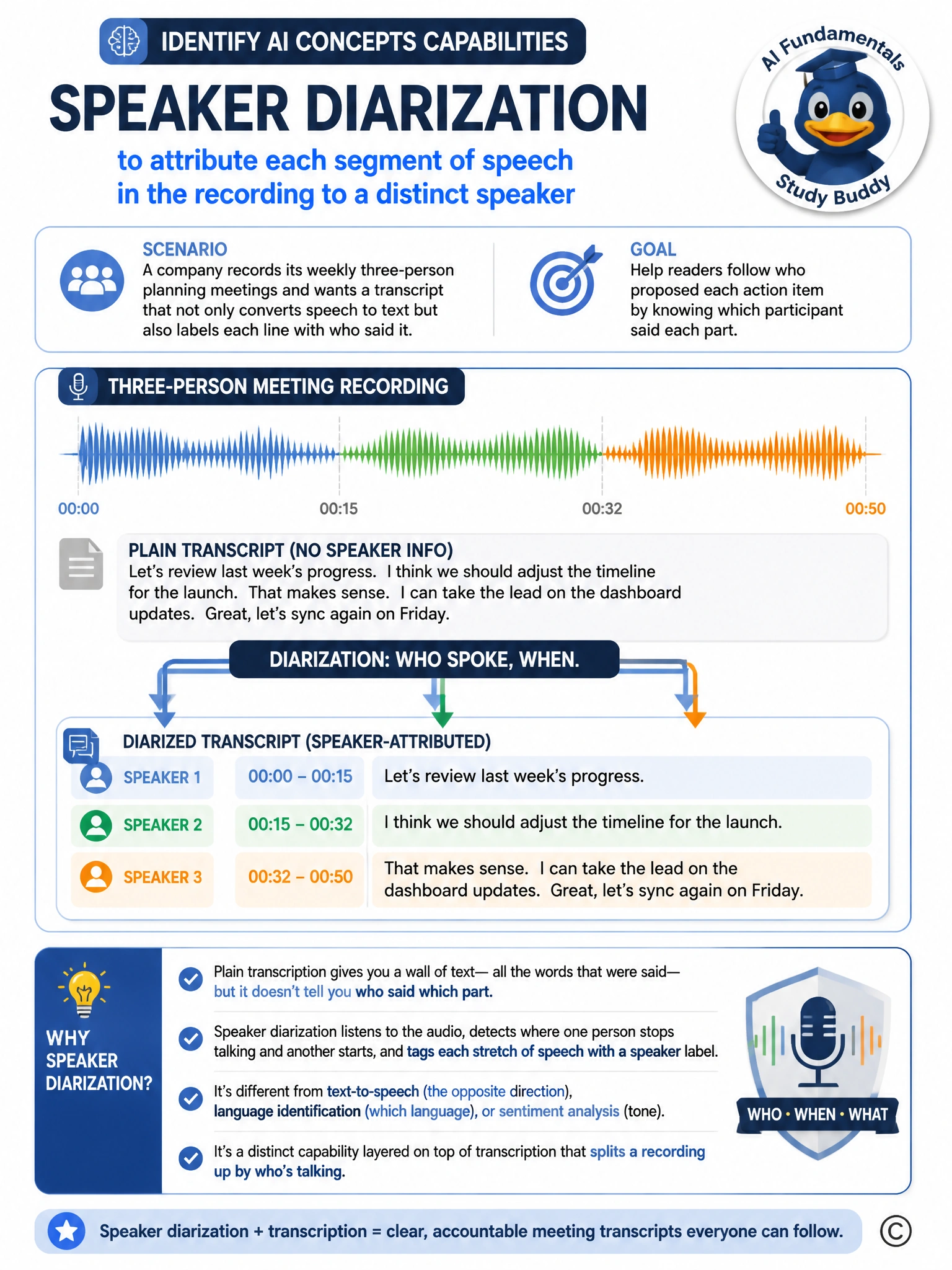
A company records its weekly three-person planning meetings and wants a transcript that not only converts the speech to text but also labels each line with which of the three participants said it, so readers can follow who proposed each action item. Beyond basic speech-to-text transcription, which additional capability does the team need?
Select an answer to reveal the explanation.
Short Explanation
Plain transcription gives you a wall of text, all the words that were said, but it doesn't tell you who said which part, and that's exactly the gap the team is trying to close. What they need is a capability that listens to the audio and figures out where one person stops talking and another starts, then tags each stretch of speech with a speaker label. That's a different job from generating audio out of text, which runs the opposite direction entirely. It's also different from figuring out what language is being spoken, since everyone in this meeting is presumably speaking the same one. And judging how someone's tone sounds doesn't tell you which of the three people was actually speaking at that moment. Splitting a recording up by who's talking is its own distinct skill layered on top of transcription.
Full Explanation
The correct answer is A. Basic transcription alone converts audio to a stream of text but does not know who said what, so the team additionally needs speaker diarization, which segments a recording and attributes each stretch of speech to a distinct speaker so the transcript can label lines by participant. Option B is incorrect because speech synthesis generates spoken audio from text, the reverse of what the team needs, and does nothing to attribute existing speech to individual speakers. Option C is incorrect because language detection identifies which language is being spoken, which is not the team's problem here since all three participants presumably speak the same language; the missing piece is who spoke, not what language was used. Option D is incorrect because sentiment analysis scores emotional tone, which would tell readers how a remark sounded but not which of the three participants made it, leaving the core requirement of speaker attribution unsolved. Speaker diarization is the specific capability layered on top of transcription to separate a multi-person recording into per-speaker segments.