
An operations team is scoping four candidate AI features for next quarter's roadmap and must sort each one by workload type to budget for the right specialists. (Select TWO.) The candidates are: extracting invoice line items from scanned image files using optical character recognition, translating shipping manifests from English into Spanish, counting vehicles in traffic camera footage using object detection, and condensing lengthy supplier contracts into short paragraphs. Which two candidates are computer vision workloads?
Select all correct answers, then click Submit.
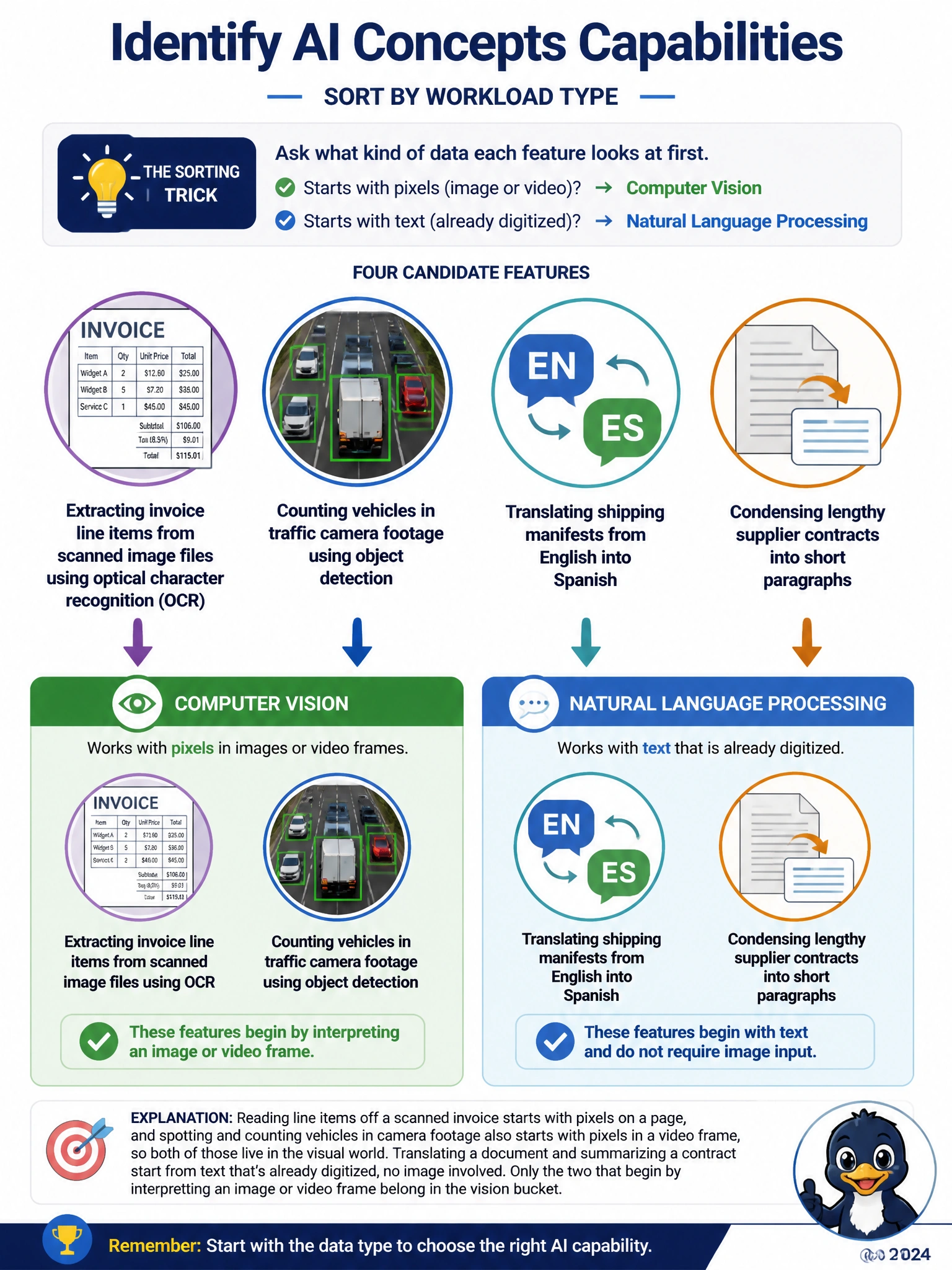
Short Explanation
The sorting trick here is simple: ask what kind of data each feature actually looks at first. Reading line items off a scanned invoice starts with pixels on a page, and spotting and counting vehicles in camera footage also starts with pixels in a video frame, so both of those live in the visual world. Translating a document from one language to another and boiling a long contract down into a short summary both start from text that's already digitized, no image involved at all. So even though all four features sound like reasonable things to put on a roadmap, only the two that begin by interpreting an image or a video frame belong in the vision bucket; the other two belong with the text-processing capabilities instead.
Full Explanation
The correct answers are A and C. Extracting invoice line items from scanned images relies on optical character recognition to read visual text from an image, and counting vehicles in traffic footage relies on object detection to locate and count discrete objects in visual frames; both operate on image data and both are core computer vision workloads. Option D is incorrect because translating text between languages is a natural language processing workload, not a computer vision one, since it operates on already-digitized text rather than interpreting pixels in an image. Option B is incorrect for the same reason: condensing lengthy contracts into short paragraphs is text summarization, another natural language processing capability, and involves no image analysis at all. The distinguishing question for sorting any of these four candidates is whether the input the system analyzes is visual, an image or video frame, or purely textual; the two vision-based candidates both start from pixels, while the two language-based candidates both start from text.