
A manufacturer wants a vision model that recognizes forty different proprietary bracket models unique to its own product line, none of which appear in any public image dataset. The pre-built image classification API the team evaluated was trained on common household and industrial objects and cannot tell the forty brackets apart, returning only a generic 'metal part' label for all of them. What should the team do to get accurate, part-specific results?
Select an answer to reveal the explanation.
Short Explanation
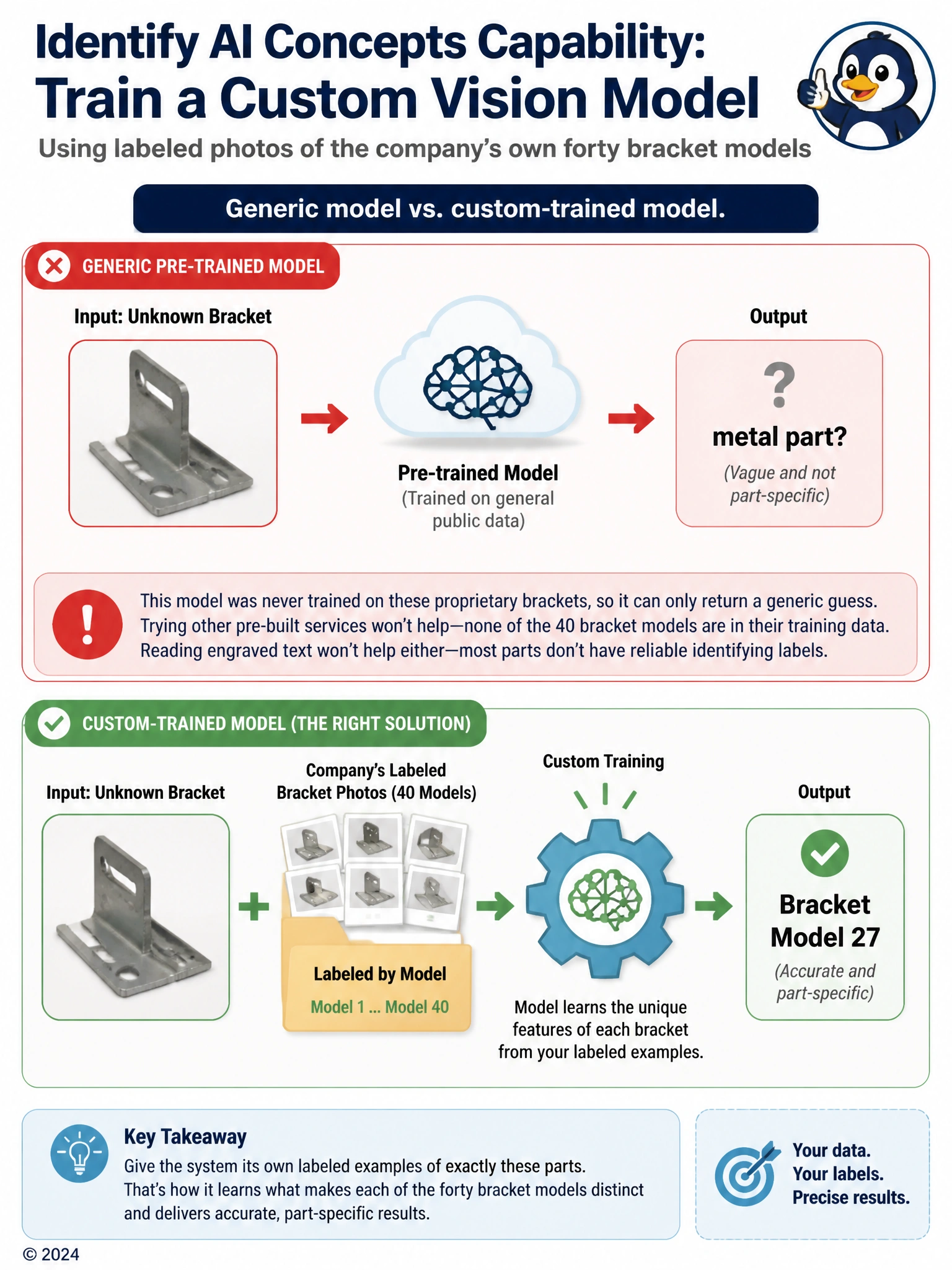
Here's the core problem: the off-the-shelf tool has never seen these parts before, because they're unique to this one manufacturer, so no amount of swapping between pre-built services fixes that. A different flavor of pre-built model, whether it's built to classify or built to detect and locate, still only knows what it was trained on, and none of these forty brackets were in that training data. The fix isn't a different pre-built tool at all, it's giving the system its own labeled examples of exactly these parts so it can learn what makes each one distinct. That's the whole idea behind letting a team bring its own images and labels rather than relying on a model trained purely on generic public objects. Reading engraved text wouldn't help either, since most of these brackets won't reliably carry identifying labels anyway.
Full Explanation
The correct answer is D. Because the forty bracket models are proprietary and absent from any public training data, the only way to get part-specific labels is to train a custom vision model on photos of those exact brackets, which is precisely what custom vision services are designed for: taking a small, labeled dataset unique to one organization and producing a model that recognizes those specific categories. Option A is incorrect because the pre-built API already demonstrated it cannot distinguish the brackets, returning only a generic label, so continuing to use it unchanged would not solve the problem. Option B is incorrect because switching from classification to a different pre-built API does not address the root issue; a pre-built object detection model trained on common objects would be just as unable to recognize proprietary brackets it has never seen, since detection is not inherently more accurate than classification, only structured to locate items rather than label a whole image. Option C is incorrect because optical character recognition extracts printed or engraved text characters, not visual part shapes, and most brackets carry no readable identifying text at all. Custom training on labeled examples is the only path to part-specific accuracy here.