
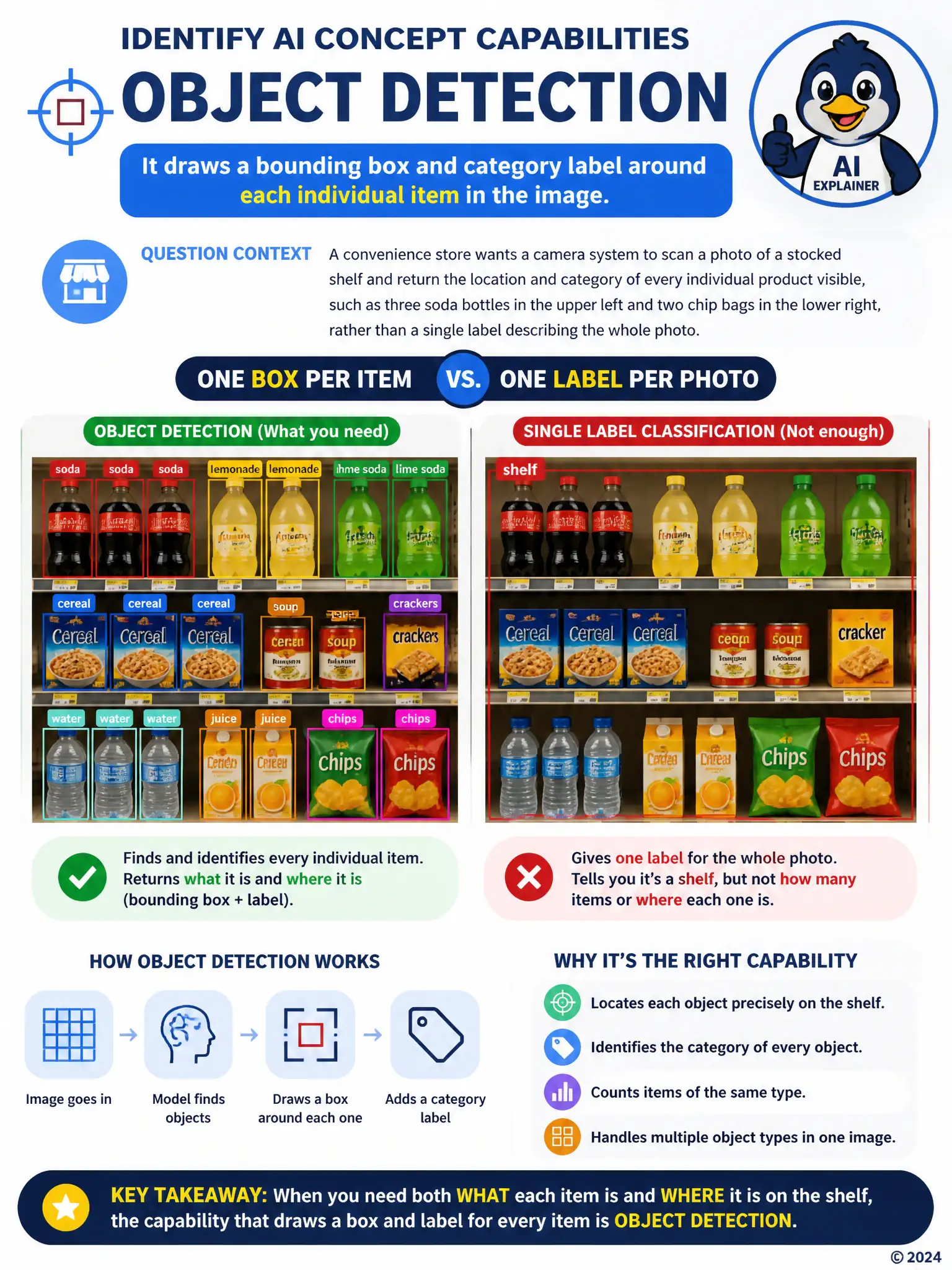
A convenience store wants a camera system to scan a photo of a stocked shelf and return the location and category of every individual product visible, such as three soda bottles in the upper left and two chip bags in the lower right, rather than a single label describing the whole photo. Which computer vision capability fits this need?
Select an answer to reveal the explanation.
Short Explanation
The giveaway here is you need both what each item is and where it sits on shelf. Whole-photo labels won't cut it, and pixel-level categories don't give you separate boxes for each soda bottle or chip bag. You need object detection, which draws bounding boxes and category labels around each individual item.
Full Explanation
The correct capability is object detection. The store needs both location and category of each distinct product on shelf, requiring separate bounding box and label around every item, the defining behavior of object detection. The image-classification option is incorrect because it produces one label for entire photo, such as 'grocery shelf,' and cannot report where individual soda bottles or chip bags sit within frame. The optical-character-recognition option is incorrect because it extracts printed text from image, such as price or brand name on label, but it does not locate or categorize products themselves. The semantic-segmentation option is incorrect because it labels every pixel by category, which would show outline of 'soda' pixels versus 'chips' pixels but does not separate touching instances into distinct, countable items with individual boxes the way object detection does. Object detection is workload purpose-built for finding multiple discrete objects and their positions within single image.