
A publishing company wants to convert its catalog of e-books into audio versions automatically, producing natural-sounding narration directly from the written text of each book without hiring voice actors. Which AI capability accomplishes this?
Select an answer to reveal the explanation.
Short Explanation
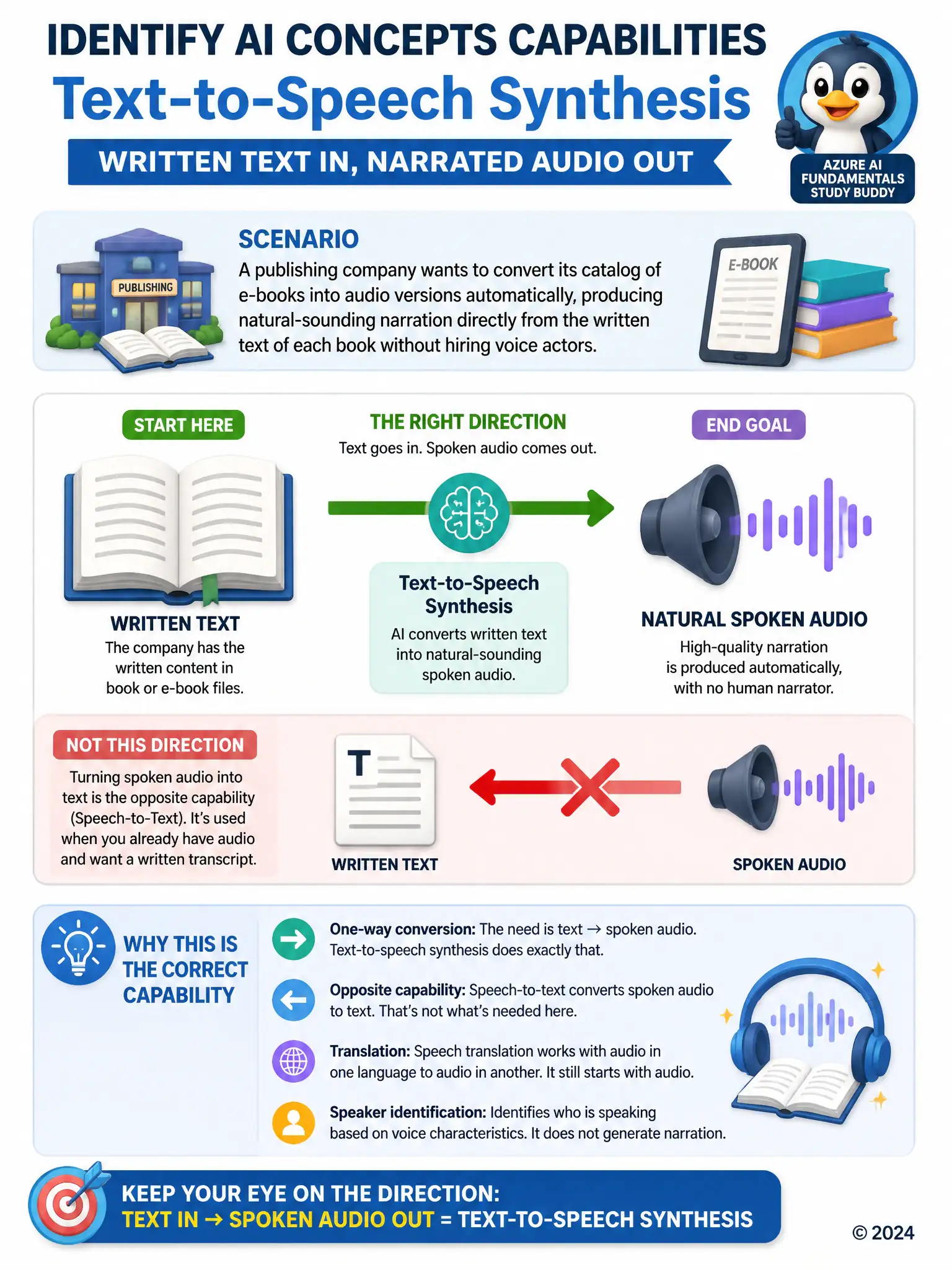
You start with written text and need spoken audio, so you want text-to-speech synthesis. It converts written words into natural-sounding narration without a human voice actor. The other capabilities either go the wrong direction, need existing audio, or identify speakers instead of creating narration.
Full Explanation
Text-to-speech synthesis is the correct capability because it takes written text as input and generates natural-sounding spoken audio as output, which is precisely the direction of conversion the publishing company needs to turn its written e-book catalog into narrated audio versions. Speech-to-text transcription is incorrect because it runs in the opposite direction, converting spoken audio into written text, which would be relevant if the company already had audio and wanted a transcript, not the other way around. Speech translation is incorrect because it converts spoken audio from one language into spoken or written output in another language; it assumes an audio source already exists and focuses on crossing languages, neither of which matches converting existing written text into narrated audio in the same language. Speaker recognition is incorrect because it identifies or verifies who is speaking based on voice characteristics, which is useful for authentication or diarization scenarios but has no role in generating new narration from written text. Since the company's need is written text in, natural spoken audio out, text-to-speech synthesis is the matching capability.