
A media monitoring service ingests thousands of news articles per day and needs to automatically pull out the specific companies, people, and locations mentioned in each article so analysts can search and filter by those entities later. Which natural language processing capability should the service use?
Select an answer to reveal the explanation.
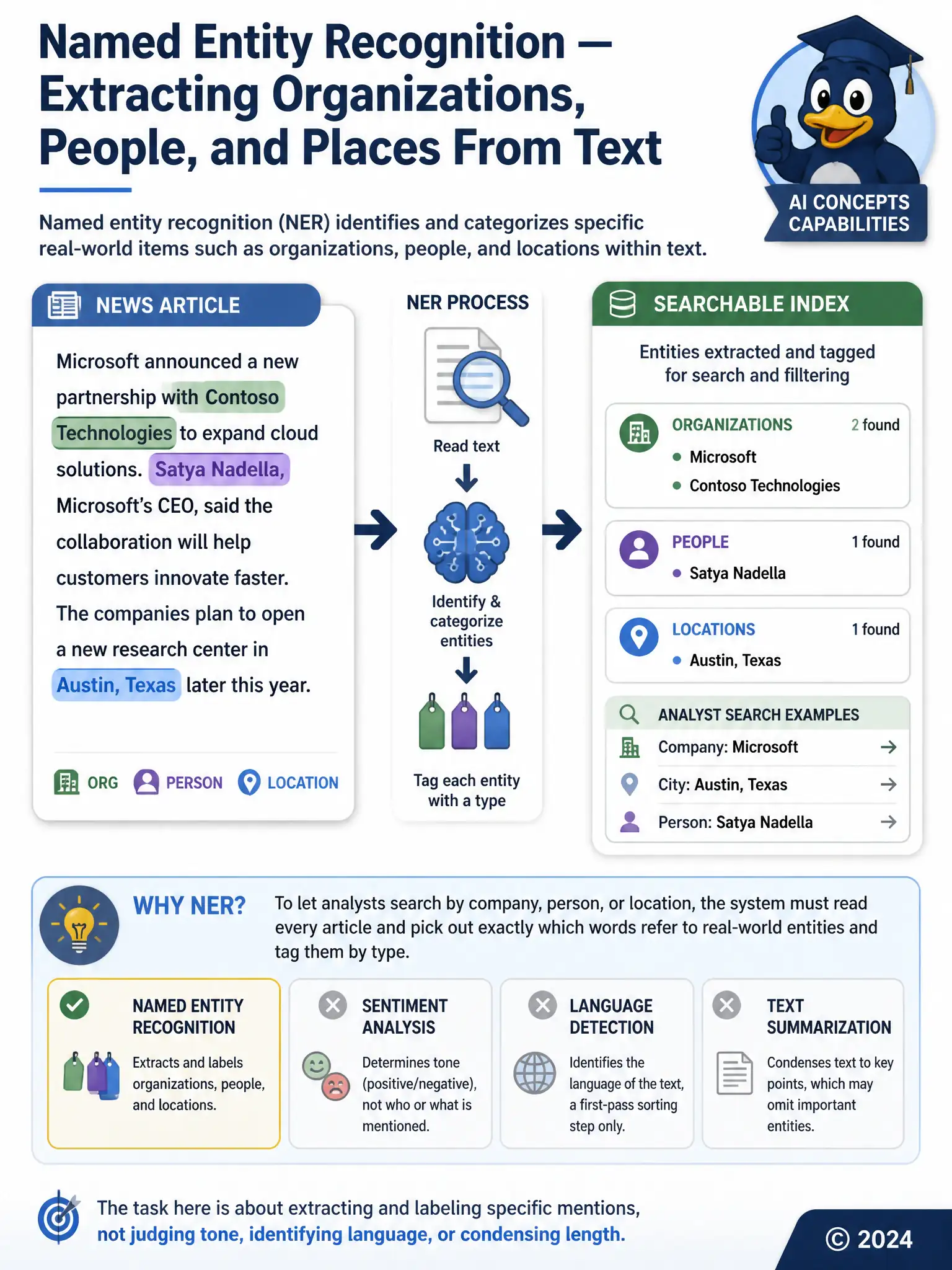
Short Explanation
You need named entity recognition—it scans the article and tags real-world items like companies, people, and places. That's what lets analysts search and filter by those entities, not tone, language, or a summary.
Full Explanation
The correct answer is named entity recognition. Named entity recognition is the natural language processing capability built specifically to scan text and identify and categorize real-world items such as organizations, people, and locations, which is exactly what the service needs in order to let analysts search and filter articles by those entities. The sentiment analysis option is incorrect because sentiment analysis produces a positive, negative, or neutral tone score for a passage of text; it says nothing about which specific companies, people, or places are mentioned, so it cannot power entity-based search and filtering. The language detection option is incorrect because language detection only identifies which natural language an article is written in, such as English or Spanish, which is unrelated to pulling out the entities mentioned inside the article's content. The text summarization option is incorrect because text summarization condenses an article into a shorter version of its key points, but a summary does not reliably enumerate every organization, person, and location mentioned in a structured, searchable way, which is what the analysts specifically require. Because the task is extracting and categorizing specific real-world mentions from free text, named entity recognition is the fitting capability.