
A data science team receives a large set of customer transaction records with no labels indicating which customers belong to which segment and no flags marking which transactions are fraudulent. The team wants to use unsupervised machine learning to group customers into naturally occurring segments based on purchasing behavior, and separately to identify transactions that deviate sharply from typical patterns without being told in advance what fraud looks like. Which two techniques should the team apply? (Select TWO.)
Select all correct answers, then click Submit.
Short Explanation
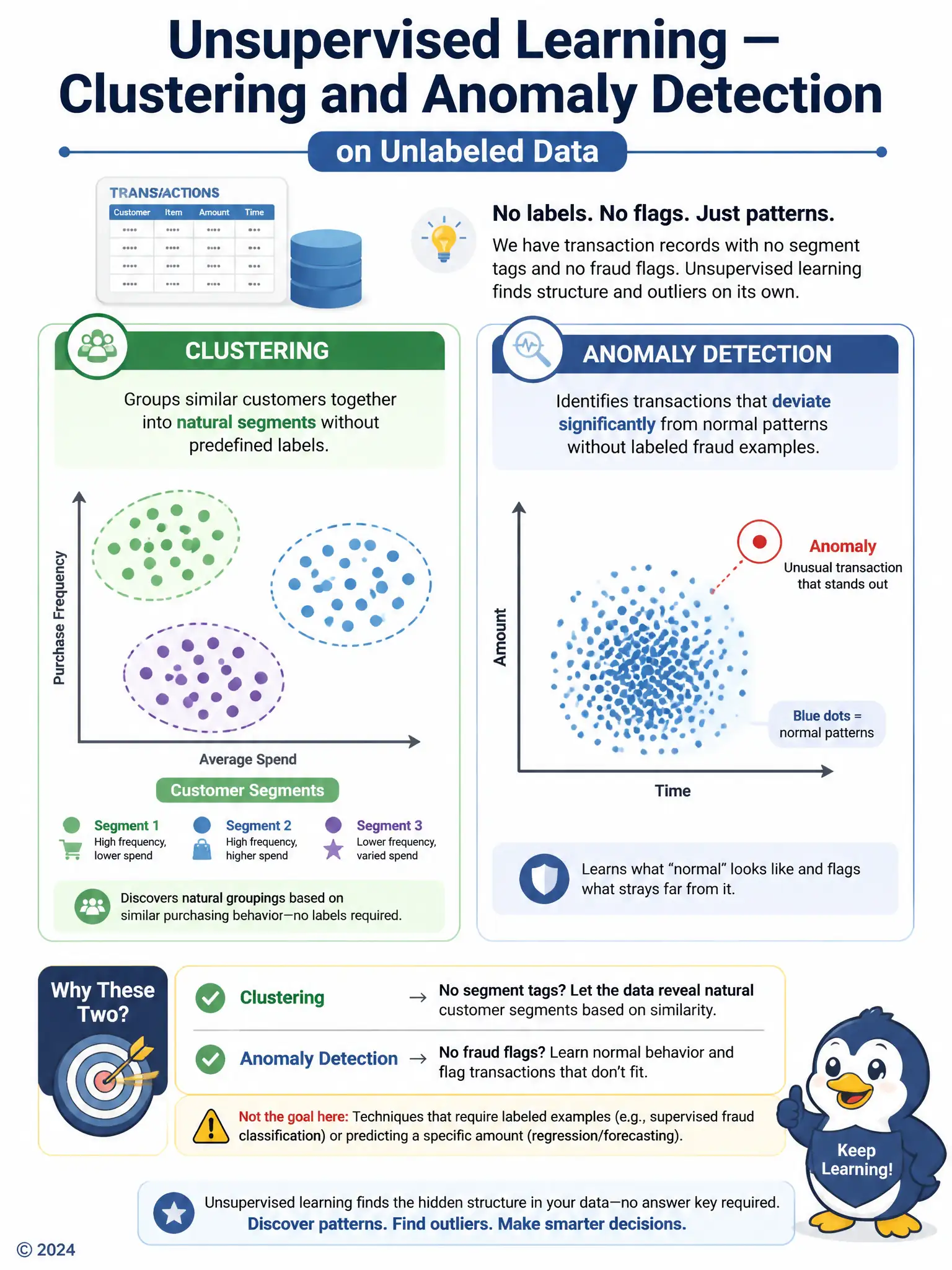
You have no labels, so you need methods that find structure on their own. Clustering groups similar customers without predefined segments, and anomaly detection flags transactions that stray from normal patterns without fraud examples. Anything that needs a labeled answer key is the wrong fit.
Full Explanation
The correct techniques are clustering and anomaly detection. Clustering is the unsupervised technique that groups customers into naturally occurring segments purely from similarity in their purchasing behavior, with no predefined segment labels required, which matches the team's first goal. Anomaly detection is the unsupervised technique that learns what typical transaction patterns look like and flags records that deviate sharply from that norm, without needing any transactions pre-labeled as fraudulent, which matches the team's second goal. The classification approach that assigns each transaction to a fraud or not-fraud category using a model trained on examples labeled by analysts is incorrect because classification is a supervised technique that requires a training set of transactions already labeled fraud or not-fraud by analysts, and the scenario explicitly states no such fraud flags exist in the data. The regression approach that predicts a specific continuous dollar amount each customer is expected to spend next month is incorrect because regression is also a supervised technique used to predict a specific continuous numeric value, such as next month's spending, and it addresses a forecasting goal that was never mentioned in the scenario, rather than the segmentation or anomaly-detection goals actually described. The trap here is reaching for techniques that sound related but actually require a labeled answer key to work. Because both stated goals involve discovering structure in unlabeled data rather than predicting a known target, clustering and anomaly detection are the appropriate pair.