
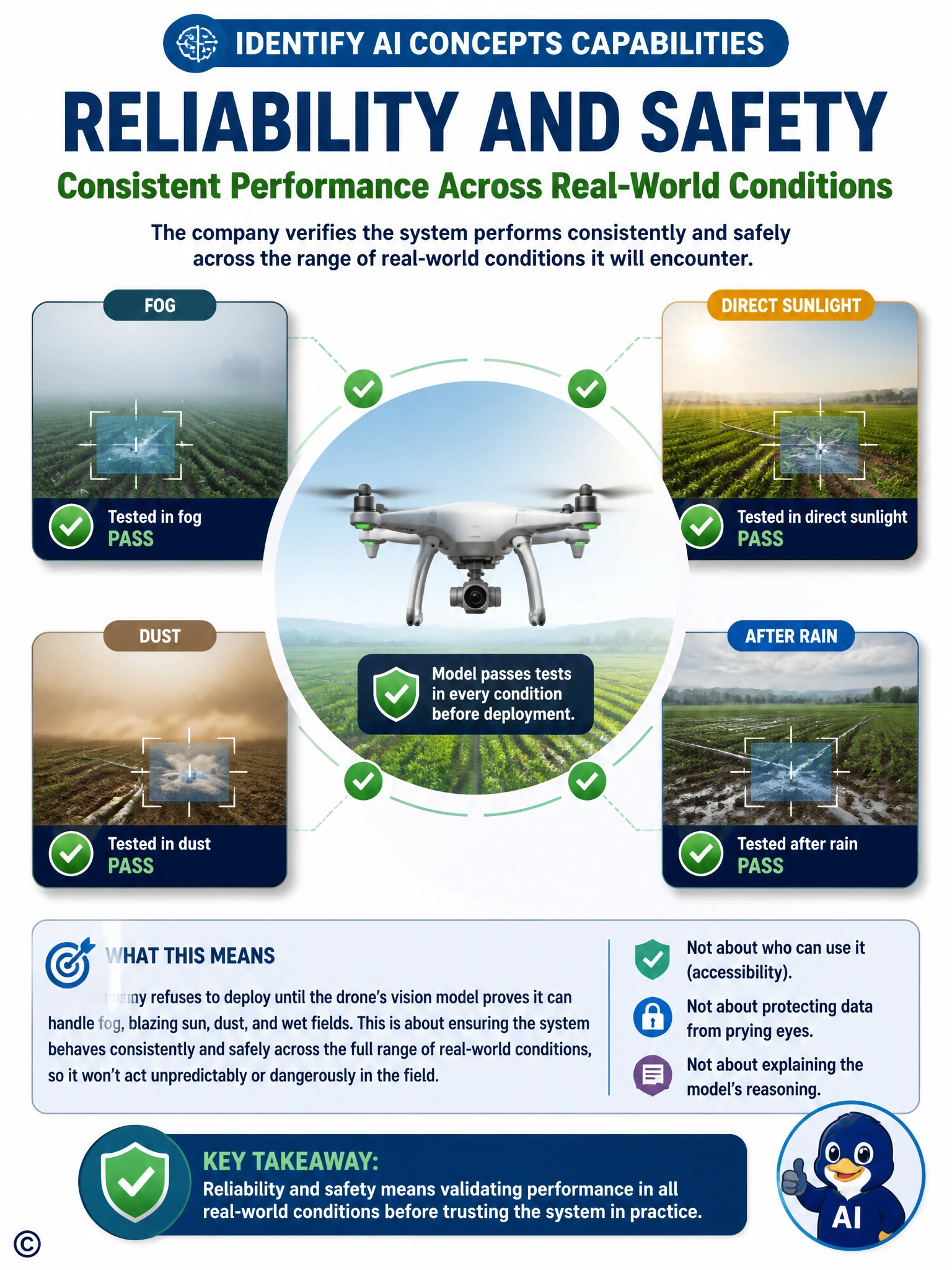
An agricultural technology company builds a computer vision model that runs on drones to identify irrigation leaks in farm fields. Before allowing the drones to operate over active fields, the company tests the model against thousands of images captured in fog, direct sunlight, dust, and after recent rain, and refuses to deploy it until it performs consistently across all of those conditions. Which responsible AI principle does this practice primarily reflect?
Select an answer to reveal the explanation.
Short Explanation
Picture a company refusing to fly its drones over a real farm until the vision model has already proven it can handle fog, blazing sun, dust clouds, and wet fields after a storm. That is not about who gets to use the tool or how the results are explained afterward. It's about whether the thing behaves the same way, dependably, no matter what the sky throws at it. That is the core idea behind ensuring a system is dependable and won't behave unpredictably or dangerously once it's actually out in the world doing its job. Don't confuse this with making a tool accessible to a broad range of users, which is a completely different concern about who can use something and how. It also isn't about locking down collected data from prying eyes, since nothing here touches data protection at all. And it isn't about explaining the model's reasoning to the people it affects, since the company isn't publishing documentation here, it's stress-testing performance before trusting the system with real operations.
Full Explanation
The correct answer is C. Reliability and safety is the principle that concerns whether an AI system performs consistently and predictably under the real-world conditions it will face, and extensively testing the drone's vision model across fog, sunlight, dust, and rain before deployment is a direct demonstration of that principle in practice. Option A is incorrect because inclusiveness concerns designing a system so people with diverse abilities, backgrounds, and circumstances can use and benefit from it, which is a different concern from whether the model performs consistently across environmental imaging conditions. Option B is incorrect because nothing in the scenario involves protecting collected data from unauthorized access or misuse; the testing described is about performance robustness, not data protection. Option D is incorrect because transparency concerns communicating how and why a system reaches its outputs to the people affected by it, such as documentation or explanations, and the scenario describes performance validation testing rather than any effort to explain the model's reasoning. The company's pre-deployment testing regimen is squarely a reliability and safety practice.