
A software company deploys a generative AI chatbot to answer customer questions about its own product line. To reduce the chance that the chatbot invents a feature or a return-policy detail that does not actually exist, the engineering team configures it to first retrieve relevant passages from the company's current product manuals and support articles, then instructs the model to base its answer only on those retrieved passages. What is this technique called?
Select an answer to reveal the explanation.
Short Explanation
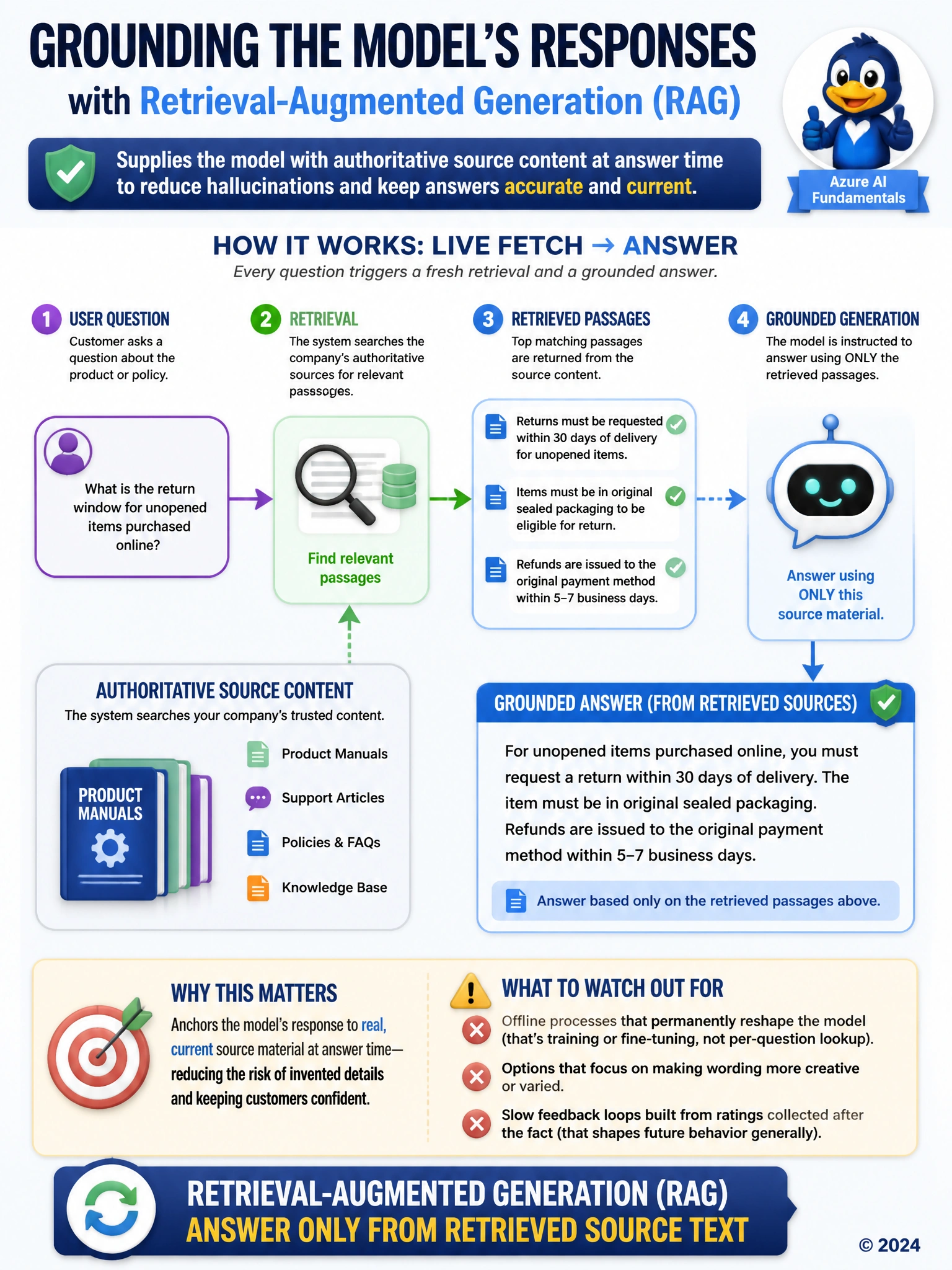
Notice the exact sequence here: before the chatbot answers, the system goes and fetches the relevant pages from the company's own manuals and support articles, then tells the model, answer using only this material. That live fetch-then-answer pattern, done fresh for every single question, is the giveaway. It's a way of anchoring the model's response to real, current source material instead of letting it rely purely on whatever it absorbed during training, which is exactly what keeps it from confidently inventing a feature or policy detail that was never true. Watch out for options describing something that happens once, ahead of time, by permanently reshaping the model itself, since that's a heavier, offline process, not a per-question lookup. Also be wary of anything that talks about making the model's wording more varied or creative, since that pulls in the opposite direction, and anything describing a slow feedback loop built from ratings collected after the fact, since that shapes future behavior generally rather than grounding one specific answer in one specific source right now.
Full Explanation
The correct answer is D. Retrieving relevant passages from the company's own manuals and support articles at the moment a question is asked, then instructing the model to answer using only that retrieved content, is grounding through retrieval-augmented generation, and it directly addresses the invented-detail problem because the model's answer is anchored to real, current source text rather than relying solely on what it learned during training. Option A is incorrect because fine-tuning permanently adjusts the model's internal weights ahead of time using a training process, which is a different, more expensive approach than retrieving fresh passages at answer time, and the scenario describes retrieval happening live for each question, not weight updates. Option B is incorrect because temperature controls how varied or random the model's word choices are, and increasing it would make invented details more likely, not less, which is the opposite of what the team is trying to achieve. Option C is incorrect because reinforcement learning from human feedback is a training-time technique that adjusts model behavior using human ratings collected over time, not a mechanism for supplying source content at the moment a specific question is answered. The scenario's live retrieve-then-answer pattern is the defining signature of grounding.