
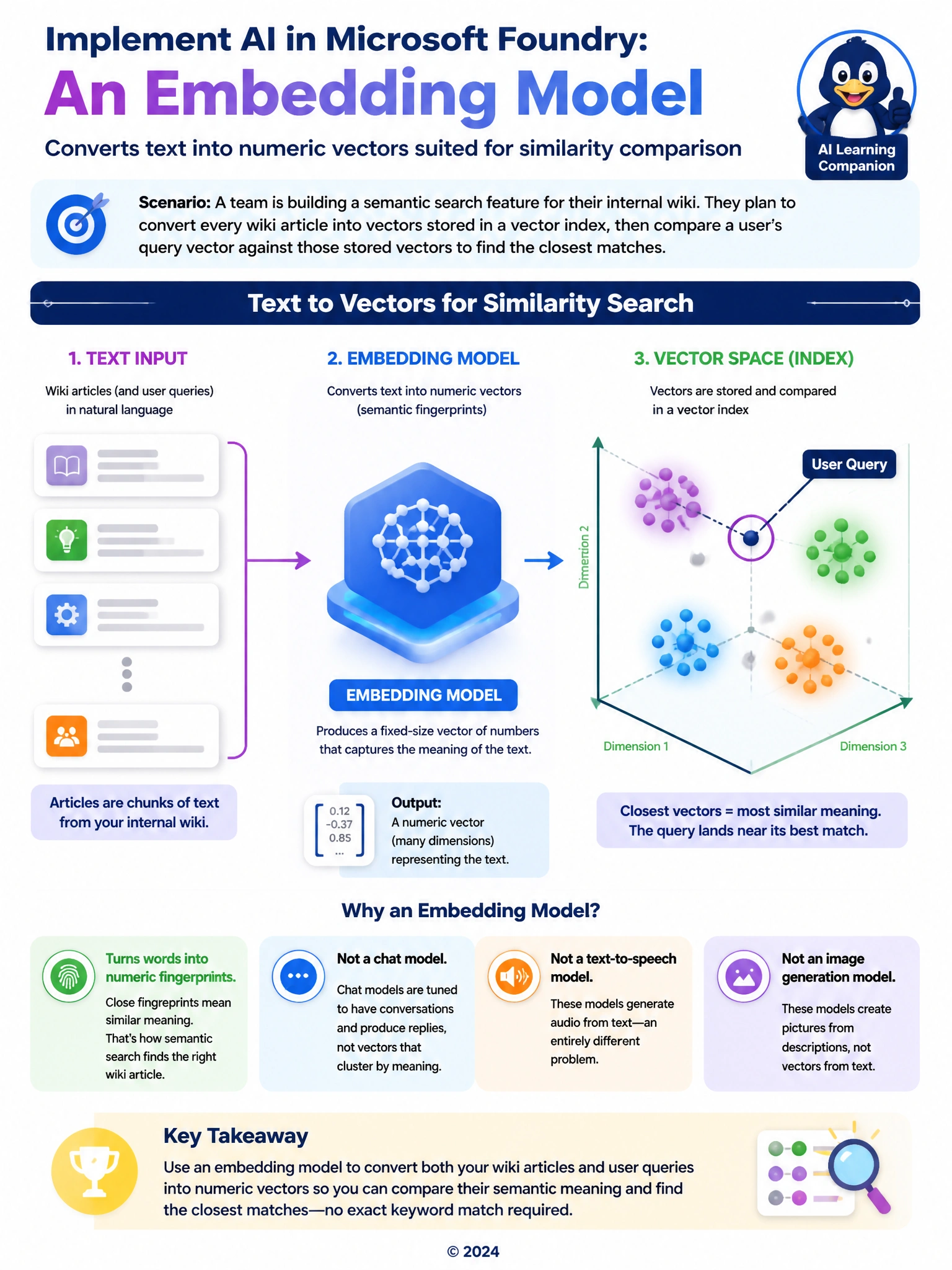
A team is building a semantic search feature for their internal wiki. They plan to convert every wiki article into vectors stored in a vector index, then compare a user's query vector against those stored vectors to find the closest matches. When browsing the Foundry model catalog, which type of model should they select to generate these vectors?
Select an answer to reveal the explanation.
Short Explanation
The job here is turning words into a kind of numeric fingerprint, close fingerprints mean similar meaning, so that a search can find the right wiki article by comparing fingerprints instead of matching exact words. That is a very specific job, and not every model in the catalog does it. A model built for holding a conversation is tuned to produce good replies, not tuned to produce fingerprints that cluster by meaning. A model that turns text into speech is solving an entirely different problem, audio instead of vectors. And a model that generates pictures from a description is even further off, it is not working with the wiki's text at all. What this team needs is the category of model specifically designed to output those numeric vectors, so that the same kind of fingerprint gets created for both the stored articles and the incoming search query, which is what lets the closest matches actually be found.
Full Explanation
The correct answer is A. An embedding model is purpose-built to convert text into numeric vectors positioned so that semantically similar content ends up close together in vector space, which is exactly what a search feature needs when comparing a user's query against every stored wiki article. Option B is incorrect because a chat completion model is optimized to generate natural-language replies to a conversation, not to produce vectors tuned for similarity comparison, so using it for this step would be working against its intended purpose. Option C is incorrect because a text-to-speech model converts written text into audio and has no role in producing searchable vector representations. Option D is incorrect because an image generation model produces pictures from text prompts, which addresses a completely different modality and has nothing to do with indexing written wiki content for search. Selecting the right model type from the catalog matters because each category is trained and optimized for a distinct job; picking an embedding model here ensures the vectors stored in the index and the vector generated from a user's query were produced the same way, which is what makes accurate similarity matching possible.