
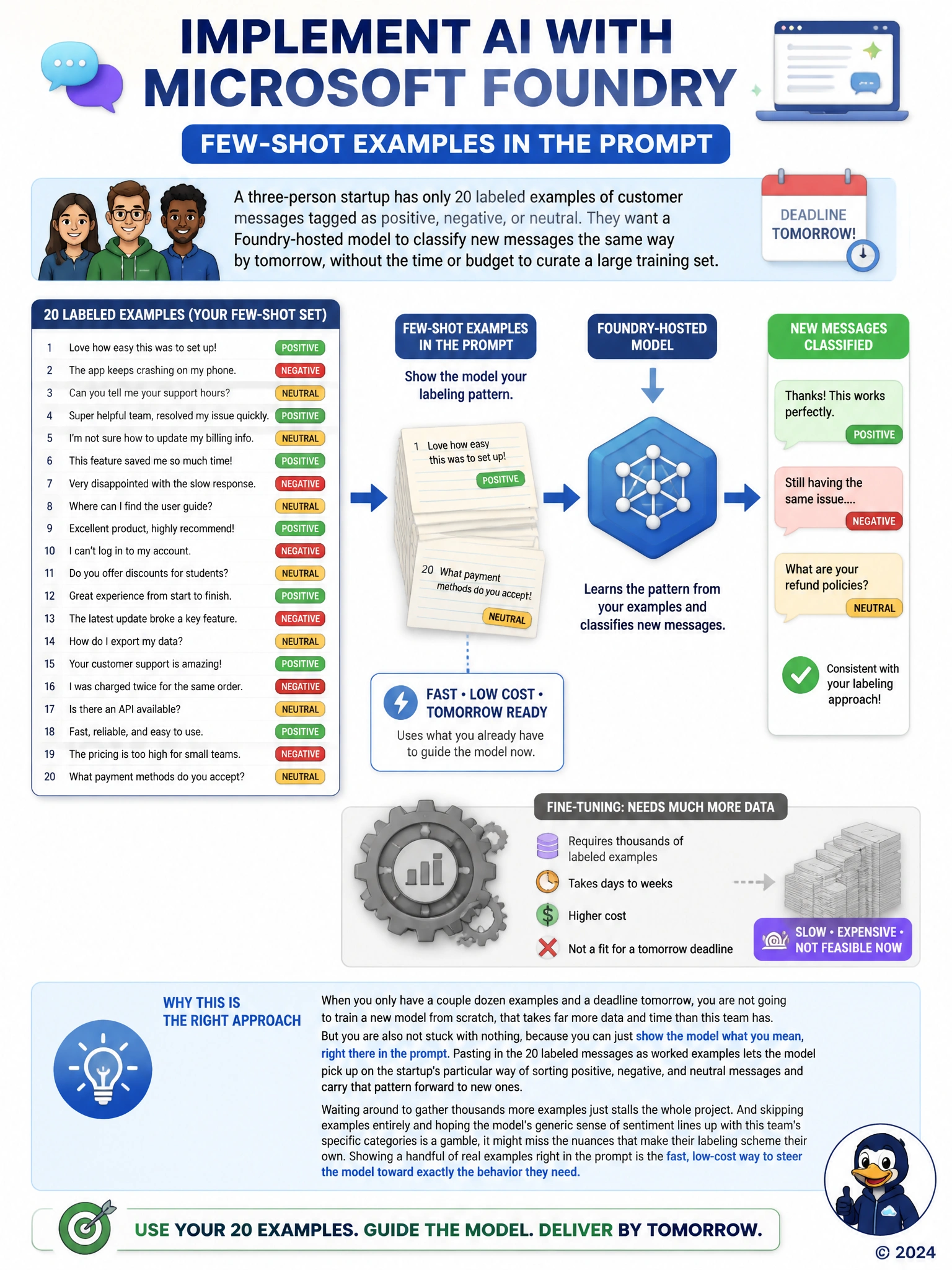
A three-person startup has only 20 labeled examples of customer messages tagged as positive, negative, or neutral. They want a Foundry-hosted model to classify new messages the same way by tomorrow, without the time or budget to curate a large training set. Which approach best fits their constraints?
Select an answer to reveal the explanation.
Short Explanation
When you only have a couple dozen examples and a deadline tomorrow, you are not going to train a new model from scratch, that takes far more data and time than this team has. But you are also not stuck with nothing, because you can just show the model what you mean, right there in the prompt. Pasting in the 20 labeled messages as worked examples lets the model pick up on the startup's particular way of sorting positive, negative, and neutral messages and carry that pattern forward to new ones. Waiting around to gather thousands more examples just stalls the whole project. And skipping examples entirely and hoping the model's generic sense of sentiment lines up with this team's specific categories is a gamble, it might miss the nuances that make their labeling scheme their own. Showing a handful of real examples right in the prompt is the fast, low-cost way to steer the model toward exactly the behavior they need.
Full Explanation
The correct answer is D. Placing the 20 labeled examples directly in the prompt as few-shot examples lets the model infer the startup's specific labeling pattern from real demonstrations and apply it to new messages immediately, without any separate training step, which fits both the tight timeline and the small budget. Option A is incorrect because fine-tuning a custom model typically needs a much larger labeled dataset than 20 examples to reliably learn a pattern, and it also takes more time and compute than the startup can spend before tomorrow. Option B is incorrect because waiting to collect thousands of examples abandons the deadline entirely and is not a solution to the problem as stated. Option C is incorrect because zero-shot prompting gives the model no examples of how this particular startup wants messages labeled, so it falls back on generic notions of sentiment that may not match their specific categories or edge cases, producing less consistent results than showing the model real, labeled examples. Few-shot prompting is well suited to exactly this situation: a small number of representative examples, included right in the prompt, that steer the model's behavior without the overhead of training a new model from scratch.