
A health-system team is preparing to launch a Foundry-hosted symptom-checker chatbot for patients. Because incorrect guidance could lead to real harm, the team wants both an automated check for unsafe content and a safeguard that catches subtler clinical errors an automated filter would miss. (Select TWO.) Which two practices should they put in place before general release?
Select all correct answers, then click Submit.
Short Explanation
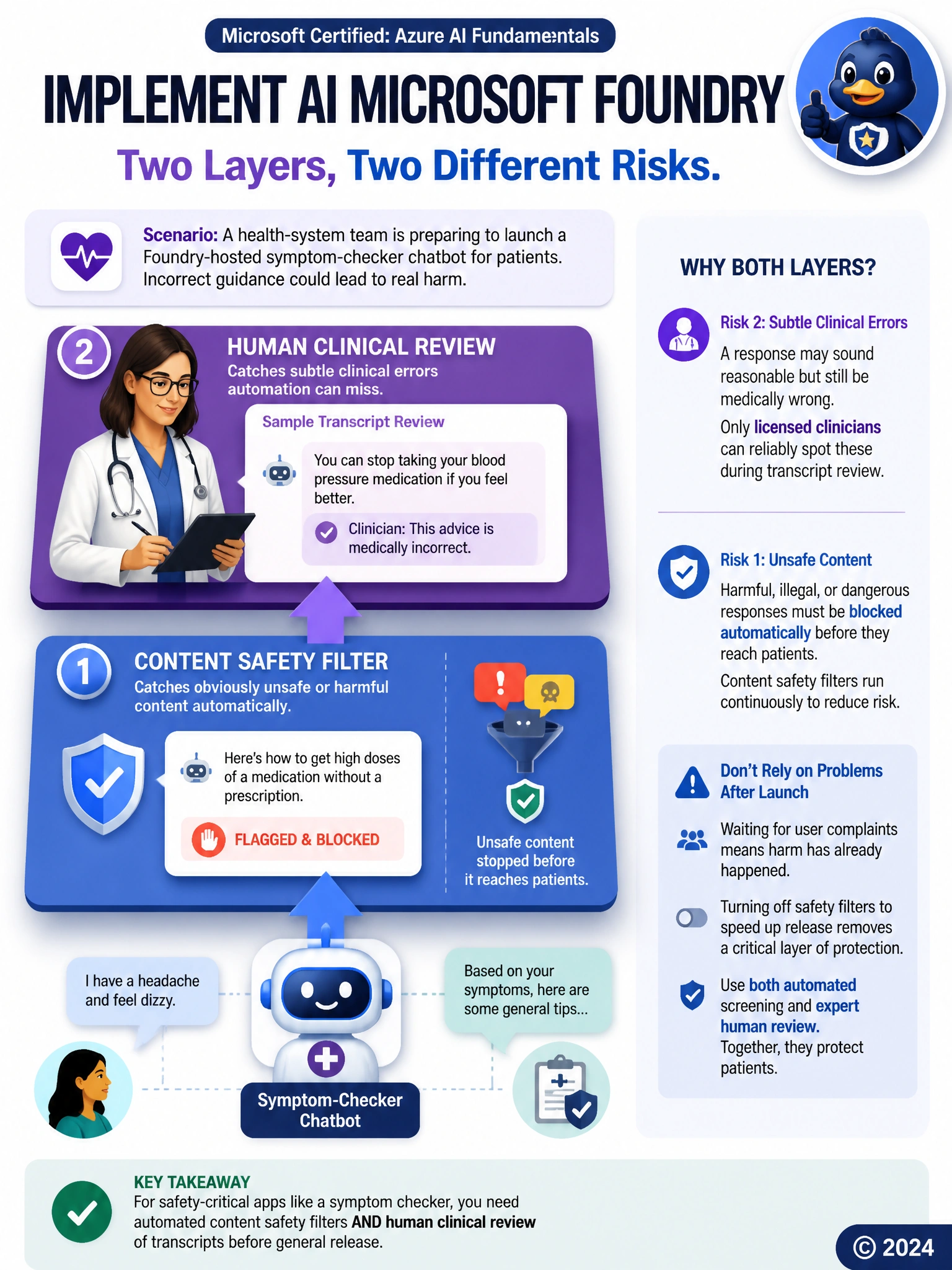
For something like a symptom checker, there are really two different kinds of mistakes to worry about, and no single safeguard catches both. One kind is the obviously unsafe response, the sort of thing an automated filter is built to catch and block before it ever reaches a patient. The other kind is more subtle, a piece of guidance that sounds reasonable but is actually medically off, and that is the kind of error only someone with real clinical training is going to reliably spot. So this team needs both an automated check running continuously and a set of clinician eyes reviewing real transcripts before the wider rollout. Waiting to hear about problems from unhappy users only after launch means the harm has already happened by the time anyone notices. And turning off the automated filter to speed things up just removes a layer of protection in a setting where a bad answer carries real stakes. Automated screening plus expert human review, together, is what actually covers both kinds of risk here.
Full Explanation
The correct answers are A and D. Running the deployment's content safety filters gives an automated, consistent first line of defense that flags or blocks clearly harmful or unsafe output before it reaches a patient, while having licensed clinicians review a sample of transcripts catches the subtler kind of mistake an automated filter is not equipped to judge, whether a piece of medical guidance is actually accurate and appropriate, not just whether it contains obviously unsafe language. Option B is incorrect because waiting for user complaints after launch is a purely reactive approach; by the time a complaint arrives, a patient may already have acted on incorrect guidance, so it does nothing to prevent harm before it happens. Option C is incorrect because disabling content filtering removes an automated safeguard specifically to gain speed, trading away a meaningful layer of protection in a domain where an unsafe response carries real consequences, which is the opposite of what a symptom-checker launch should prioritize. Combining automated content safety checks with human clinical review addresses two different kinds of risk, one catching broadly unsafe content at scale and the other catching domain-specific accuracy problems, which together give this team a stronger safety net than either measure alone before they open the chatbot to the wider patient population.