
A customer support team's Foundry-hosted chatbot keeps the entire conversation history in every request so it can remember earlier turns. On long support sessions that run for dozens of messages, the assistant begins returning errors indicating the request exceeds the model's context limit, and some replies start ignoring details mentioned early in the conversation. What should the team do to keep long conversations working reliably?
Select an answer to reveal the explanation.
Short Explanation
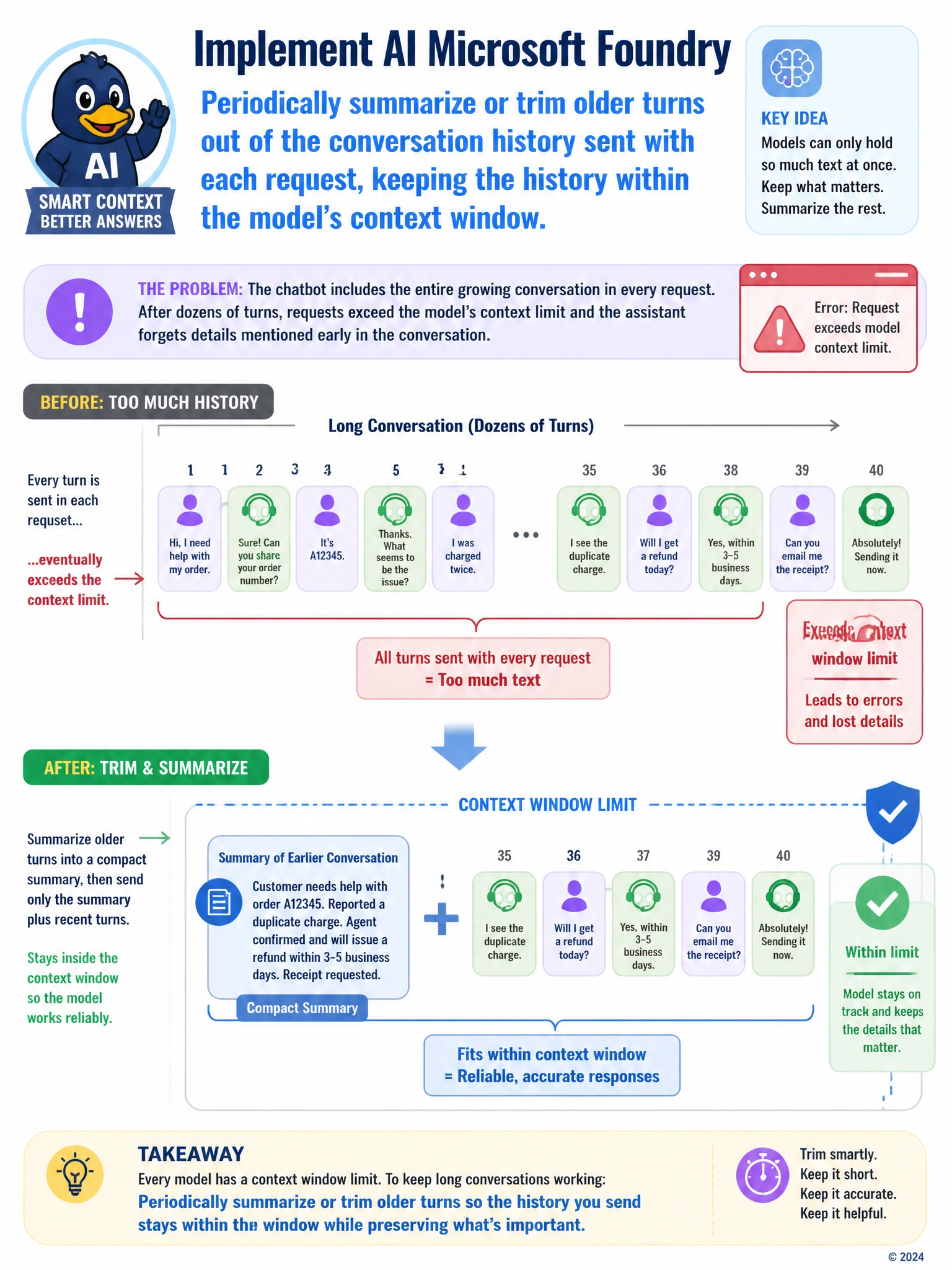
Every model can only hold so much text in its head at once for a single request, and stuffing the entire growing conversation into every message eventually overflows that limit, which is exactly the error the team is seeing along with the assistant losing track of things said early on. The fix is to manage what actually gets sent each time: summarize or drop older turns so the running history stays within what the model can hold, while keeping the details that still matter. The other options solve different problems entirely. Adjusting how strictly harmful content gets filtered has nothing to do with how much total text fits in a request. Making the model's wording more random doesn't give it access to information that simply isn't there anymore. And filing away the full transcript somewhere for later search is a fine idea for other purposes, but it doesn't shrink what's being sent in the live request right now. Long conversations need active trimming or summarizing, not a safety or randomness tweak.
Full Explanation
The correct answer is D. Every model has a fixed context window measured in tokens, and sending the full, ever-growing history eventually exceeds that limit; summarizing or trimming older turns keeps the request within the window while preserving the important details from earlier in the conversation, which resolves both the errors and the dropped-detail problem. Option A is incorrect because content safety severity thresholds control which categories of harmful content get filtered; they have no relationship to how many tokens a request contains and would not prevent a context-limit error. Option B is incorrect because temperature affects how varied or random the model's word choices are, not how much information it can access; raising it does not let the model recall details that were never included in the current request, and can make responses less reliable. Option C is incorrect because storing the raw transcript in a vector index is useful for later retrieval or search, but the team's immediate problem is that too much text is being sent in each live request; simply archiving the transcript elsewhere does not by itself reduce what gets sent to the model unless it is paired with a retrieval and trimming strategy. Managing the active history sent per request is the direct fix.