
A company deploys a Foundry-hosted assistant to screen incoming job applications and generate a shortlist recommendation for recruiters. During a fairness review, the team finds the assistant recommends candidates from certain universities and backgrounds at a noticeably higher rate than others, even when qualifications are similar. Which two actions should the team take to responsibly address this before continuing to use the assistant in hiring decisions? (Select TWO.)
Select all correct answers, then click Submit.
Short Explanation
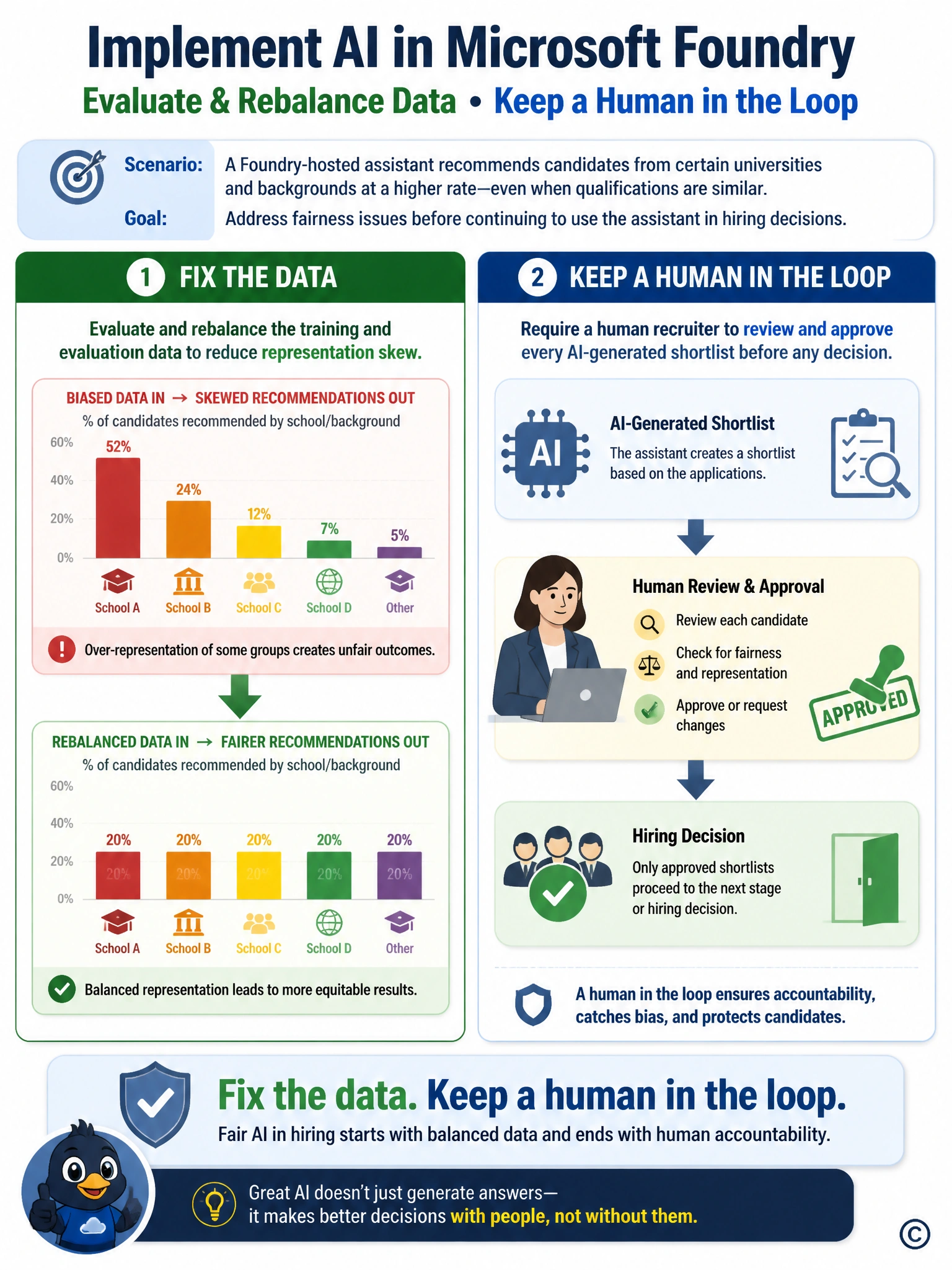
When a screening tool starts favoring certain schools or backgrounds even among equally qualified candidates, that's a signal the problem lives in what the system learned from and how much unchecked authority it has, not in how it phrases things. So the real fixes work on those two fronts: dig into the data driving the recommendations and correct the skew that's causing similar candidates to be treated differently, and put a person in the loop who has to actually look at and approve every shortlist before it touches a real hiring decision, so a biased pick gets caught rather than acted on automatically. Making the assistant's picks more random doesn't correct a systematic skew, it just adds noise on top of the same underlying problem. And trimming how much explanation text comes back has nothing to do with which candidates get recommended in the first place. Fairness problems in a high-stakes tool like hiring get solved by fixing what's feeding the recommendations and by keeping a human accountable for the final call, not by cosmetic generation settings.
Full Explanation
The correct answers are A and B. Evaluating and rebalancing the data behind the recommendations directly targets the root cause the fairness review uncovered, which is skewed representation driving unequal outcomes for similarly qualified candidates, and it aligns with the responsible AI principle of fairness that Foundry deployments in high-stakes areas like hiring are expected to follow. Requiring a human recruiter to review and approve every AI-generated shortlist adds the human oversight that responsible AI guidance calls for in consequential decisions, catching biased recommendations before they affect a real candidate's outcome. Option C is incorrect because increasing temperature only makes the model's wording and specific picks more varied or random; it does not address why certain universities or backgrounds are systematically favored, and could even make outcomes less predictable without fixing the underlying skew. Option D is incorrect because shortening response length changes how much explanation text is generated, not which candidates get recommended or why, so it has no effect on the fairness problem the review identified. Bias in a hiring tool has to be addressed at the data and oversight level, not through generation-length or randomness settings, which is why the two data-and-review actions are the ones that responsibly address the finding.