
A team uses a general-purpose Foundry model to classify incoming emails as either urgent or not urgent and feed that label into an automated routing system. During testing, the same email sometimes gets classified differently on repeated runs, which breaks the routing logic downstream. Without changing the model or retraining anything, what should the team adjust to make the classification output more consistent across repeated runs?
Select an answer to reveal the explanation.
Short Explanation
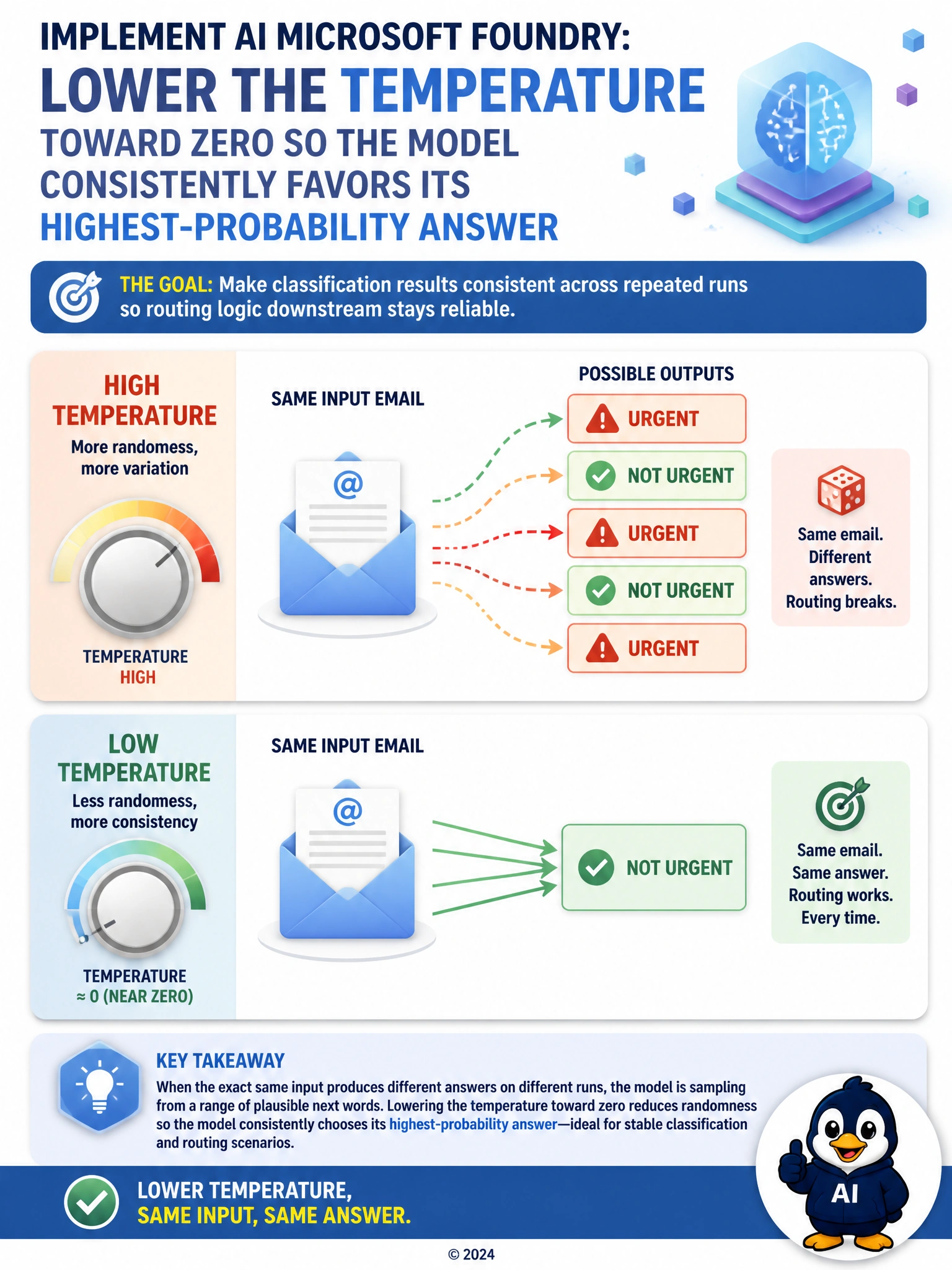
The clue here is that the exact same input is producing different answers on different runs, and that's a sign the model is sampling from a range of plausible next words instead of always picking its single most confident guess. There's a dial for exactly that behavior: turn it down toward zero, and the model stops rolling the dice on wording and just goes with whatever it's most sure about every time, which is what a routing system that depends on a stable label actually needs. None of the other knobs touch that problem. Letting the model write a longer response doesn't make its underlying choice more repeatable. A safety filter is built to catch harmful language, not flaky labels, so it wouldn't even notice the inconsistency. And swapping out the component used for finding similar text elsewhere has nothing to do with how confidently the model commits to an answer in this classification task. When repeat runs disagree, the fix is turning down randomness, not touching search or safety settings.
Full Explanation
The correct answer is C. Temperature controls how much randomness the model introduces when choosing among likely next words; lowering it toward zero makes the model consistently pick its highest-probability output instead of sampling more varied alternatives, which is exactly what the team needs for a binary classification label that must stay stable across repeated runs on the same input. Option A is incorrect because the maximum token limit only controls how long a response can be, and a longer allowed response does nothing to make the underlying word or label choice more deterministic. Option B is incorrect because content safety filters detect harmful content categories like hate speech or violence; they have no role in enforcing consistency of a classification label and would not catch or fix varying urgent or not-urgent outputs. Option D is incorrect because embedding models are used to represent text for similarity search or retrieval tasks, not to generate the classification label itself in this chat-style setup, so changing the embedding model would not affect the variability the team is observing. Adjusting temperature is the direct, no-retraining fix for output consistency.