
A European healthcare provider wants to deploy a Foundry-hosted assistant that processes patient intake notes, and its legal team requires that patient data never leave the European Union at any point in processing, per GDPR obligations. What should the team do when creating the Foundry resource and model deployment?
Select an answer to reveal the explanation.
Short Explanation
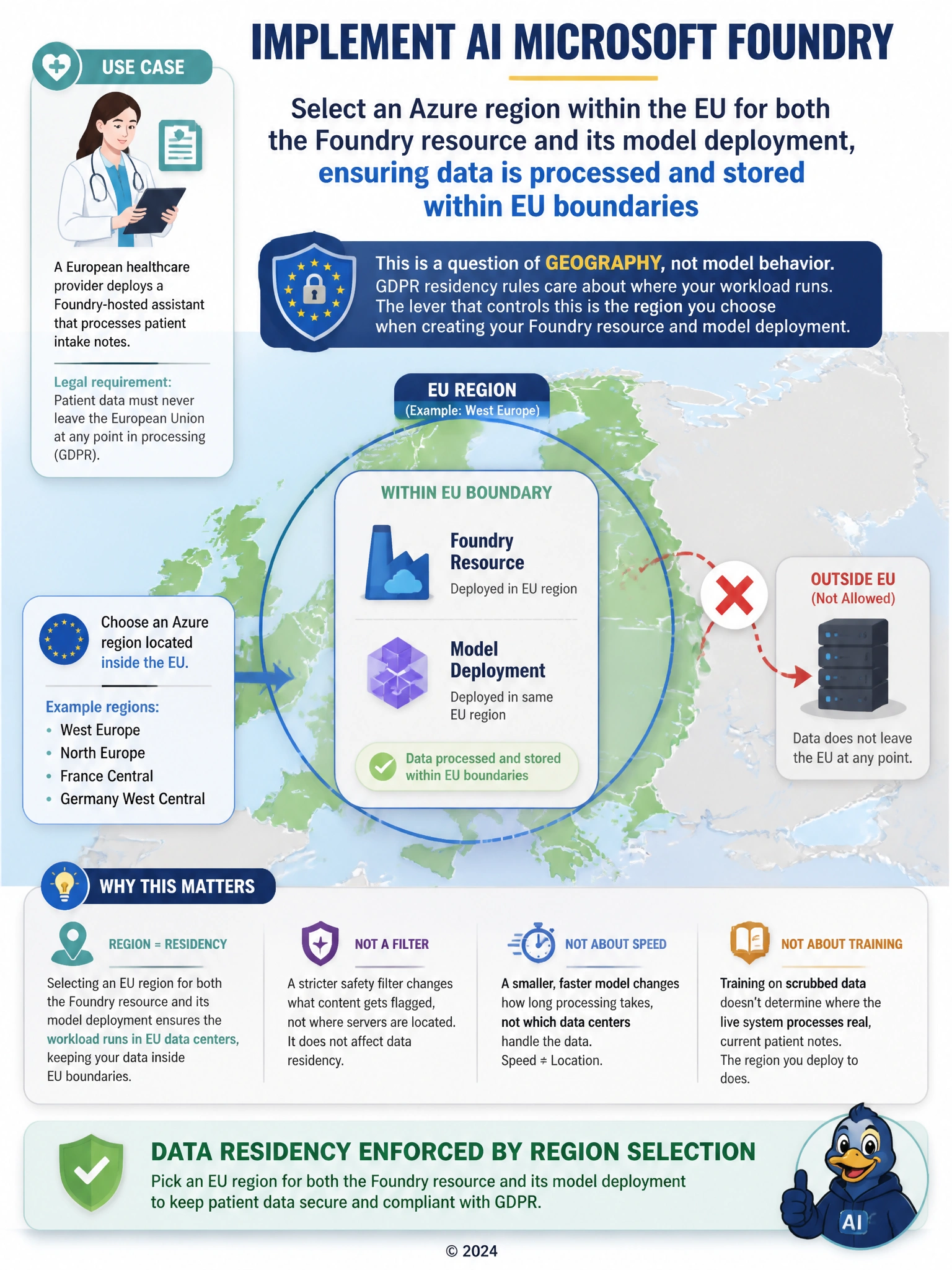
This is really a question of geography, not model behavior. GDPR residency rules care about which physical region a workload runs in, and the one lever that controls that is picking where the Foundry resource and its deployment actually live when you set them up; choose a region inside the EU, and the data processing stays inside the EU. None of the other options touch that lever at all. A stricter safety filter changes what content gets flagged, not where servers are located. A smaller, quicker model changes how long processing takes, not which country's data centers it runs in, since speed and location are unrelated. And training a version of the model on scrubbed data still leaves the live system needing to handle real, current patient notes somewhere, and that somewhere is still determined by the region chosen at deployment, not by what the model was trained on. Residency requirements get solved at the infrastructure layer, by region selection, not by tuning the model.
Full Explanation
The correct answer is B. Choosing an EU-based Azure region for both the Foundry resource and the model deployment keeps data processing and storage within EU boundaries, which is the direct, supported way to satisfy a data residency requirement tied to GDPR. Option A is incorrect because content filtering screens generated and submitted text for harmful content categories; it has no bearing on which geographic region processes or stores the data, so it does nothing to satisfy a residency requirement. Option C is incorrect because model size and speed affect latency and cost, not where the computation physically occurs; a faster model deployed in a non-EU region would still violate the residency requirement regardless of how briefly the data is in transit. Option D is incorrect because fine-tuning on anonymized data might reduce exposure of specific patient identities during training, but the live deployment still needs to process real, current patient intake notes to be useful, and fine-tuning does not control which region that live processing happens in. Region selection at resource creation time is the mechanism that actually determines data residency, and it is the step the legal team's requirement is really about.