
A platform aimed at teenagers hosts a Foundry-powered writing assistant that helps users draft short fiction. The moderation team wants to strictly block sexual content and self-harm content at the lowest severity threshold, while still allowing mild fictional violence such as a sword fight in an adventure story to pass through. Which content safety configuration approach fits this requirement?
Select an answer to reveal the explanation.
Short Explanation
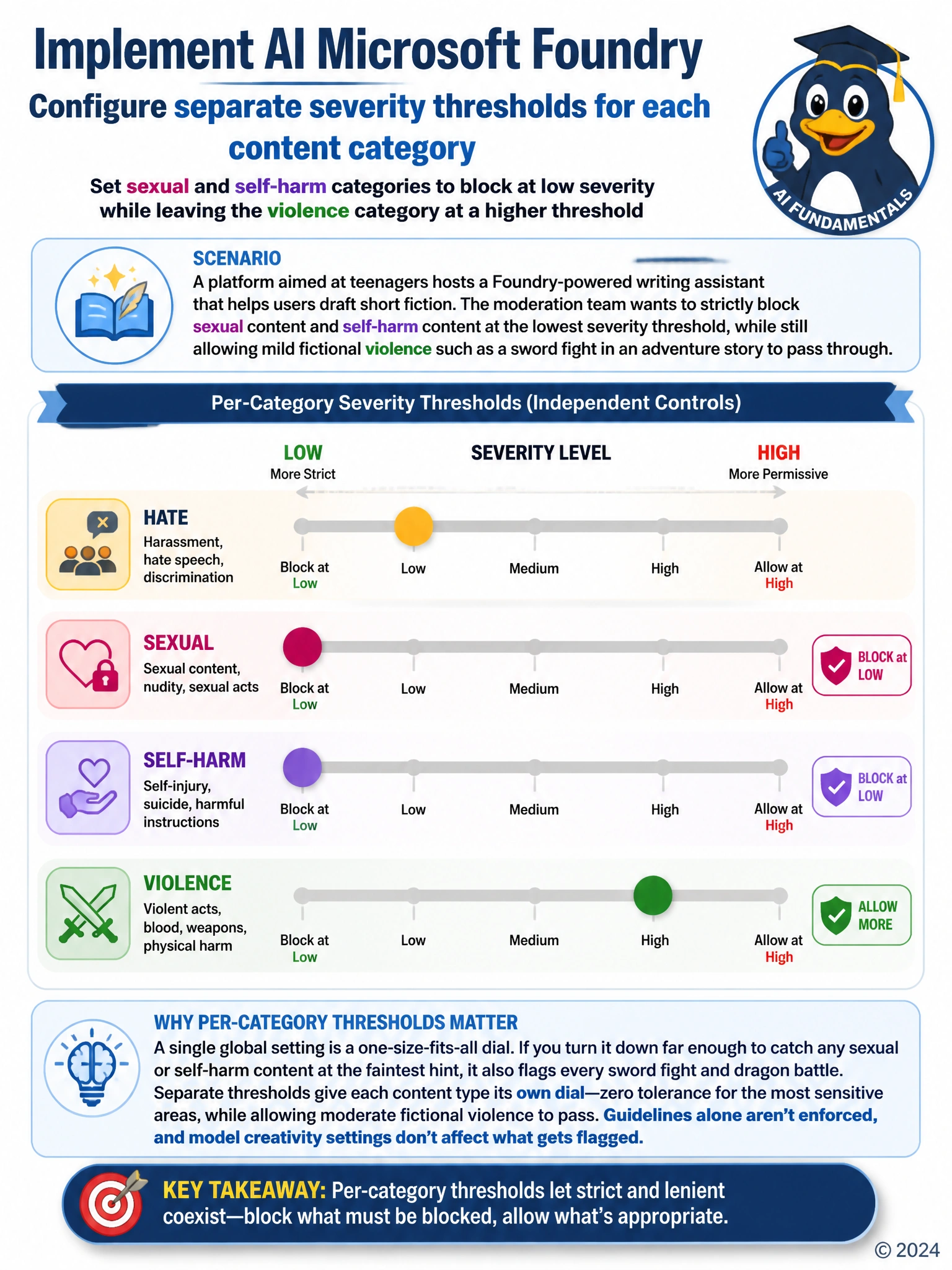
The moderation team here doesn't want a single strict-or-lenient switch, they want different rules for different kinds of content, and that's the key distinction. A one-size-fits-all setting forces a trade-off: crank it down far enough to catch anything sexual or self-harm related at the faintest hint, and it will also flag every sword fight and dragon battle in an adventure story, because a single dial can't tell graphic self-harm apart from fictional swordplay. The fix is to give each type of sensitive content its own dial, so the ones that need zero tolerance get it while the one that's fine in moderate doses stays open. Just writing polite instructions into the assistant's setup and hoping it behaves isn't a real safeguard, since a determined or unusual prompt can talk right past a suggestion that isn't backed by an enforced filter. And adjusting how predictable the model's word choices are has nothing to do with what topics get flagged in the first place. Separate thresholds per category is what actually lets strict and lenient coexist.
Full Explanation
The correct answer is A. Azure AI Foundry's content safety filtering lets a team set independent severity thresholds per category, such as hate, sexual, self-harm, and violence, so the moderation team can strictly block sexual and self-harm content at low severity while still permitting the milder violence typical of adventure fiction, which a single blanket setting cannot do. Option B is incorrect because a single global toggle applies the same threshold to every category at once, meaning any setting strict enough to catch sexual or self-harm content at low severity would also block the mild fictional violence the team wants to allow. Option C is incorrect because removing the filter and relying only on a system message leaves the assistant with no enforced technical safeguard; a system message is an instruction the model may not always follow, especially under adversarial or unusual prompts, so it cannot substitute for a moderation layer. Option D is incorrect because temperature controls the randomness of word choice, not the detection or blocking of harmful content categories; a model with temperature set to zero can still generate sexual or self-harm content if nothing is filtering for it. Per-category thresholds are the tool designed for exactly this mixed tolerance.