
A university library digitizes fifty years of scanned theses and research papers that have inconsistent file names and no catalog. Staff want researchers to type a topic into a search box and instantly retrieve relevant documents, with the system automatically pulling out metadata such as author names and publication years from the scanned text so results can be filtered. Which AI capability class fits this need?
Select an answer to reveal the explanation.
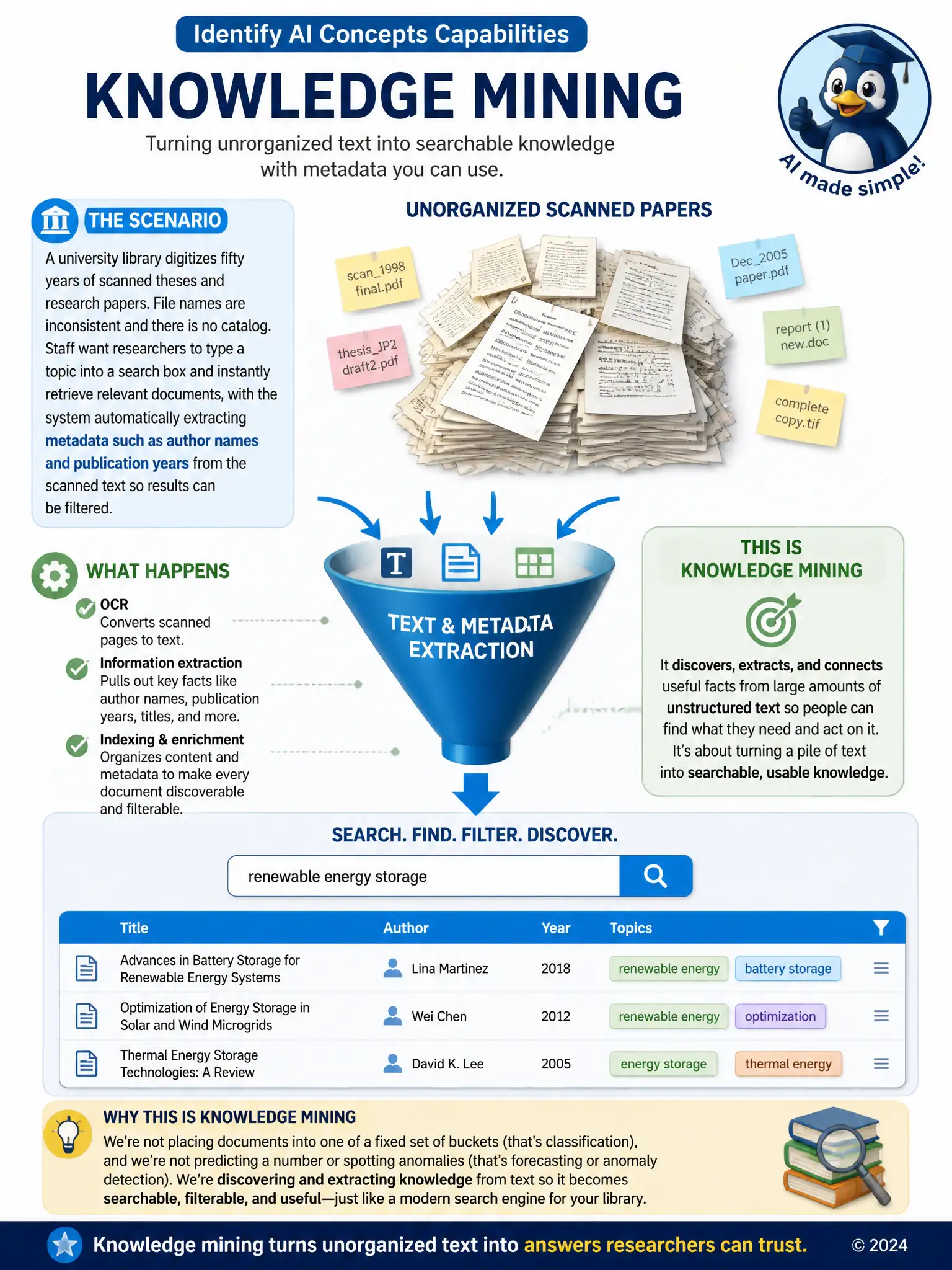
Short Explanation
Fifty years of scanned papers with no catalog is basically a pile of paper dumped on the floor. You need a system that searches the text and pulls out author and date automatically, so a topic query returns relevant documents fast. That's knowledge mining, not sorting into fixed buckets, predicting numbers, or spotting outliers.
Full Explanation
Knowledge mining is the capability that fits this need. It combines content extraction, such as pulling text and metadata out of scanned or unstructured documents, with an indexed search experience, so users can type a query and retrieve relevant content along with structured facts like author or date pulled from the source material. That combination of full-text search plus automatic metadata extraction over a large, disorganized document collection is precisely what the library needs. A custom classification model is incorrect because it sorts each document into one of a predefined set of categories, which does not by itself build a searchable index or extract open-ended metadata like names and dates. Regression forecasting is incorrect because it predicts a continuous numeric value, such as next year's checkout volume, and has no role in indexing documents or extracting text-based metadata. Anomaly detection is incorrect because it flags data points that deviate from an expected pattern, which is unrelated to helping researchers search a document collection or surfacing metadata from scanned pages. The library's need to search across decades of unindexed scanned material and enrich it with extracted facts points specifically to a knowledge mining solution.