
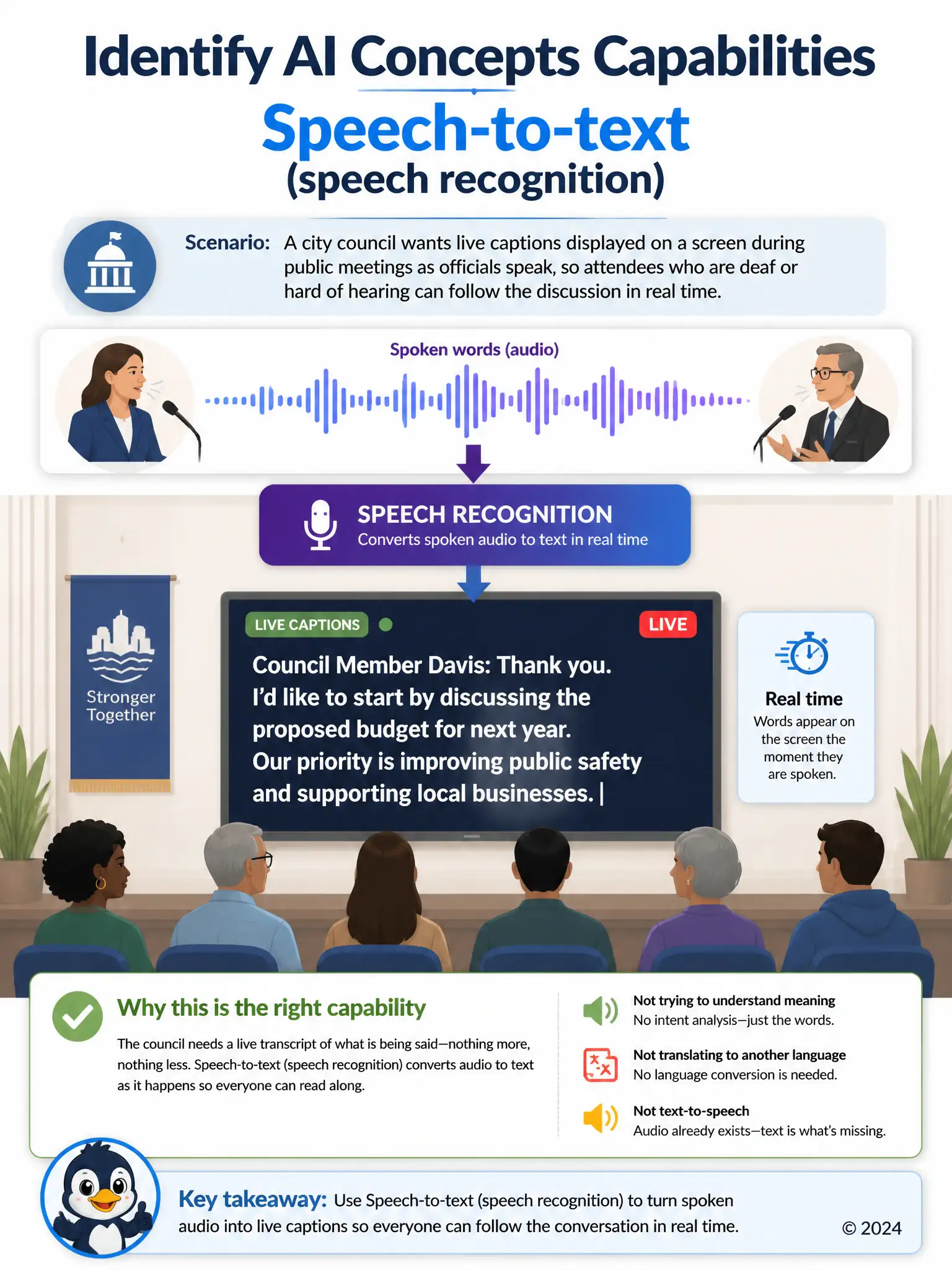
A city council wants live captions displayed on a screen during public meetings as officials speak, so attendees who are deaf or hard of hearing can follow the discussion in real time. Which AI capability should the team implement?
Select an answer to reveal the explanation.
Short Explanation
You need speech-to-text. It turns what officials say into words on the screen as they say it. Text-to-speech goes the wrong way, and translation or intent recognition doesn't give you live captions.
Full Explanation
The correct answer is speech-to-text, also called speech recognition, which converts spoken audio into written text in real time. That is exactly what is needed to display live captions as officials speak during the meeting. The text-to-speech capability is incorrect because it does the opposite of what is needed here: it converts written text into spoken audio, which would not help attendees who need to read captions of speech that is already being spoken aloud. The text translation capability is incorrect because it converts written or spoken content from one language into another; nothing in the scenario indicates officials are speaking a different language than the audience needs, so translation is not the missing capability, and even if it were added later it would still require speech-to-text as the first step to produce text from the audio. The natural language understanding intent recognition capability is incorrect because it analyzes text to determine what action or goal a speaker or writer is expressing, such as identifying that a customer message is a complaint, which is unrelated to producing a readable, real-time transcript of spoken words on a screen. The council's core need is turning spoken audio into on-screen text as it happens, which is the defining function of speech recognition.