
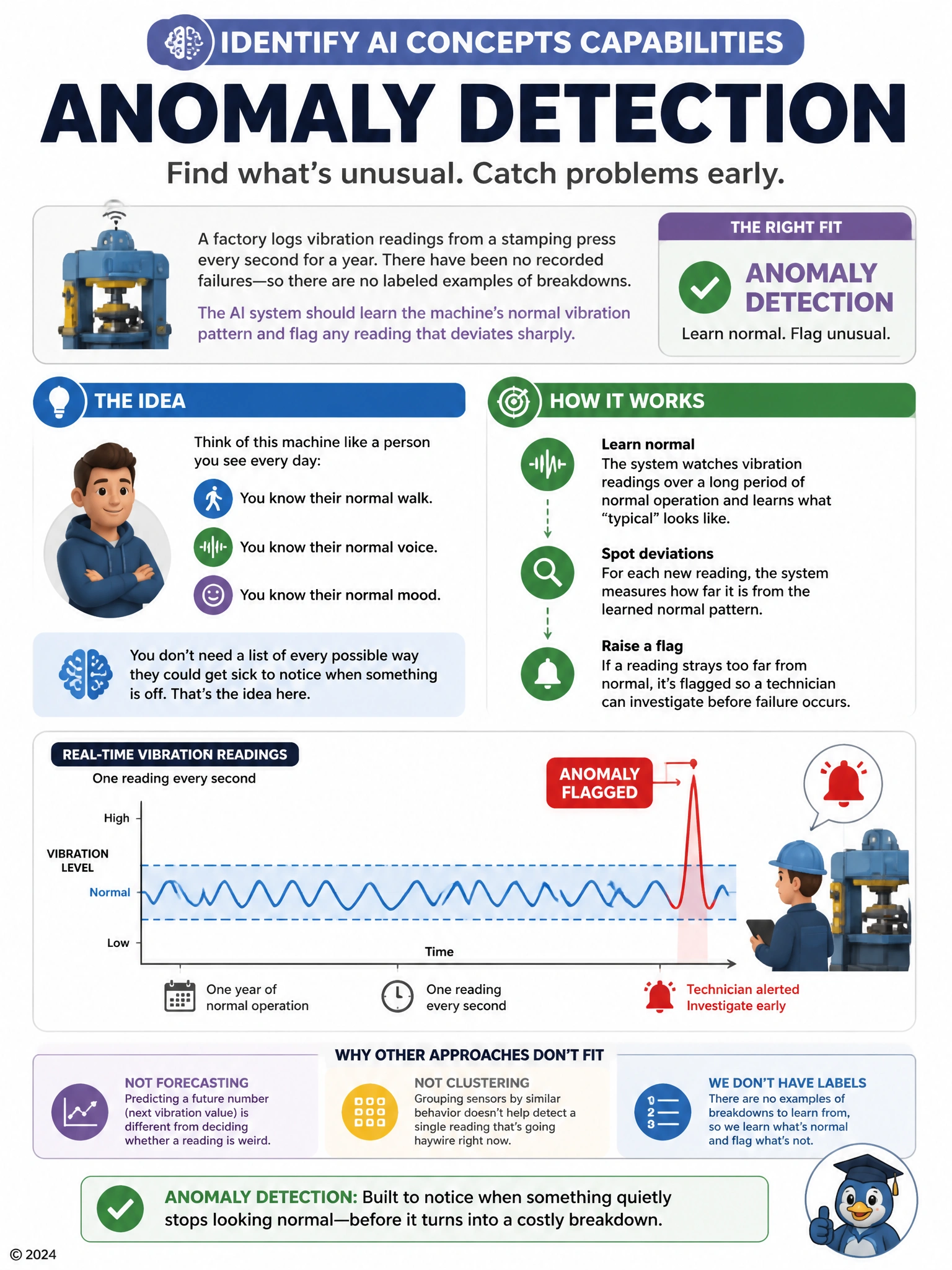
A factory attaches vibration sensors to a stamping press and logs a reading every second for an entire year. Engineers have never recorded an actual equipment failure in that time, so there are no labeled examples of what a breakdown looks like. They want the AI system to learn the machine's normal vibration pattern on its own and flag any reading that deviates sharply from that pattern, so a technician can investigate before a breakdown occurs. Which type of AI workload fits this requirement?
Select an answer to reveal the explanation.
Short Explanation
Think of this machine like a person you see every day: you know their normal walk, their normal voice, their normal mood. You don't need a list of every possible way they could get sick to notice when something is off. That's the idea here. The engineers never recorded a breakdown, so there's nothing to point at and say 'this is what failure looks like.' Instead, the system watches the vibration pattern over a long stretch of normal running time, learns what typical looks like, and then raises a flag whenever a new reading strays far from that pattern. Predicting a specific future number is a different job than judging whether a number is weird, and sorting the sensors into groups based on how they behave doesn't help you catch a single reading going haywire in real time. What this factory needs is a system built to notice when something quietly stops looking normal, before it turns into a costly breakdown.
Full Explanation
The correct answer is A. The engineers have continuous numeric readings but no labeled failure events, and they want the system to learn what normal operation looks like and flag readings that fall outside that pattern. That is exactly what anomaly detection does: it establishes a baseline from historical data and scores new observations by how much they deviate from it, without needing examples of past failures. Option B is incorrect because regression forecasting predicts a specific future numeric value, such as tomorrow's vibration reading, but predicting a value is a different task from deciding whether an already-observed value is abnormal; it does not inherently produce a deviation flag. Option C is incorrect because image classification operates on pictures and assigns a category label to a whole image, and nothing in this scenario involves visual data. Option D is incorrect because clustering groups similar items, such as sensors with similar behavior, into segments; it organizes the population of sensors rather than continuously comparing each new reading against a learned baseline to catch outliers as they happen.