
A law firm holds decades of case files as scanned image pages, native PDFs, and Word documents. The firm wants a single search index that extracts the text buried in scanned pages, tags people and organizations mentioned throughout, and lets staff run one search query across all of these different, previously unsearchable document formats at once. Which AI workload describes this combined solution?
Select an answer to reveal the explanation.
Short Explanation
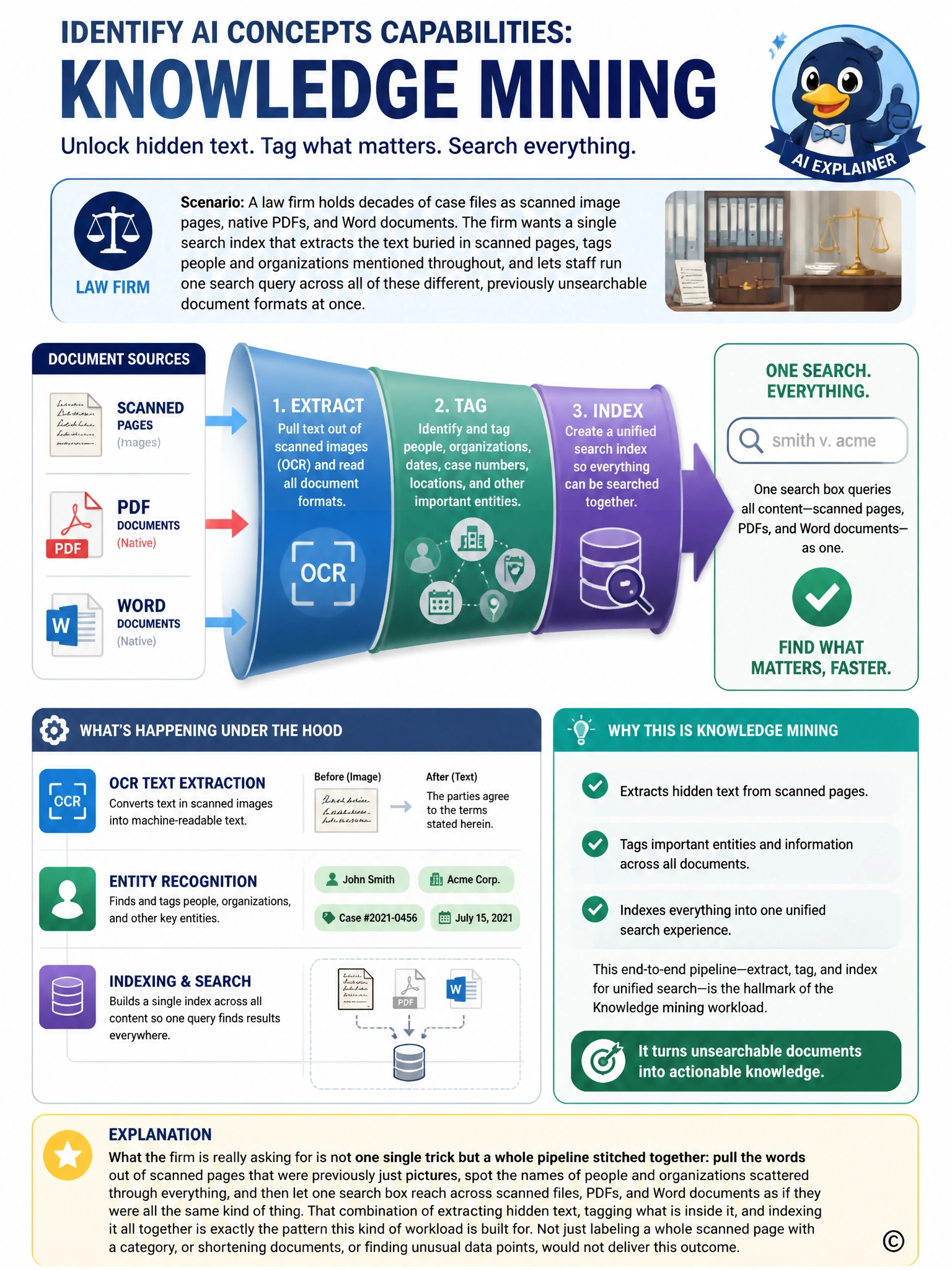
What the firm is really asking for is not one single trick but a whole pipeline stitched together: pull the words out of scanned pages that were previously just pictures, spot the names of people and organizations scattered through everything, and then let one search box reach across scanned files, PDFs, and Word documents as if they were all the same kind of thing. That combination of extracting hidden text, tagging what is inside it, and indexing it all together is exactly the pattern this kind of workload is built for. Just labeling a whole scanned page with a category, like calling it a contract or a memo, would not surface the text inside it or make anything searchable. Shortening documents down to their key points assumes the text has already been pulled out and organized, which is the very problem the firm is trying to solve first. And flagging unusual data points that break from a normal pattern has nothing to do with organizing legal paperwork for search. Since the firm needs extraction, tagging, and unified search rolled together, the combined workload is the fit.
Full Explanation
The correct answer is D. Knowledge mining is the AI workload that combines multiple capabilities, such as extracting text from scanned images, identifying entities like people and organizations, and indexing the results, into a single searchable index over large volumes of previously unsearchable content, which matches the firm's need to search across scanned pages, PDFs, and Word documents at once. Option A is incorrect because image classification only assigns a category label to an entire image, such as identifying a scanned page as a contract or a letter, and does nothing to extract the text within it or build a cross-format search index. Option B is incorrect because text summarization condenses existing text into a shorter version, which could be layered on top of already-extracted content but does not itself extract text from images or unify multiple document formats into one searchable index. Option C is incorrect because anomaly detection identifies unusual data points that deviate from a learned normal pattern, which has no connection to making decades of scanned and typed legal documents searchable. Because the firm's goal is combining text extraction, entity tagging, and unified search across mixed document formats, that composite capability is precisely what knowledge mining describes.