
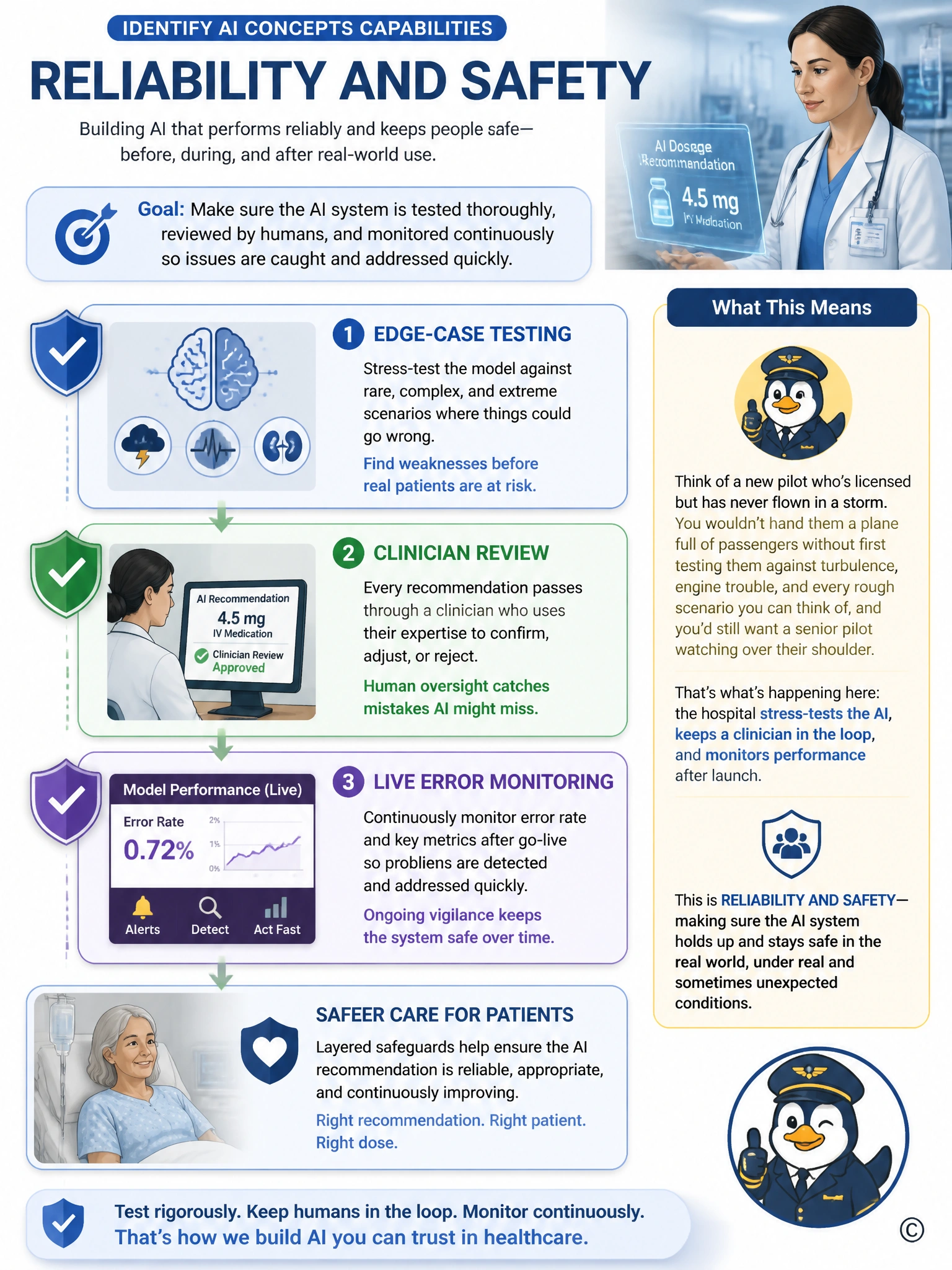
A hospital pilots an AI model that recommends dosage adjustments for a high-risk intravenous medication. Before letting the system influence real patient care, the clinical team runs extensive testing against rare edge cases, requires that every recommendation pass through a clinician for review, and continuously monitors the model's error rate after go-live so problems are caught quickly. Which responsible AI principle are they primarily applying?
Select an answer to reveal the explanation.
Short Explanation
Picture a new pilot who's technically licensed but has never flown in a storm. You wouldn't hand them a plane full of passengers without first testing them against turbulence, engine trouble, and every rough scenario you can think of, and you'd still want a senior pilot watching over their shoulder. That's what's happening here. Before this dosage-recommendation tool ever touches a real patient, the hospital is stress-testing it against the rare, ugly cases where things could go wrong, keeping a clinician in the loop to catch mistakes, and watching its error rate closely after launch. That's different from simply deciding who gets blamed if something goes wrong, and it's different from making the system's reasoning easy to explain to outsiders. This is about making sure the tool actually holds up and stays safe once it's making recommendations in a real hospital, under real and sometimes unexpected conditions, not just that it worked fine in a demo.
Full Explanation
The correct answer is B. Reliability and safety is the principle that AI systems must perform consistently and safely under real-world conditions, including edge cases, and that teams build in monitoring and human checkpoints to catch problems before and after deployment. Testing against rare edge cases and tracking the model's error rate once it is live are both direct efforts to ensure the system behaves safely across the range of situations it will actually encounter, which is the core of this principle. Option A is incorrect because accountability is about establishing who is responsible for a system's outcomes and putting governance structures in place to assign that responsibility; it describes organizational ownership rather than the technical testing and monitoring practices described here. Option C is incorrect because inclusiveness concerns designing systems that work well for people of varied abilities and backgrounds, which is not what this scenario addresses. Option D is incorrect because transparency involves helping people understand how and why a system produces its outputs, such as through documentation or explanations, rather than the edge-case testing and error-rate monitoring described in the scenario.