
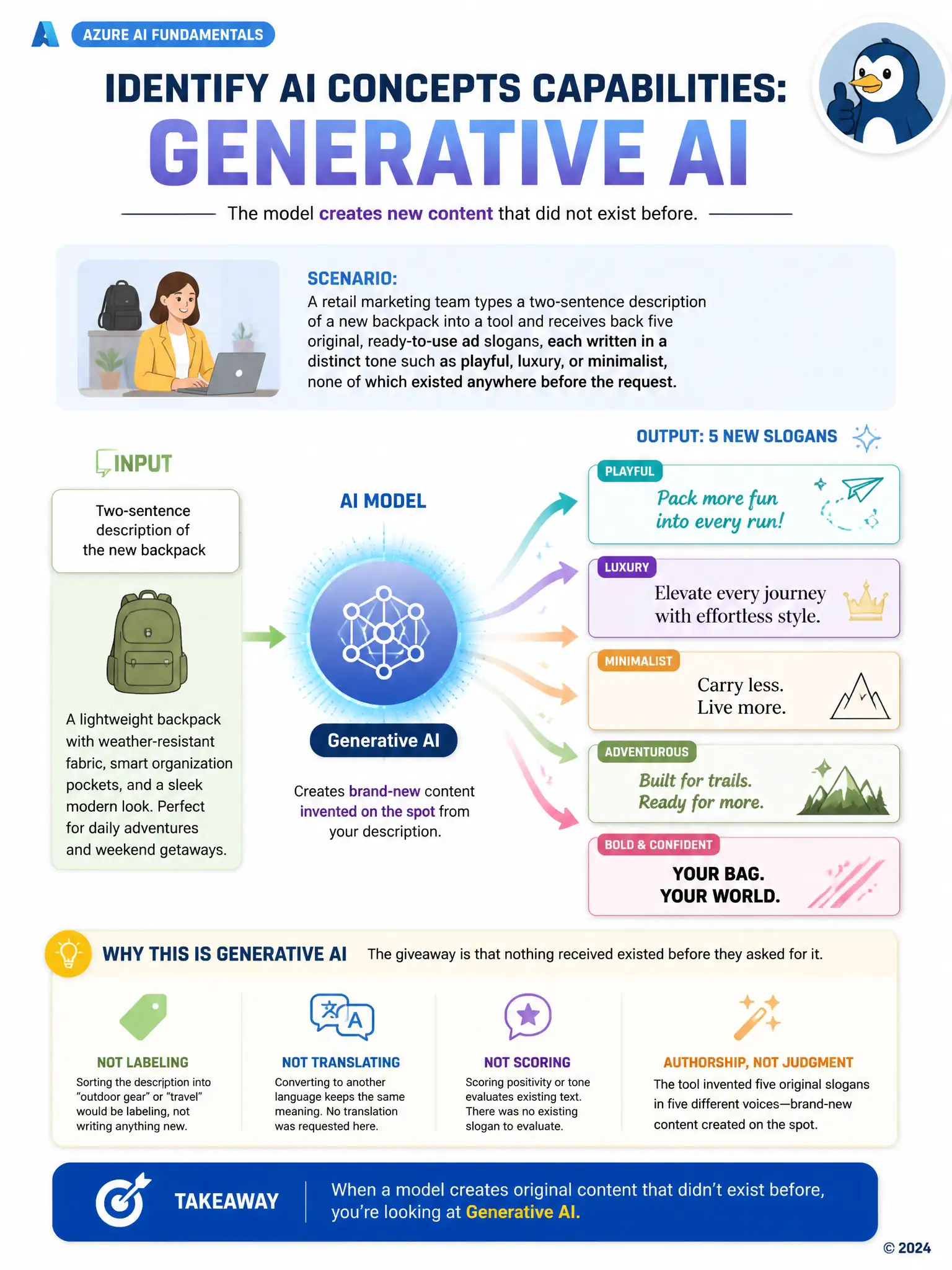
A retail marketing team types a two-sentence description of a new backpack into a tool and receives back five original, ready-to-use ad slogans, each written in a distinct tone such as playful, luxury, or minimalist, none of which existed anywhere before the request. Which category of AI capability produced this output?
Select an answer to reveal the explanation.
Short Explanation
The giveaway is that the tool invented five brand-new slogans on the spot. That is generative AI, because it creates original content instead of sorting, translating, or scoring text that already exists.
Full Explanation
The capability being demonstrated is generative AI. Generative AI refers to models, typically large language models, that create new original content such as text, images, or code in response to a prompt, which matches the tool producing five brand-new slogans that did not exist before the marketing team's request. The classification capability is incorrect because it assigns an input to one of a predefined set of categories or labels, such as tagging the backpack description as sports or travel gear, rather than producing new creative text. The translation capability is incorrect because it converts existing text from one language into another while preserving its original meaning, and there is no indication the marketing team's description was in a different language or that the tool was converting between languages. The sentiment analysis capability is incorrect because it evaluates the emotional tone of existing text and returns a score or label; it does not author new content, and the scenario describes slogans being created rather than evaluated. Because the defining feature of this scenario is that the tool authored several original pieces of writing on demand rather than labeling, translating, or scoring text that already existed, generative AI is the capability being demonstrated.