
A team building a spam-email filter reviews their model's mistakes and decides that a legitimate email being wrongly marked as spam and hidden from the user is far more damaging than an actual spam email slipping into the inbox. Which evaluation metric should the team prioritize maximizing when tuning the model?
Select an answer to reveal the explanation.
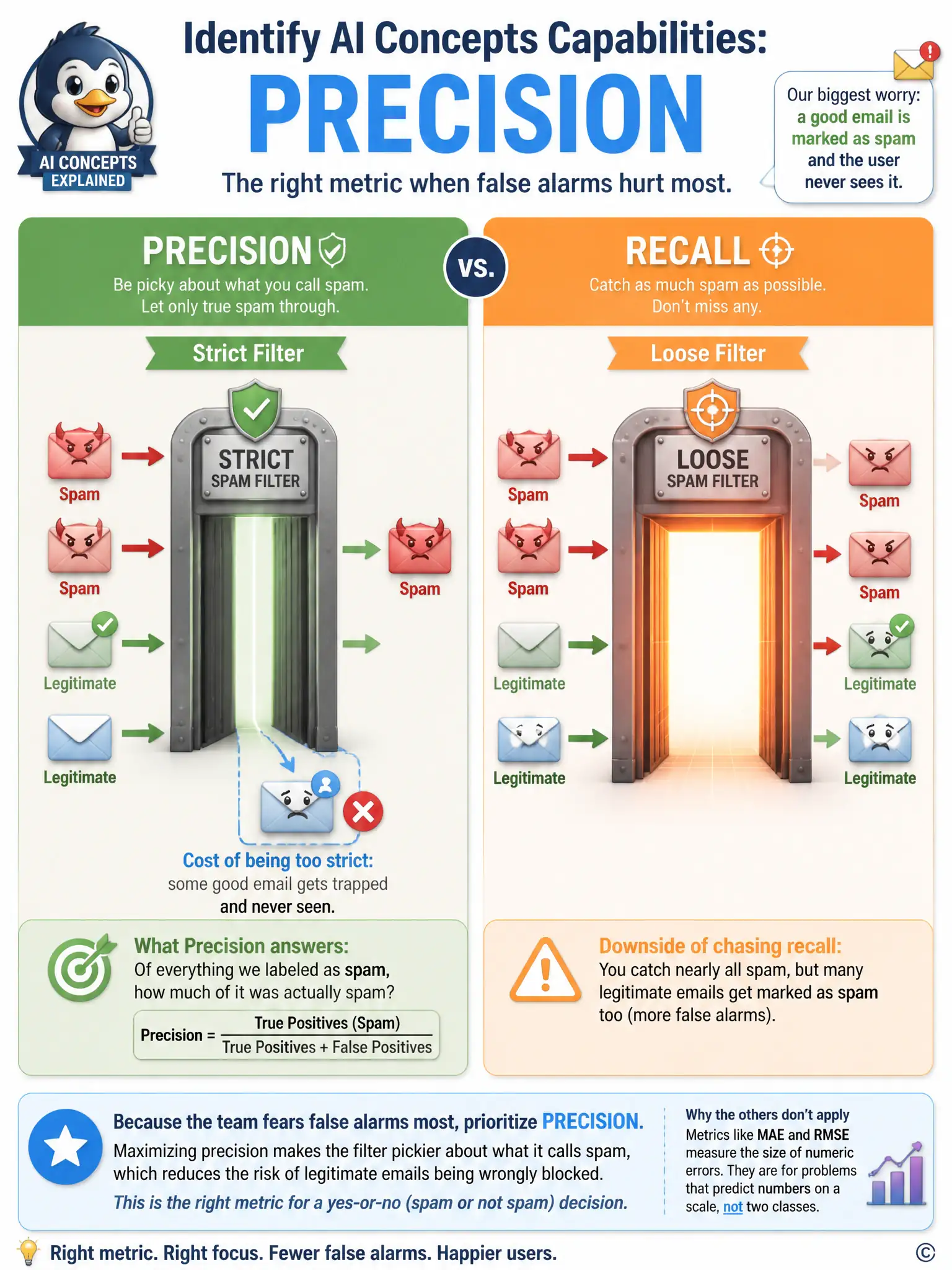
Short Explanation
You want Precision here because the team cares most about not trapping good mail. If you push Precision up, the filter only calls spam when it's pretty sure, so fewer legit messages get hidden. Recall would make it trigger-happy, and the regression metrics don't fit a yes/no spam decision.
Full Explanation
The metric to prioritize is Precision. Precision measures, out of everything the model labeled as positive, in this case spam, how many of those labels were actually correct, so maximizing Precision directly reduces the number of legitimate emails incorrectly flagged as spam, which is the exact cost the team wants to minimize. Recall is incorrect because it measures how many of the actual spam emails the model successfully caught, and prioritizing it would push the model toward flagging more emails as spam overall, increasing rather than decreasing the risk of legitimate email being misclassified. Mean absolute error is incorrect because it is a metric used to evaluate regression models that predict continuous numeric values, such as predicted prices or temperatures, and does not apply to a classification decision like spam versus not spam. R-squared is incorrect because it measures how well a regression model's predictions explain the variance in a continuous outcome, which again is a regression concept and has no meaning for a binary spam classification task. Since the team's stated concern is specifically about false positives, that is, legitimate email wrongly caught by the filter, the metric that directly penalizes that error is the one they should prioritize.