
A team is building semantic search over a 5-million-document knowledge base using a vector index in Azure AI Search connected to a Foundry-hosted model. Storage and query costs for the index have grown far larger than expected, and the team wants to reduce those costs while keeping the index able to find semantically related passages, not just exact keyword matches. (Select TWO.) Which two changes address this?
Select all correct answers, then click Submit.
Short Explanation
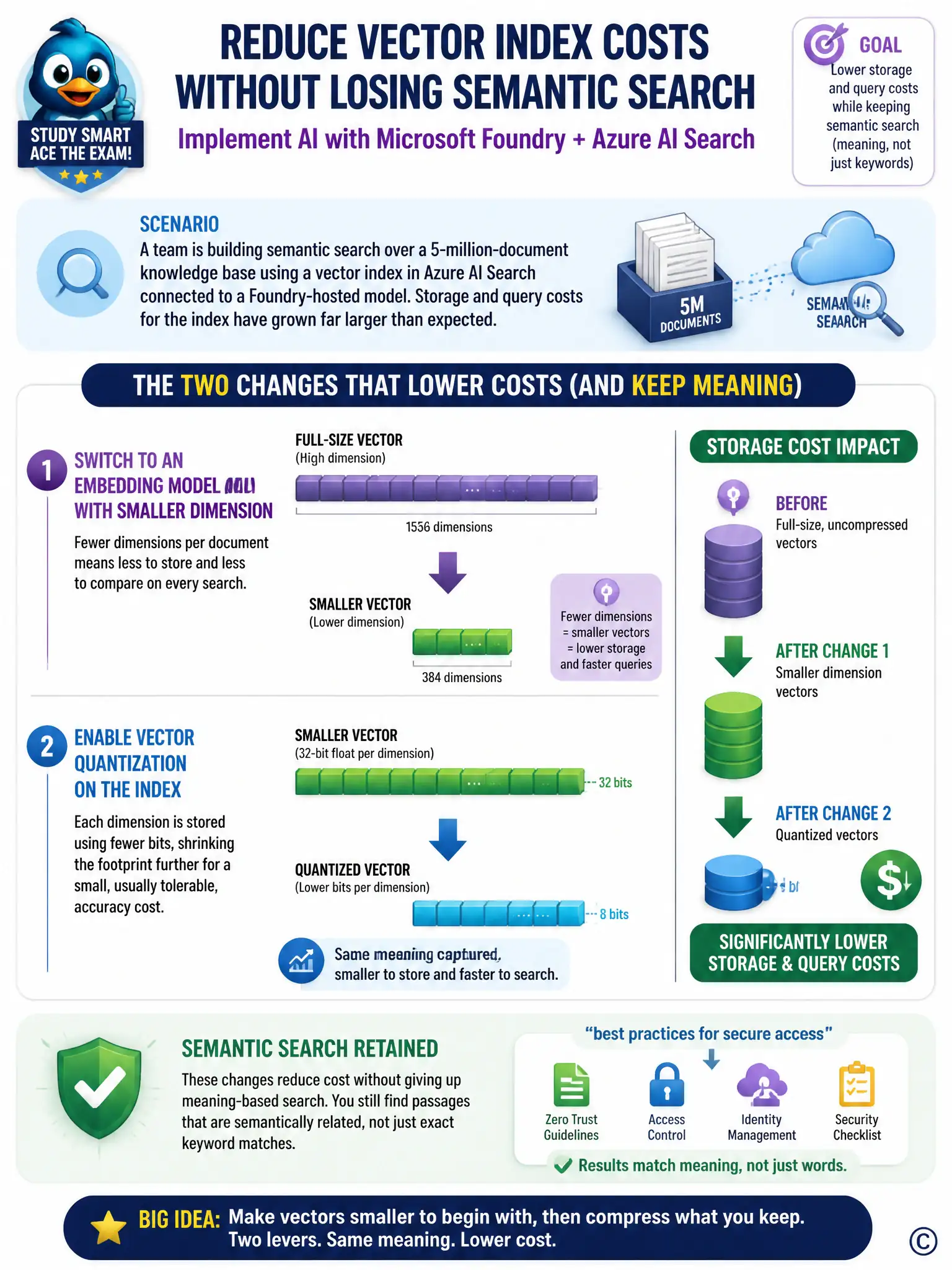
When your vector index costs balloon, shrink the vectors themselves. Use an embedding model that outputs fewer dimensions per document, and turn on vector quantization so each stored vector uses fewer bits per dimension. You keep semantic matching while cutting storage and query compute.
Full Explanation
The changes that address the cost problem are switching to an embedding model that produces a smaller vector dimension for each document and enabling vector quantization on the index so each stored vector uses fewer bits per dimension. Choosing an embedding model with a smaller output dimension means every one of the 5 million document vectors takes less storage and less compute to compare at query time, directly cutting cost while the index still performs semantic similarity search. Enabling quantization compresses each stored vector's dimensions into fewer bits, shrinking the index's memory and storage footprint further with only a small, usually acceptable, loss in precision, again while preserving semantic matching. Replacing the vector index with a keyword-only full-text index is incorrect because it abandons semantic search entirely; it would find exact term matches but miss the related-meaning passages the team explicitly wants to keep finding. Increasing the number of chunks retrieved per query is incorrect because it increases, rather than decreases, the compute and data transferred on every search, working directly against the team's cost goal.