
A retail company runs a Foundry-hosted chat deployment on model version 2 in production, serving live customer traffic. The team wants to switch to model version 3, which tests better in evaluation, but wants to catch any regression in real customer conversations before committing all traffic to it. Which deployment approach best satisfies this?
Select an answer to reveal the explanation.
Short Explanation
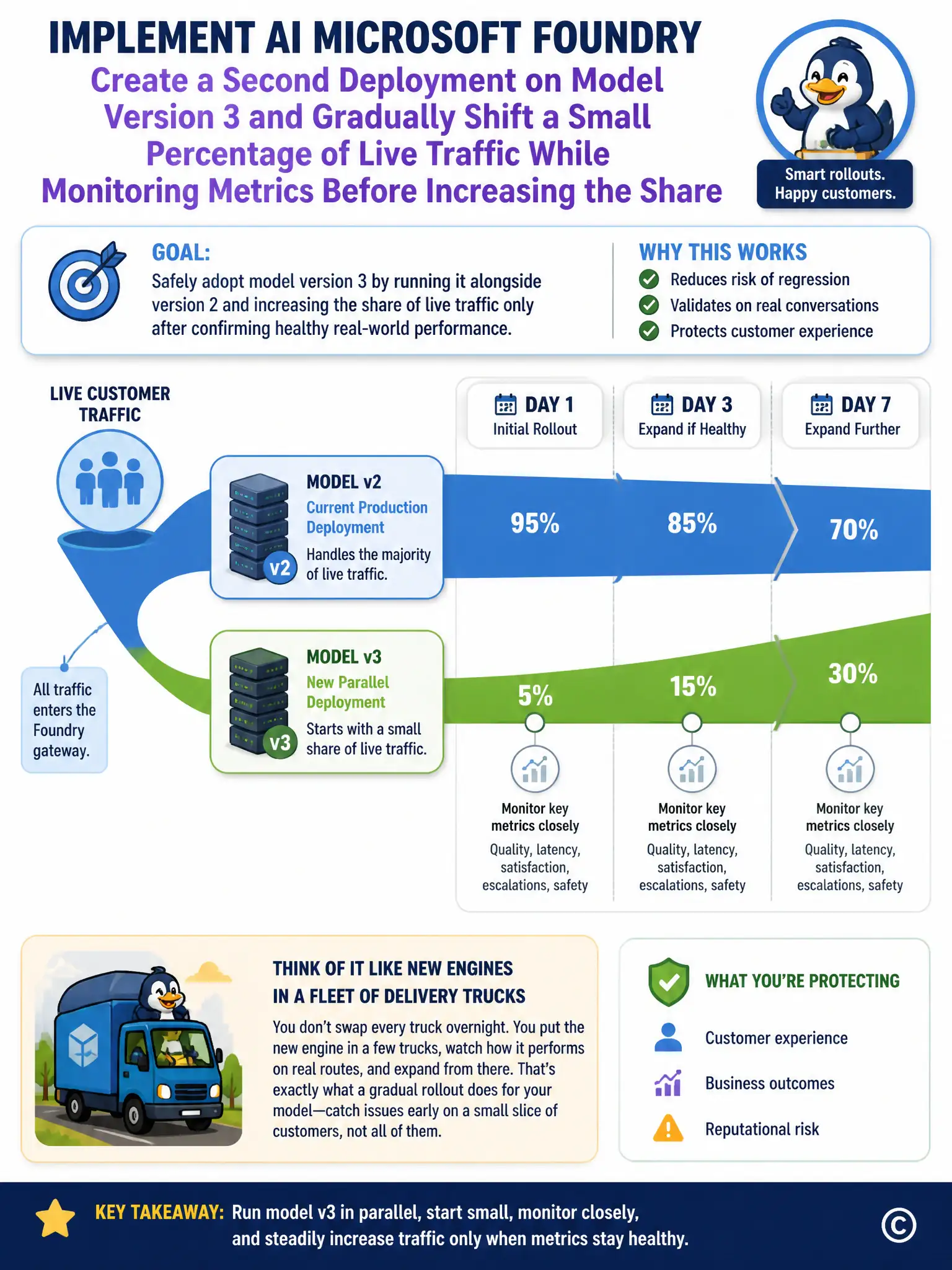
You want a parallel deployment on model version 3 and a gradual shift of a small percentage of live traffic while monitoring metrics. That catches regressions on a small slice of customers instead of everyone at once. A one-shot cutover, offline-only scores, or playground spot checks won't give you real production evidence.
Full Explanation
Creating a second deployment on model version 3 and routing a small, increasing share of live traffic to it lets the team compare real customer outcomes against version 2 and catch a regression before it affects everyone, which is the staged, evidence-based rollout the scenario calls for. Deleting the version 2 deployment and immediately pointing all traffic at a new version 3 deployment is wrong because cutting over all traffic at once removes any chance to detect a regression before every customer is affected, exactly the risk the team wants to avoid. Keeping all traffic on version 2 and relying solely on offline evaluation scores already collected for version 3 is wrong because offline evaluation scores, however good, do not capture how the model behaves on the specific mix of real customer conversations this deployment receives; only live traffic testing can catch that. Deploying version 3 only in the Azure AI Foundry portal playground and manually sending sample prompts before any customer traffic reaches it is wrong because manual playground testing only exercises prompts the tester thinks to try; it cannot substitute for observing behavior across genuine, high-volume customer traffic, and it never actually validates the production path.