
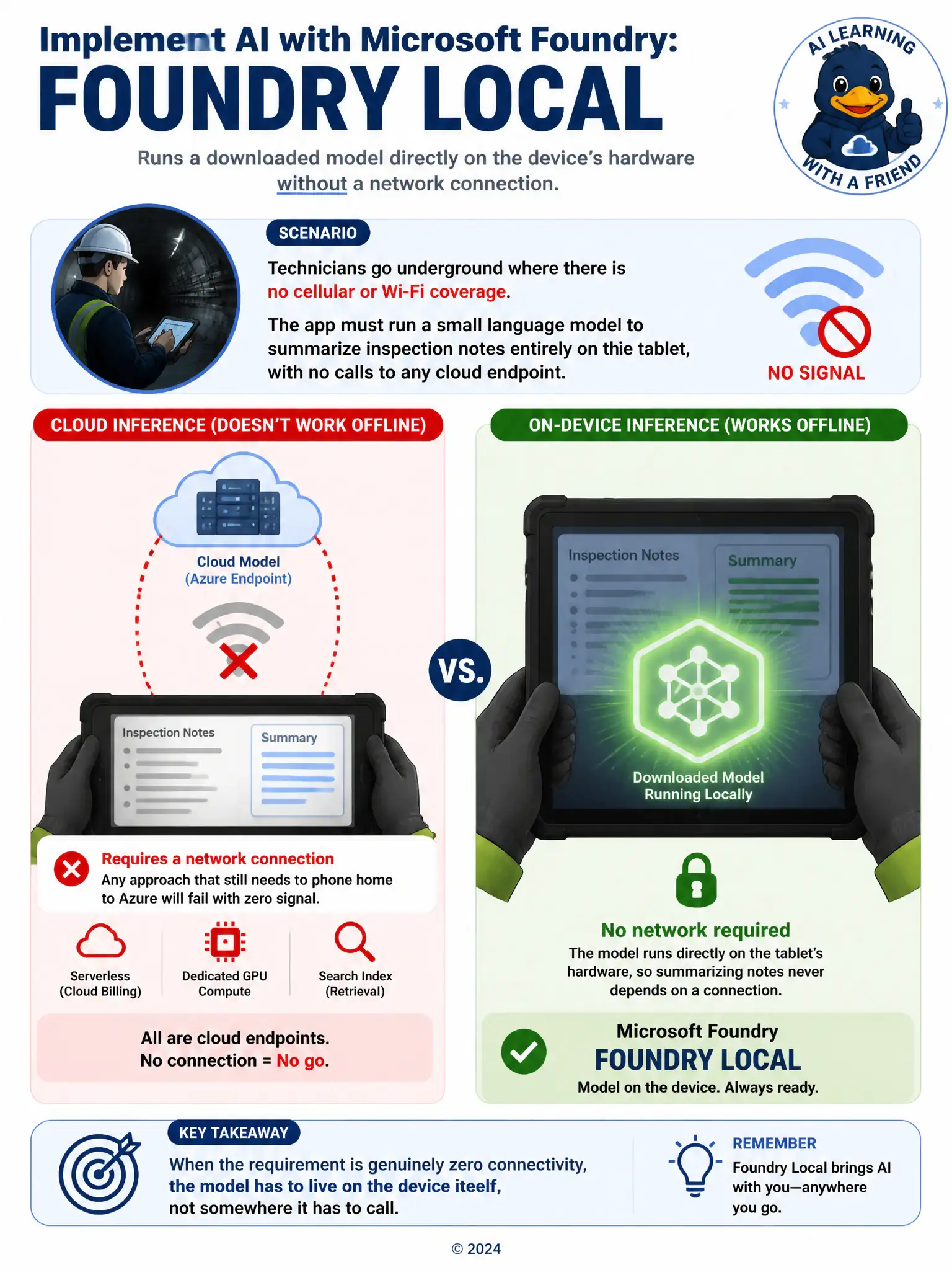
A field-inspection company builds an app that runs on tablets carried by technicians into underground facilities with no cellular or Wi-Fi coverage. The app must run a small language model to summarize inspection notes entirely on the tablet, with no calls to any cloud endpoint. Which Microsoft Foundry capability should the team use to meet this requirement?
Select an answer to reveal the explanation.
Short Explanation
When the technician loses signal, anything that phones home is dead. You need Foundry Local, because it runs the downloaded model on the tablet's own hardware, so the summary happens with zero connectivity.
Full Explanation
Foundry Local, which runs a downloaded model directly on the device's hardware without a network connection, is the correct capability because it packages a model to run directly on the device's own CPU, GPU, or NPU, so the inspection app can summarize notes with zero network dependency, exactly the underground, no-connectivity requirement in the stem. The Foundry-hosted serverless API deployment that bills per token and scales automatically is incorrect because it is still a cloud endpoint reached over the internet; without connectivity the tablet cannot reach it. The Foundry-hosted managed compute deployment reserved to a dedicated GPU instance is incorrect for the same reason: managed compute deployments run on Azure-hosted GPU instances, so the app would still need network access to send requests. Azure AI Search integrated with a Foundry-hosted model to ground responses in indexed documents is incorrect because grounding requires querying a cloud-hosted index over the network, which does nothing to solve the offline requirement and adds a dependency the team explicitly cannot use.