
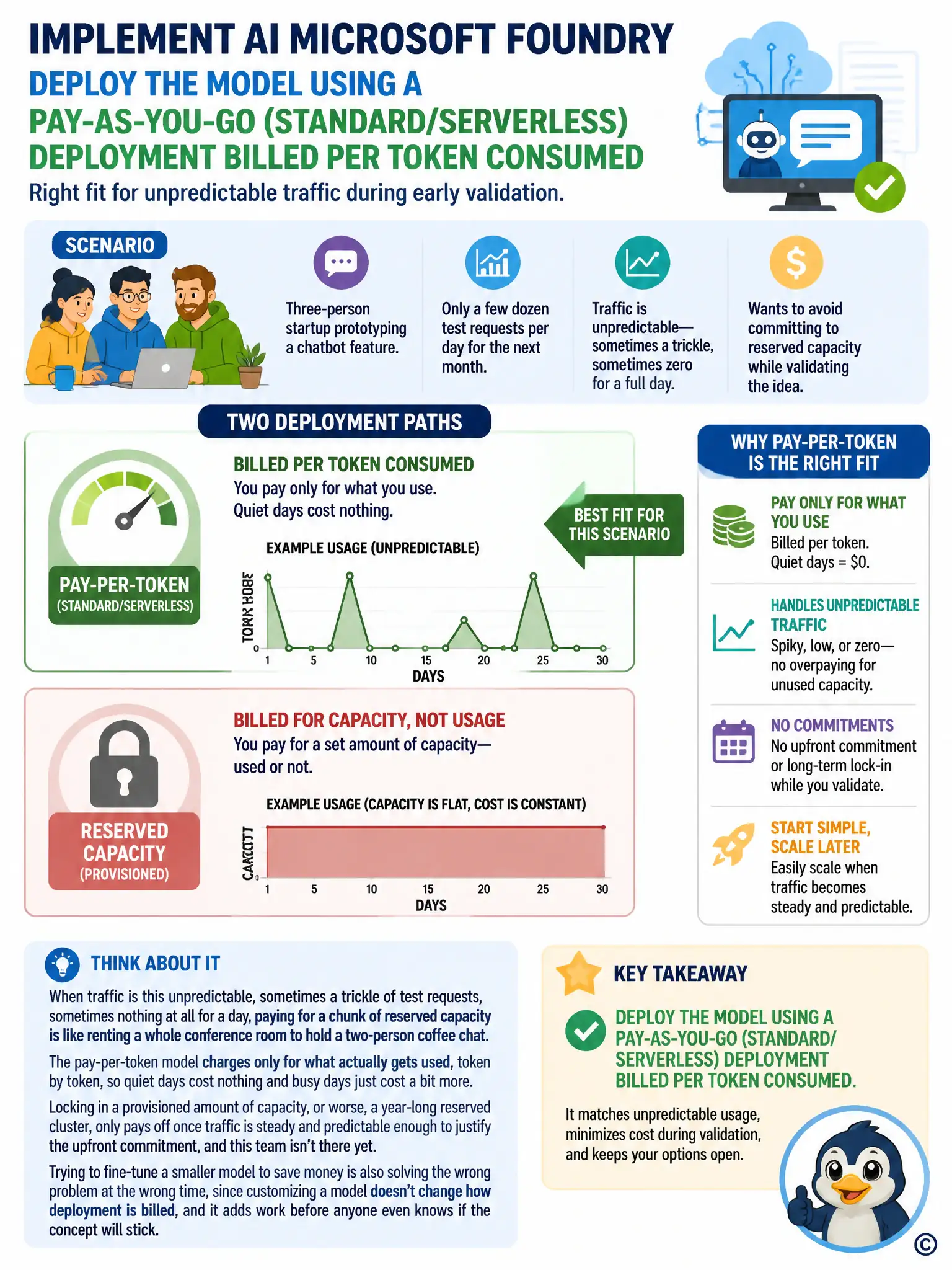
A three-person startup is prototyping a chatbot feature and expects only a few dozen test requests per day for the next month while early users try the concept. Request volume will be unpredictable, sometimes dropping to zero for a full day, and the team wants to avoid committing to reserved capacity while they are still validating the idea.
Select an answer to reveal the explanation.
Short Explanation
When traffic swings from a few dozen requests to zero, you don't want to pay for capacity you're not using. Pay-as-you-go deployment charges only for the tokens you actually consume, so quiet days cost nothing and busy days just cost a bit more. Reserved capacity or fine-tuning first only makes sense once the workload is steady and the concept is validated.
Full Explanation
The correct choice is deploying the model using a pay-as-you-go (standard/serverless) deployment billed per token consumed, because it bills only for the tokens actually consumed and carries no capacity commitment, which matches a workload that swings from a few dozen requests a day to none at all during an early validation phase. Purchasing a provisioned throughput unit deployment sized for the team's peak expected load is incorrect because provisioned throughput units are priced for reserving guaranteed capacity ahead of time, which makes sense for steady high-volume traffic but wastes money when demand is this sparse and unpredictable. Requesting a dedicated managed compute cluster reserved for a full year is incorrect for the same reason: a dedicated cluster reserved for a year assumes sustained usage that a one-month prototype with idle days does not have, locking the startup into a long-term cost before the concept is even validated. Fine-tuning a smaller model to reduce per-token cost before any testing begins is incorrect because fine-tuning is a model-customization step that adds upfront cost and engineering time; it does not address the deployment billing model at all, and doing it before the idea is validated risks investing in a version of the product that may still change.