
A defense contractor's legal team requires that any AI model used in a new tool can eventually be exported and run entirely on the company's own hardware with no ongoing dependency on a cloud vendor's API. Which type of model from the Azure AI Foundry catalog satisfies this requirement?
Select an answer to reveal the explanation.
Short Explanation
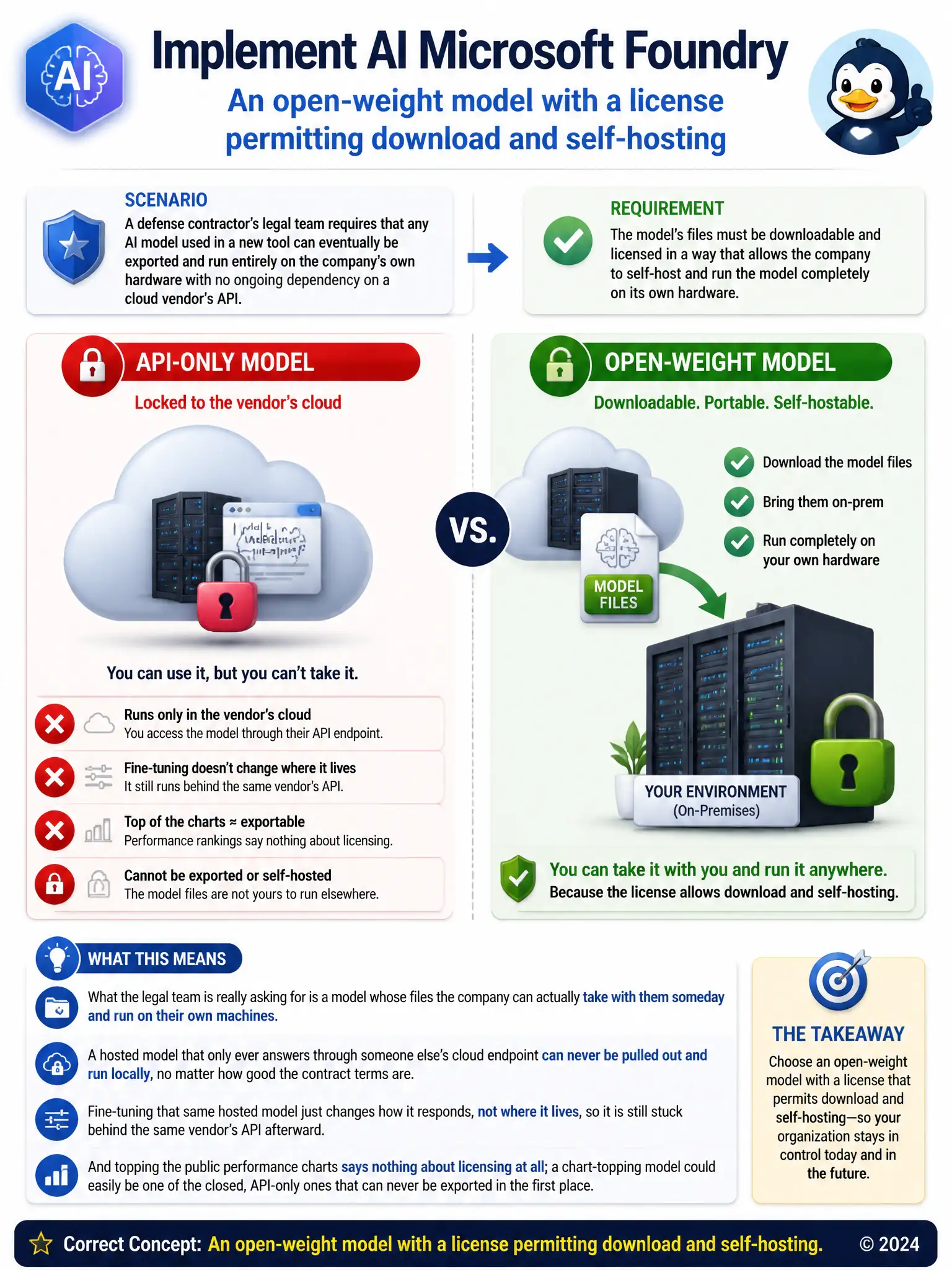
You need a model you can actually take with you and run on your own hardware, and that only works with an open-weight model whose license lets you download and self-host it. A hosted API-only model stays stuck in the vendor's cloud, and fine-tuning it doesn't change that. Benchmark rankings don't prove you can export it.
Full Explanation
The correct answer is the open-weight model with a license permitting download and self-hosting. A requirement to eventually export a model and run it entirely on the company's own hardware, independent of any vendor's cloud API, can only be satisfied by an open-weight model whose license explicitly permits downloading and self-hosting the model files. A proprietary frontier model offered only as a hosted API endpoint is incorrect because it never exposes downloadable weights, so it can never be run outside the vendor's cloud regardless of usage volume or contract terms. A fine-tuned version of a proprietary API-only model is incorrect because fine-tuning changes its behavior but does not change its distribution model; the resulting custom model is still only accessible through the same vendor's hosted endpoint. Whichever model ranks highest on the catalog's public benchmark leaderboard is incorrect because leaderboard ranking reflects task performance, not licensing terms, and a top-ranked model could just as easily be a closed, API-only offering that cannot be exported at all.