
A developer has used the Azure AI Foundry portal playground to manually test prompts against a candidate model and is satisfied with the results. The next step is to call that model automatically every night as part of an unattended batch pipeline. What should the developer do?
Select an answer to reveal the explanation.
Short Explanation
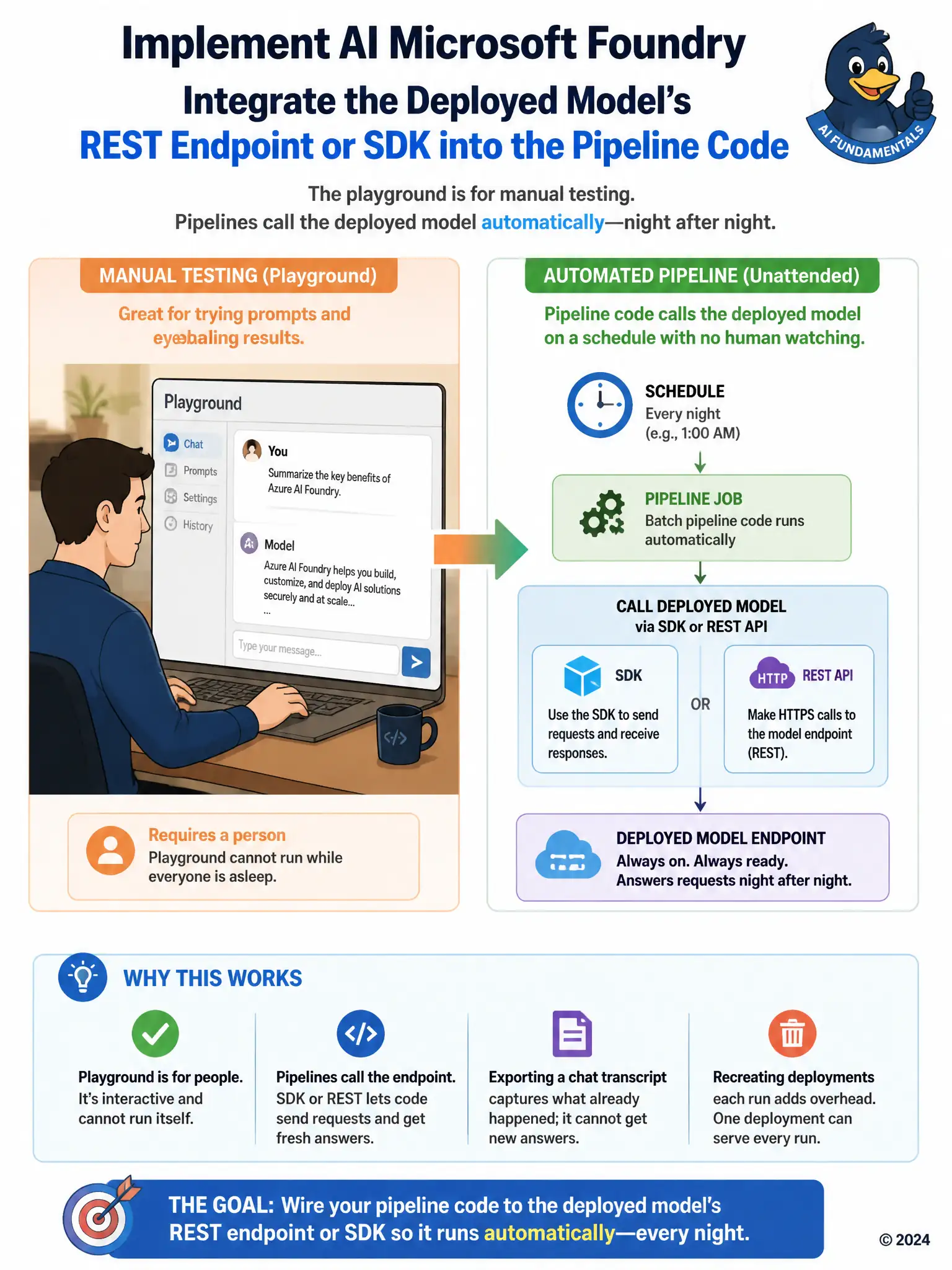
The playground is for you to try prompts and eyeball results, not for a job that runs while you're asleep. Wire your pipeline to the deployed model's REST endpoint or SDK so it can call the model automatically every night. A chat export is just yesterday's answers, and spinning up a new deployment each run is needless overhead.
Full Explanation
The correct approach is to integrate the deployed model's REST endpoint or SDK into the pipeline code. The playground in Azure AI Foundry is designed for interactive, manual experimentation with prompts and models, not for unattended, repeatable execution. Once a model has been validated there, moving it into production means calling the deployed model's REST endpoint or an SDK from the pipeline's own code, so the batch job can run automatically every night without a person present. Continuing to run prompts through the playground each night and copying outputs is incorrect because the playground requires a human to enter prompts and read results, which is incompatible with an unattended nightly job. Exporting the playground chat history as the pipeline's data source is incorrect because a chat history export is a log of a manual session, not a callable interface the pipeline can invoke to generate new responses on new data each night. Requesting a new model deployment for each nightly run and deleting it afterward is incorrect because creating and deleting a fresh deployment for every run adds unnecessary setup time, cost, and complexity when a single persistent deployment can simply be called repeatedly through its endpoint.