
An online furniture retailer wants shoppers to upload a photo of a chair they like and have the site return visually similar chairs from the catalog, without relying on any text description. Which capability should the team deploy through Azure AI Foundry?
Select an answer to reveal the explanation.
Short Explanation
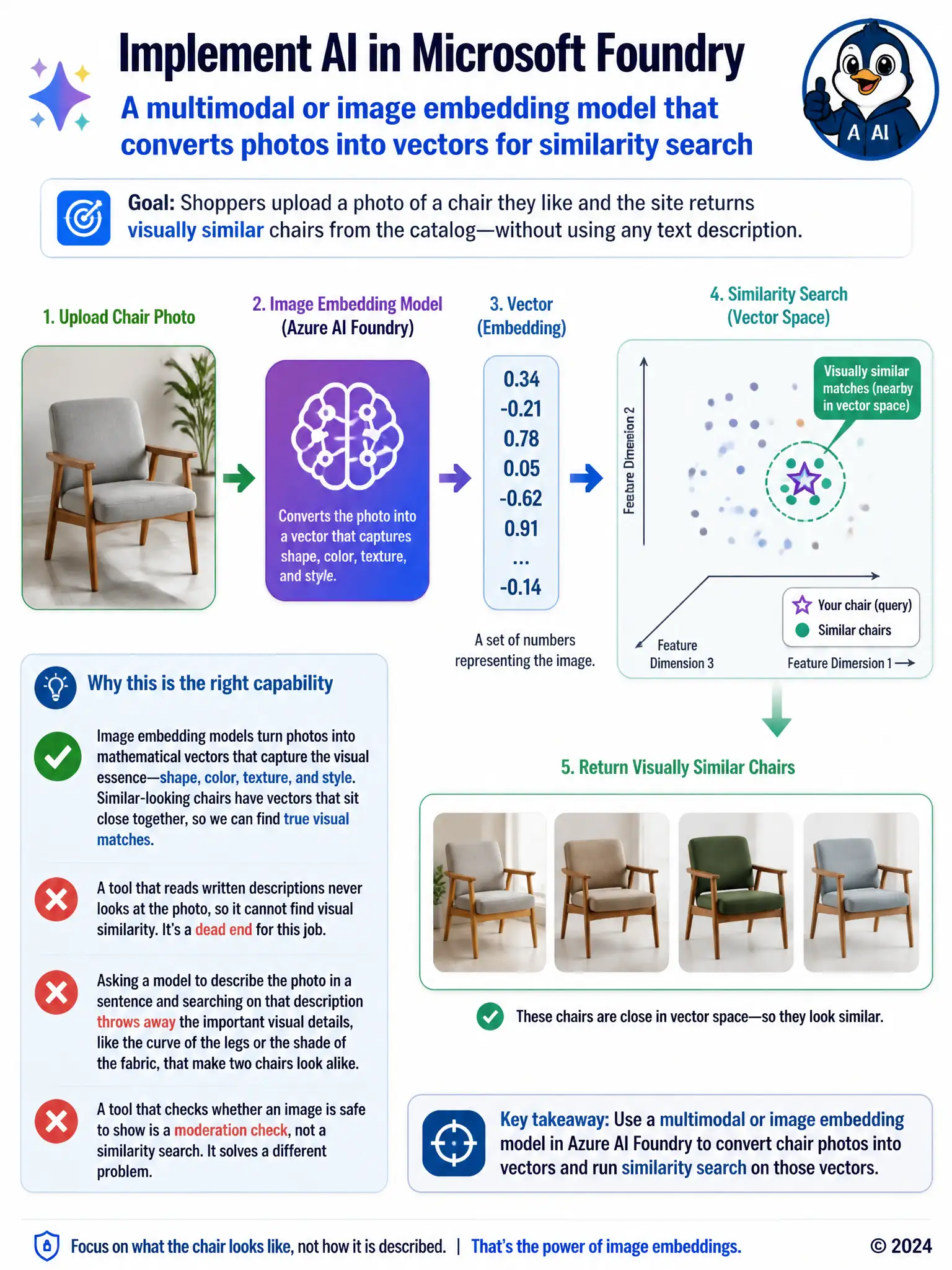
You need a multimodal or image embedding model because it turns the uploaded photo into a vector that captures shape, color, and style, letting you find catalog chairs with nearby vectors. Text-only embeddings, photo-to-text descriptions, and content safety checks don't measure visual similarity from the photo itself.
Full Explanation
The correct capability is a multimodal or image embedding model that converts photos into vectors for similarity search. Finding visually similar products from an uploaded photo requires converting images into numeric vectors that capture visual features like shape, color, and pattern; the retailer can then compare the uploaded photo's vector against stored vectors for catalog items to find the closest visual matches. The text embedding model applied to each product's written description is incorrect because it only processes written descriptions and has no way to interpret the pixels of an uploaded photo, so it cannot power a photo-in search. The large language model prompted to describe the uploaded photo in words is incorrect because it introduces an unnecessary translation step that discards visual detail like exact shape and shading, making the match less accurate than comparing image vectors directly. The content safety model to classify whether the uploaded photo is appropriate is incorrect because it classifies whether an image is appropriate to display, which is a moderation task entirely separate from measuring visual similarity between products.