
A boutique law firm wants a Foundry-deployed model to draft client emails in a very particular tone, but they only have eight example emails written in that style. They ask whether to fine-tune a model on this data before deploying it. What is the best guidance?
Select an answer to reveal the explanation.
Short Explanation
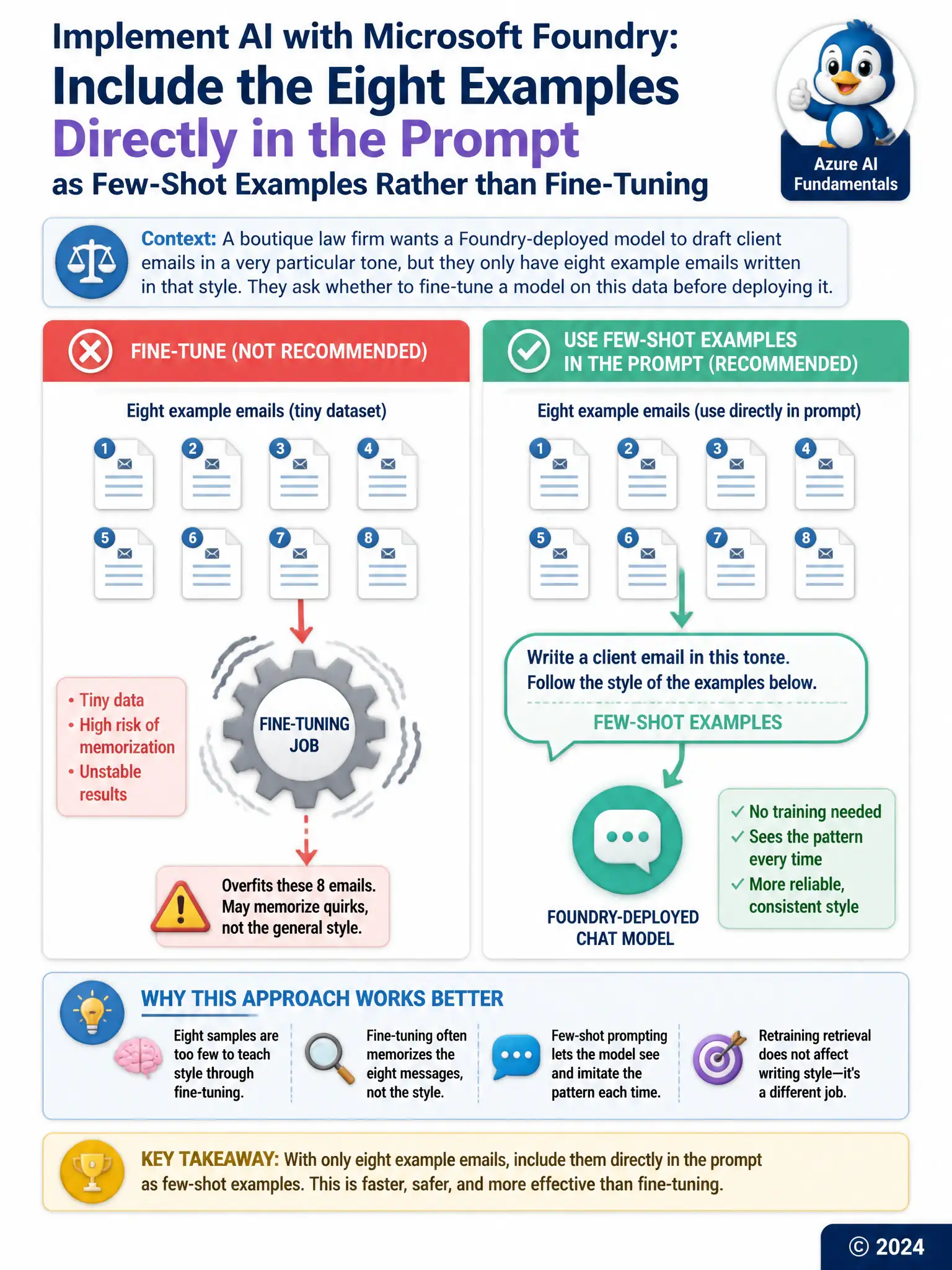
Eight sample emails is too little data to fine-tune a Foundry-deployed model; you'll likely teach it to memorize those messages instead of the style. Put the eight examples right in the prompt as few-shot examples so the model can copy the pattern on the spot.
Full Explanation
The best guidance is to include the eight example emails directly in the prompt as few-shot examples rather than fine-tuning. With only eight example emails, there is not enough labeled data to fine-tune a custom model reliably; a small dataset like this risks the model overfitting to quirks of those specific examples rather than learning the general tone. Including the same eight emails directly in the prompt lets the base model pattern-match the desired style at inference time without any training step, which is well suited to small sample sizes. The guidance to fine-tune immediately is incorrect because fine-tuning on so few examples typically produces an unstable or overfit model rather than a genuine quality improvement. The guidance to skip customization entirely is incorrect because tone and style are exactly the kind of pattern a language model can pick up from examples, whether through few-shot prompting or fine-tuning with enough data; the premise that it cannot be taught is false. The guidance to fine-tune only the embedding model used for retrieval is incorrect because it fine-tunes the wrong component: the embedding model is used for retrieval and similarity search, not for generating the styled email text, so tuning it would not change how the emails are written.