
Before releasing a Foundry-hosted assistant that answers from a retrieved knowledge base, a QA team wants an automated, repeatable way to measure how often the assistant's answers are actually supported by the retrieved passages, without manually reading every response. What should they use?
Select an answer to reveal the explanation.
Short Explanation
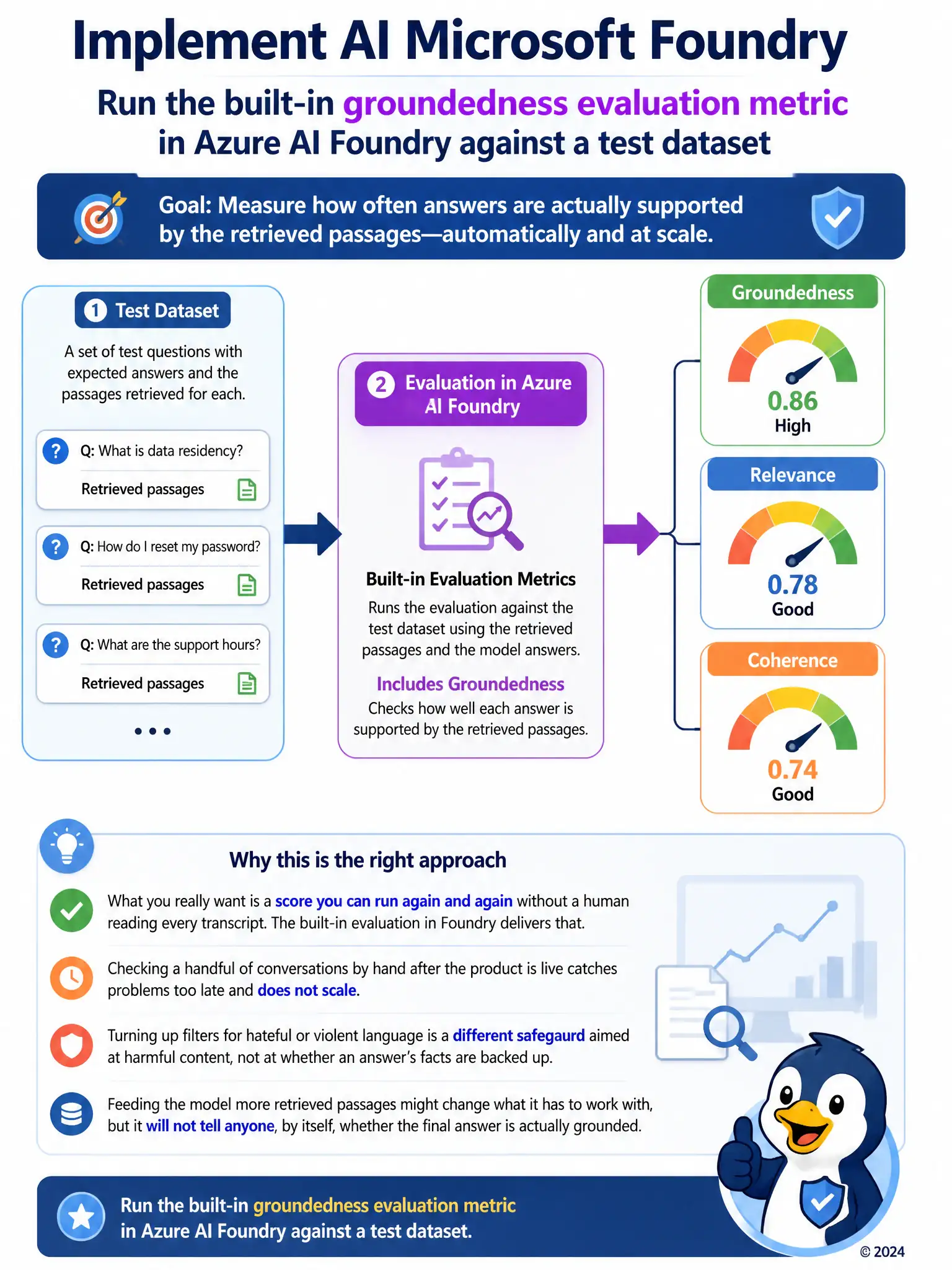
You want a score you can rerun without a human reading every transcript. The built-in groundedness evaluation metric in Azure AI Foundry checks whether each answer sticks to the retrieved passages. That gives you repeatable, automated QA before launch.
Full Explanation
The right choice is the built-in groundedness evaluation metric in Azure AI Foundry run against a test dataset. Azure AI Foundry includes built-in evaluation metrics, including groundedness, that can be run automatically against a test dataset of questions and retrieved passages to score how well each generated answer is supported by the source material, giving the QA team a repeatable, scalable measurement instead of manual review. Manual spot-checking a sample of transcripts each week after launch is incorrect because it is neither automated nor repeatable, and it happens after users are already affected rather than during pre-release testing. Raising content safety filter severity for the hate and violence categories is incorrect because those thresholds control filtering of harmful categories; they say nothing about whether an answer's claims are actually supported by retrieved documents. Increasing the number of retrieved passages returned per query is incorrect because returning more passages might change what information is available to the model, but it does not by itself measure or report how grounded the resulting answers are; that still requires an evaluation step.