
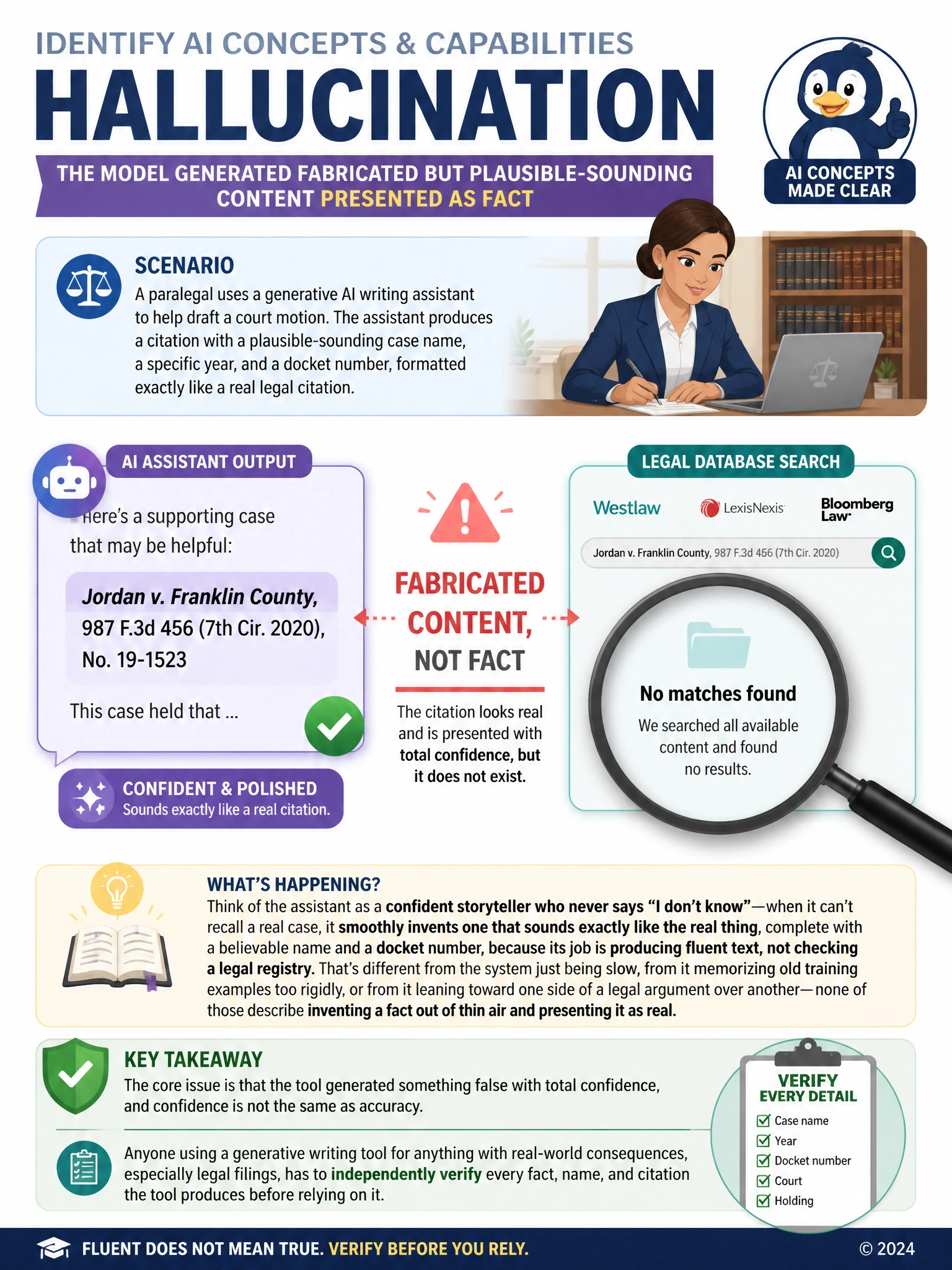
A paralegal uses a generative AI writing assistant to help draft a court motion. The assistant produces a citation with a plausible-sounding case name, a specific year, and a docket number, formatted exactly like a real legal citation. When the paralegal searches every available legal database, no such case exists anywhere. Which concept describes what the assistant did?
Select an answer to reveal the explanation.
Short Explanation
Think of the assistant as a confident storyteller who never says 'I don't know' - when it can't recall a real case, it smoothly invents one that sounds exactly like the real thing, complete with a believable name and a docket number, because its job is producing fluent text, not checking a legal registry. That's different from the system just being slow, from it memorizing old training examples too rigidly, or from it leaning toward one side of a legal argument over another - none of those describe inventing a fact out of thin air and presenting it as real. The core issue is that the tool generated something false with total confidence, and confidence is not the same as accuracy. Anyone using a generative writing tool for anything with real-world consequences, especially legal filings, has to independently verify every fact, name, and citation the tool produces before relying on it.
Full Explanation
The correct answer is B. Hallucination describes exactly this situation: a generative model produces content that is fluent, well-formatted, and confident in tone, but factually invented, with no basis in any real source, because the model is predicting plausible-sounding text rather than retrieving verified facts. A fabricated case citation with a believable name and docket number is a textbook example. Option A is incorrect because latency refers to how long the system takes to respond, a performance and timing issue that has nothing to do with whether the generated content is true. Option C is incorrect because overfitting is a training-time problem where a model learns its training data so closely that it fails to generalize to new inputs; it does not explain a model inventing a citation that never existed in any data. Option D is incorrect because bias refers to systematic favoritism toward particular outcomes, groups, or classes learned from skewed data, whereas the paralegal's problem is fabrication of nonexistent facts, not a lopsided preference between real, valid legal outcomes. The paralegal's real fix is verifying every AI-generated citation against an authoritative source before filing.